


The interstellar comet 3I/ATLAS concluded its closest trajectory to Terra on December 19, configuring an event of great relevance for the scientific community. Este celestial body, of origin external to Sistema Solar, remained at a safe distance of approximately 270 million kilometers, not posing any risk of collision. Sua passage was observed by astronomers from several institutions.
The detailed analysis of the hyperbolic orbit of 3I/ATLAS confirmed its interstellar nature, that is, its formation occurred in a star system distinct from ours. Essa characteristic positions it as one of the few objects to visit our cosmic neighborhood, being only the third confirmed to date. The rarity of the event heightened the interest of researchers.
Discovered on July 1, 2025 by an ATLAS telescope located at Chile, the comet provided a unique opportunity for study. Agora, he continues his journey back to interstellar space, taking with him data that could revealinsightsabout planetary formation in other regions of the universe.
Discovery and nature of the cosmic visitor
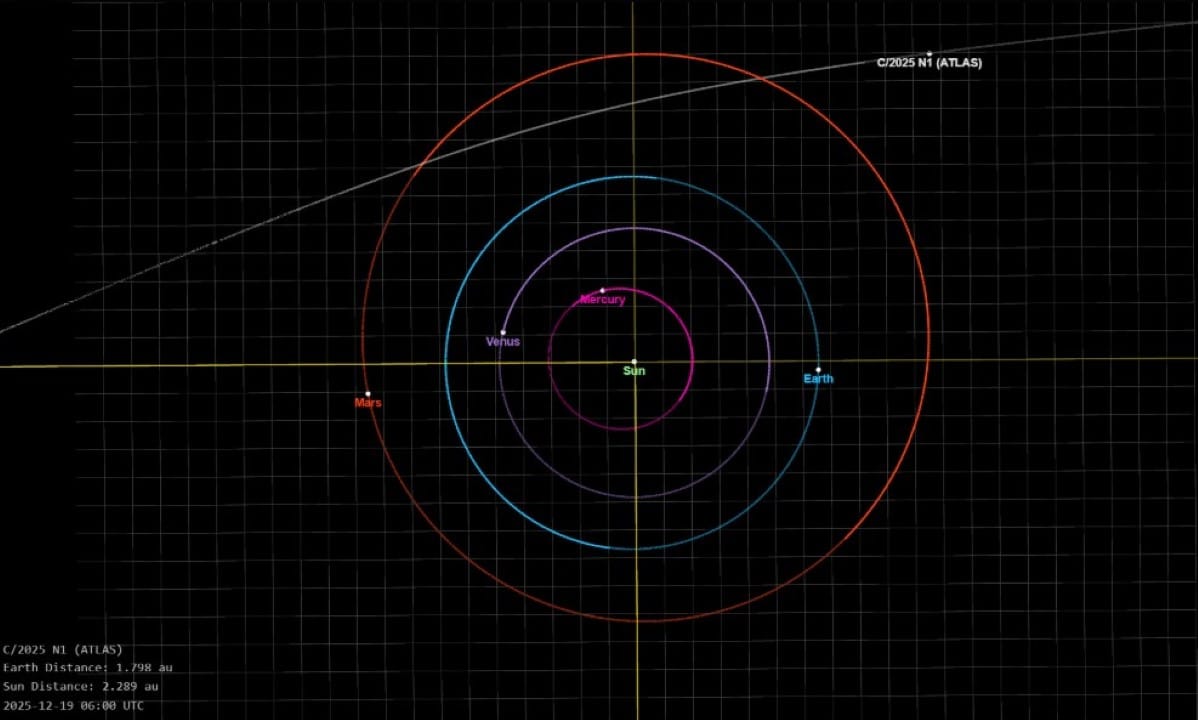
The identification of comet 3I/ATLAS by the ATLAS system telescope on Chile marked an important moment in astronomy. The initial data from the observation, carried out on July 1, 2025, were crucial for calculating its trajectory and subsequently confirming its origin. Essa initial step is essential to determine the origin and dynamic behavior of celestial objects, especially those with unusual characteristics.
Scientists quickly noticed 3I/ATLAS’s hyperbolic orbit, a clear indication that it is not gravitationally bound to Sol. Tal trajectory is the signature of an interstellar object, which just passes through our solar system before continuing on its journey. 3I/ATLAS joins a select group of bodies arriving from beyond our stellar neighborhood, providing valuable information about other planetary systems.
Monitoring and observation challenges
Despite the great interest generated, the observation of comet 3I/ATLAS was not accessible to the general public. Ele has not developed enough brightness to be visible to the naked eye or through smaller amateur telescopes. Essa limitation highlights the need for high-performance scientific equipment, used by observatories and astronomical research centers.
To follow 3I/ATLAS, astronomers used large-aperture telescopes and sophisticated instruments capable of capturing light at different wavelengths. Essa technology allowed the monitoring of its speed, the spectroscopic analysis of its chemical composition and the study of its cometary activity. The data collected is essential to build a detailed profile of this cosmic traveler.
Structure and composition analysis
During its passage through Sistema Solar, researchers dedicated themselves to studying the comet’s coma and tail. The coma is the cloud of gas and dust that surrounds the comet’s nucleus, while the tail is formed by the interaction of these materials with solar radiation and the solar wind. The direction and shape of the tail provide clues about the intensity of these phenomena.
The analyzes indicated the presence of volatile substances and dust particles, common characteristics in comets from our own system. Essa discovery strengthened the interpretation that 3I/ATLAS is, in fact, a natural body, similar in many aspects to the comets we know, but with an extraterrestrial origin. Não any behaviors suggesting an artificial nature were observed.
The observed chemical composition, which included elements such as frozen water, carbon dioxide and methane, offers a glimpse of the materials that predominate in distant planetary systems. Comparar This data with the composition of Sistema Solar’s native comets helps scientists better understand cosmic variations and similarities.
Significance of interstellar objects for science
The detection and study of objects like 3I/ATLAS represent significant advances in astrophysics, as they serve as direct samples of material from other stellar systems, allowing investigations that would otherwise be impossible. Esses cosmic visitors provide a unique window into understanding the diversity of planetary formation conditions and processes occurring in other galaxies. The rarity of these occurrences makes each new discovery a milestone, pushing the scientific community to constantly improve its detection and analysis techniques in order to extract as much information as possible from each passage and deepen our knowledge of the universe beyond our stellar borders.
Technologies involved in tracking
The ATLAS system (Asteroid Terrestrial-impact Last Alert System), responsible for the discovery of 3I/ATLAS, is a network of telescopes designed to detect objects close to Terra, including asteroids and comets. Sua The ability to scan large areas of the sky quickly is essential for identifying these celestial bodies before they get too close. The technology behind ATLAS enables automated tracking, crucial for capturing short-lived events.
In addition to ATLAS, other space observatories and telescopes contributed to complementary high-resolution observations. Esses advanced instruments provide crucial data on the comet’s morphology, dynamics and spectral characteristics, information that is combined to create a three-dimensional, evolutionary model of the object. International collaboration between research centers is essential to maximize data capture.
Processing the collected data involves complex algorithms and supercomputers that analyze vast volumes of information to extract patterns and anomalies. Essa technological infrastructure not only confirms the interstellar nature of objects like 3I/ATLAS, but also makes it possible to predict their future trajectories. The accuracy of the calculations is vital for ruling out collision risks and planning future observation campaigns.
The constant calibration of these instruments and the development of new detection techniques are essential to expanding our ability to identify and characterize cosmic objects. The evolution of astronomical technology continues to unravel mysteries of the universe, from small asteroids to giant comets coming from other stars. Cada enhancement contributes to a more complete understanding of our space environment.
Next steps of the research
With the retirement of 3I/ATLAS, scientists will now focus on the post-observation phase, which involves compiling and interpreting all the data collected. Esta stage can last months or even years, resulting in the publication of scientific articles that will share discoveries with the global community. The objective is to integrate new knowledge about 3I/ATLAS into the general panorama of astrophysics, enriching the understanding of the formation and evolution of stellar systems beyond our own.
The expectation is that the information obtained will allow us to refine models on the distribution of matter in interstellar space and the frequency of visitors from other stars. 3I/ATLAS data can, for example, help estimate how many interstellar objects may be crossing Sistema Solar at any given time, even if they are not detected. The continued advancement of telescope technology promises new discoveries in the future.
Journey back to the universe
After its brief passage through our cosmic neighborhood, comet 3I/ATLAS is now moving away from Sol, propelled by its hyperbolic orbit that takes it back into the vast, cold interstellar space. Sua departure marks the end of a chapter of intense observations and analysis, leaving behind a legacy of information that will continue to be studied by generations of astronomers.



