China’s rebel province stance escalates Taiwan tensions amid significant military readiness in 2025 Por Luís Pereira
6 min de leitura
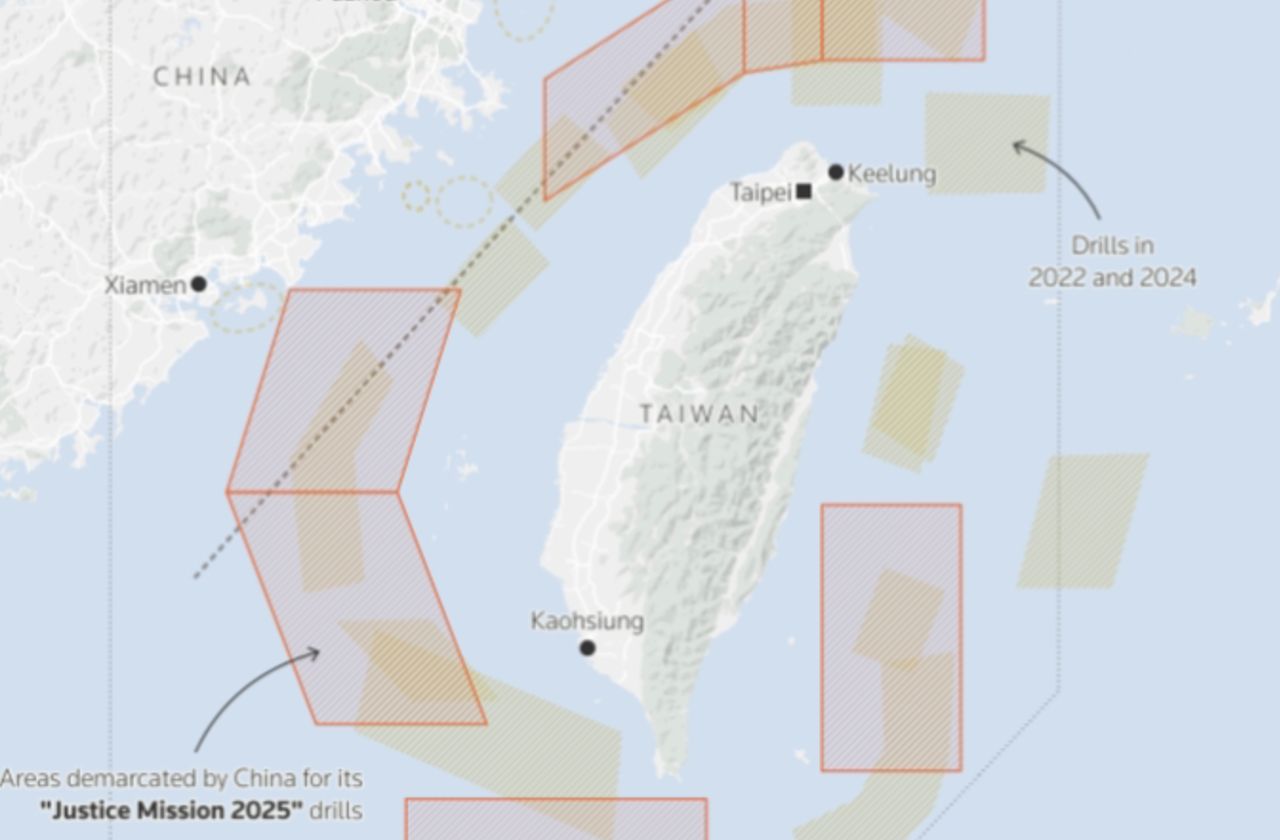 |
Intense military exercises by China around Taiwan have recently heightened regional tensions, drawing international scrutiny to Beijing’s unwavering assertion over the island. These maneuvers, characterized by an unprecedented scale and sophisticated deployment of forces, serve as a stark reminder of China’s long-held position that Taiwan is an inseparable “rebel province.” This classification effectively frames the issue as an internal Chinese affair, a narrative Beijing consistently employs to deflect any perceived external interference, particularly from powers like the United States, which maintain unofficial ties and arms sales with Taipei. The strategic posturing is not merely directed at Taiwan but also at a global audience, showcasing China’s burgeoning military capabilities and resolve, a critical factor in understanding the geopolitical landscape of 2025.
The persistent nature of these drills underscores a critical element of China’s strategic doctrine, aiming to integrate Taiwan with the mainland, potentially by force if diplomatic means fail. This overarching objective drives the continuous modernization and expansion of the People’s Liberation Army, signaling a clear trajectory for future military engagements.
Alberto Pfeifer, a coordinator at DSI-USP and researcher at Insper Agro, recently provided insights into these complex dynamics, emphasizing China’s refusal to acknowledge Taiwan’s autonomy or sovereignty. He highlighted that China firmly views Taiwan as a domestic issue, rejecting international intervention, a stance frequently reinforced through these very military displays.
Beijing’s Unwavering “One China” Position
China consistently reaffirms its “One China” principle, a core policy stating there is only one sovereign state under that name, which includes mainland China, Hong Kong, Macau, and Taiwan. This principle is foundational to Beijing’s foreign policy and its claim over Taiwan, seen as a breakaway territory destined for reunification.
Taiwan, officially the Republic of China, operates with its own democratically elected government, constitution, and armed forces, independent from Beijing. China, however, staunchly refuses to recognize this autonomy, viewing it as a direct challenge to its territorial integrity. This fundamental disagreement is central to ongoing tensions.
Strategic Messaging Through Military Drills
The extensive military exercises conducted by China around Taiwan serve multiple communicative purposes, extending beyond a simple show of force against the island. These maneuvers are precisely orchestrated to convey distinct messages to various audiences, both domestic and international, reinforcing Beijing’s strategic objectives.
Domestically, such displays aim to bolster nationalistic sentiment and assure the Chinese populace of the government’s unwavering commitment to its territorial claims, particularly concerning Taiwan. These actions foster public support and demonstrate the leadership’s resolve.
For the People’s Liberation Army (PLA) itself, the exercises are vital for testing new military hardware, refining combat readiness protocols, and evaluating command and control capabilities under simulated conditions. These internal benefits enhance the PLA’s operational effectiveness.
Globally, China uses these exercises to showcase its strategic reach and technological advancements, signaling its capacity to project power across the Indo-Pacific region. The intensified volume of recent drills, noted by Alberto Pfeifer, underscores China’s increasing military confidence and preparedness for complex operations.
Leadership Changes and Renewed Preparedness
A significant overhaul within China’s military command structure has recently coincided with intensified military demonstrations, indicating a renewed emphasis on operational efficiency and strategic readiness for 2025. Expert analysis points to substantial leadership changes, including the replacement of seven out of eight primary commanders, suggesting a comprehensive recalibration within the People’s Liberation Army’s top echelons. This extensive shake-up is widely interpreted as a strategic effort to enhance command and control capabilities, ensuring the military is optimally positioned for any operational contingency, streamlining decision-making processes and integrating advanced military doctrines more effectively.
Such widespread leadership renewal suggests a deliberate move towards fostering a more responsive and efficient fighting force, capable of executing complex maneuvers and adapting swiftly to evolving geopolitical landscapes. The synchronized timing of these changes with increased military drills highlights a concerted effort to project an image of heightened readiness and operational cohesion. This aims to consolidate military power under unified leadership, poised to respond decisively to perceived threats and uphold national interests, not exclusively confined to the Taiwan Strait, but across its broader strategic ambitions.
Taiwan’s Indispensable Economic Role
Taiwan’s strategic importance extends far beyond its contested political status, encompassing an indispensable role in global economics and the intricate web of technological supply chains. The island nation is a preeminent global leader in the production of advanced semiconductors and high-capacity processing chips, components that are absolutely essential for virtually every modern electronic device, ranging from consumer smartphones and cutting-edge computers to sophisticated automotive systems and advanced military hardware. This unparalleled technological dominance renders Taiwan an indispensable player in the global economy, making its stability and continued output a critical concern for nearly every industrialized nation, and underscoring its pivotal position in international affairs.
US Arms Sales and Regional Stability
The United States, recognizing Taiwan’s democratic governance and profound strategic value, consistently provides defensive arms to the island. This policy is interpreted as a clear message of sustained interest and a commitment to its partnership in the vital Indo-Pacific region. These ongoing sales, while not an explicit guarantee of direct military intervention, are crucial for bolstering Taiwan’s self-defense capabilities.
Such support serves as a critical factor in maintaining regional stability and supply chain resilience, especially given Taiwan’s technological prominence. The continued provision of arms underscores a broader geopolitical strategy by the United States to uphold a delicate balance of power in the Indo-Pacific, deterring potential aggression and ensuring the free flow of commerce.
Global Concerns Over Escalation
The international community generally observes the escalating tensions between China and Taiwan with considerable concern, frequently advocating for de-escalation and peaceful resolution through dialogue. While many nations formally adhere to some version of the “One China” policy, a substantial number also express apprehension regarding China’s assertive military posturing.
Concerns primarily center on the potential for destabilization in a region critical for global trade routes and as a hub for advanced technology. Such a conflict would have far-reaching economic and security implications extending well beyond the immediate vicinity, affecting global stability.
Therefore, calls for restraint and strict adherence to international law are consistently voiced by global leaders, reflecting a pervasive desire to avert conflict and ensure continued peace and stability in the vital Taiwan Strait.
Future Outlook on Cross-Strait Relations
As 2025 unfolds, the intricate dynamics in the Taiwan Strait are expected to remain a significant focal point in global geopolitical discourse. The ongoing interplay between China’s escalating military capabilities, Taiwan’s indispensable strategic economic value, and the United States’ persistent commitment to regional security will fundamentally shape the trajectory of this complex and critically important relationship for the foreseeable future.