Comet 3I/ATLAS has an old image with asymmetric brightness analyzed by astronomy experts

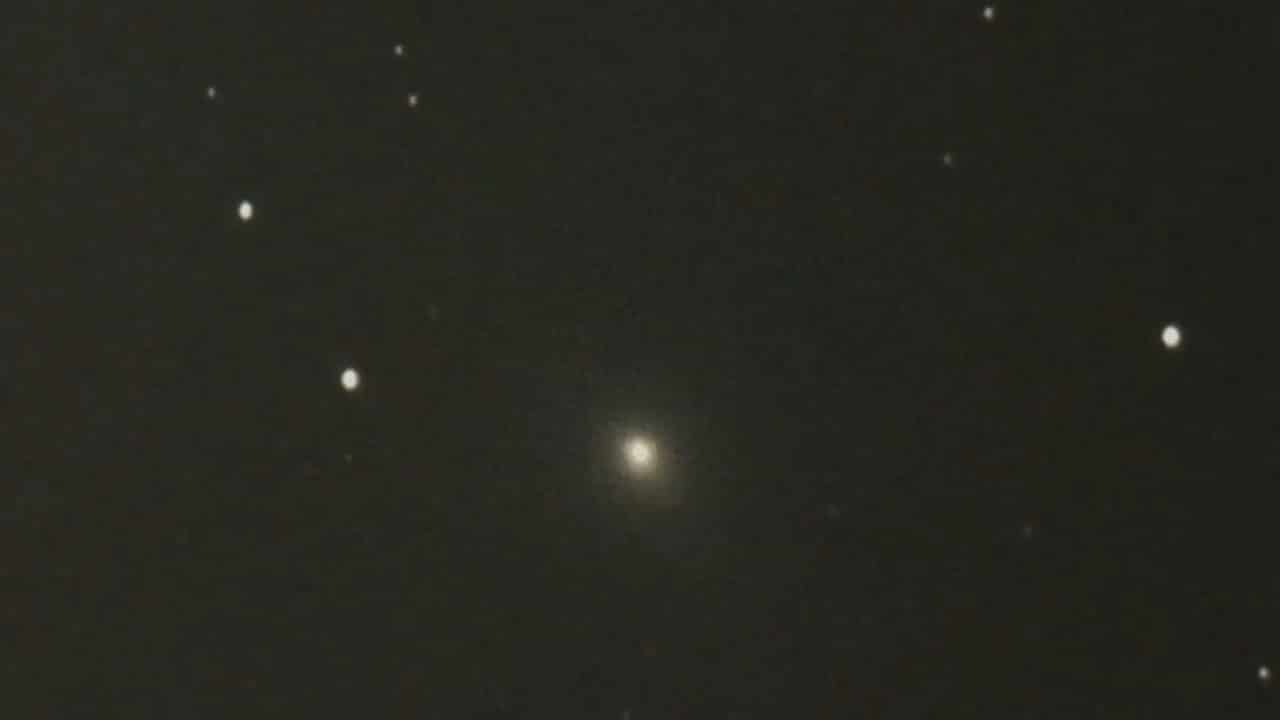
An image captured months before more detailed observations of the interstellar comet 3I/ATLAS reveals an irregular glow with a bright spot offset from the center. Esse’s initial record, obtained by the ATLAS monitoring system, has been reanalyzed by astronomers who identify unusual patterns rarely seen in Sistema Solar’s comets.
The object, classified as the third confirmed interstellar, was discovered in July 2025 and has a hyperbolic trajectory that confirms its external origin. Especialistas highlight that the strange appearance in the old photo is not just a result of technical limitations, but indicates distinct characteristics of the comet’s behavior.
Further observations with telescopes such as Hubble confirm intense activity around the nucleus, including a visible coma and tail. Comparison between old and recent images suggests that the displaced bright spot represents an early sign of non-gravitational acceleration detected in the object.
Discovery and trajectory of the object
Comet 3I/ATLAS was initially identified as a fast-moving point by the Asteroid Terrestrial-impact Last Alert System survey, operated at different locations. The orbital analysis revealed a speed exceeding 200 thousand kilometers per hour, a value incompatible with origins within Sistema Solar.
Astronomers mobilized ground and space observatories soon after confirming its interstellar nature. The hyperbolic trajectory indicates that the object traveled millions of years from another star to reach the solar neighborhood.
The perihelion occurred in a recent period, when the comet passed closer to Sol and exhibited a significant increase in brightness. Dados collected in this phase show variations in the gas composition released by the nucleus.

Features observed in the initial image
The old photograph records a bright point clearly displaced in relation to the expected center of the nucleus. Esse offset, combined with irregular brightness around it, differentiates the object from typical comets that have a symmetrical distribution of ejecta.
Image processing techniques applied later highlight asymmetrical contours in the initial coma. Pesquisadores interpret these patterns as signs of fragmentation or uneven release of gases in the early stage of solar approach.
- Bright spot visible outside the central axis;
- Diffuse glow with varying intensity in specific sectors;
- Absence of a defined tail in the initial registration phase;
- High contrast in peripheral regions of the object.
These elements contribute to differentiating 3I/ATLAS from previous visitors such as 2I/Borisov.
Comparison with recent observations
Images obtained by Telescópio Espacial Hubble show remarkable evolution in the comet’s structure. The nucleus appears surrounded by an extensive coma, while tails of dust and gas extend in directions opposite to the Sol.
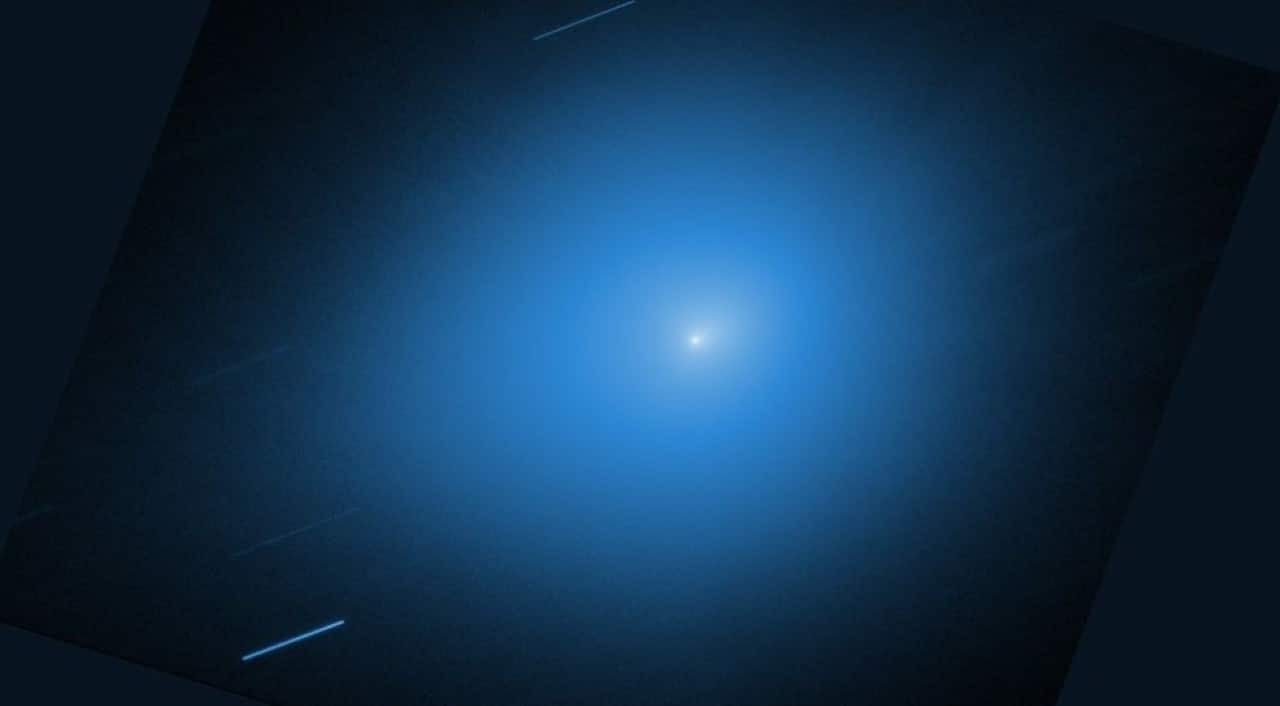
The non-gravitational acceleration recorded suggests release of material that alters the orbit in a measurable way. Esse phenomenon, also observed in previous objects, gains greater relevance in the case of 3I/ATLAS due to the detected intensity.
Terrestrial records complement space data with spectroscopic measurements that identify the presence of common molecules in comets. The combination of information makes it possible to map changes that have occurred since the old image was captured.
Anomalies detected in behavior
The comet exhibited a color change to more bluish tones during maximum approach to Sol. Essa change indicates a composition rich in certain gases that reflect sunlight in a specific way.
Observations indicate an unexpected increase in brightness in a period close to perihelion. Astrônomos record variations that exceed predictions based on standard ice sublimation models.
Intense cometary activity generated multiple structures in the tail, including possible fragments detached from the main nucleus. Continuous Monitoramento reveals relative stability after the phase of greatest solar proximity.
Researchers analyze radio data to characterize natural emissions from the object. Resultados obtained so far reinforces the classification as a comet of interstellar origin.
Context of known interstellar objects
1I/’Oumuamua, the first confirmed object in this category, had an elongated shape and no detectable coma. Sua passage in 2017 led to the creation of specific protocols for monitoring external visitors.
2I/Borisov, identified in 2019, exhibited a pronounced tail and a composition similar to solar comets. Observações detailed data allowed comparative studies that help in the interpretation of new cases.
3I/ATLAS represents a rare opportunity for real-time analysis of objects with hybrid characteristics. Extended visibility facilitates data collection by global telescope networks.
Additional observations made
Telescopes located at Hemisfério Sul captured images during critical phases of the trajectory. Esses records show evolution of the ionized tail in response to the solar wind.
High-resolution spectroscopy identifies characteristic emission lines of carbon monoxide and other compounds. The presence of these elements reinforces the hypothesis of origin in a distant star system.
- Detection of cyanide in measurable quantities;
- Presence of water in the form of vapor in the coma;
- Signs of carbon dioxide in active sublimation;
- Absence of complex organic compounds at high levels.
These measurements contribute to understanding physical processes in interstellar environments.
Current approach monitoring
The comet reached its closest point to Terra in December 2025, a safe distance of hundreds of millions of kilometers. Observadores amateurs with appropriate equipment recorded images in dark skies.
Campaigns coordinated by space agencies maintain monitoring even after maximum passage. Dados collected serve to refine models of orbital dynamics in hyperbolic objects.
The current position of 3I/ATLAS indicates gradual exit from internal Sistema Solar. Large Telescópios continue tracking to document long-term variations.
Reanalysis of old photography
Experts apply modern algorithms to the initial image to extract previously obscured details. Processing reveals internal structure suggestive of a fragmented or asymmetric active nucleus.
Direct comparisons with recent records confirm the continuity of certain light patterns. The initially observed displaced point corresponds to regions of greater activity identified later.
These discoveries motivate revisions in databases of objects discovered by ATLAS. Astrônomos look for similar signals in other candidates’ archived records.
The study of the ancient image reinforces the importance of reevaluating preliminary data on astronomical discoveries. Técnicas allow us to extract valuable information from catches considered limited at the time.
Jeronimo Santos é colaborador da redação do Mix Vale, portal de notícias com cobertura de Brasil e mundo. Produz conteúdo nas editorias de economia e benefícios, com foco em informação de serviço para o leitor brasileiro. Escreve para o portal desde 2016: Formação: Marketing