

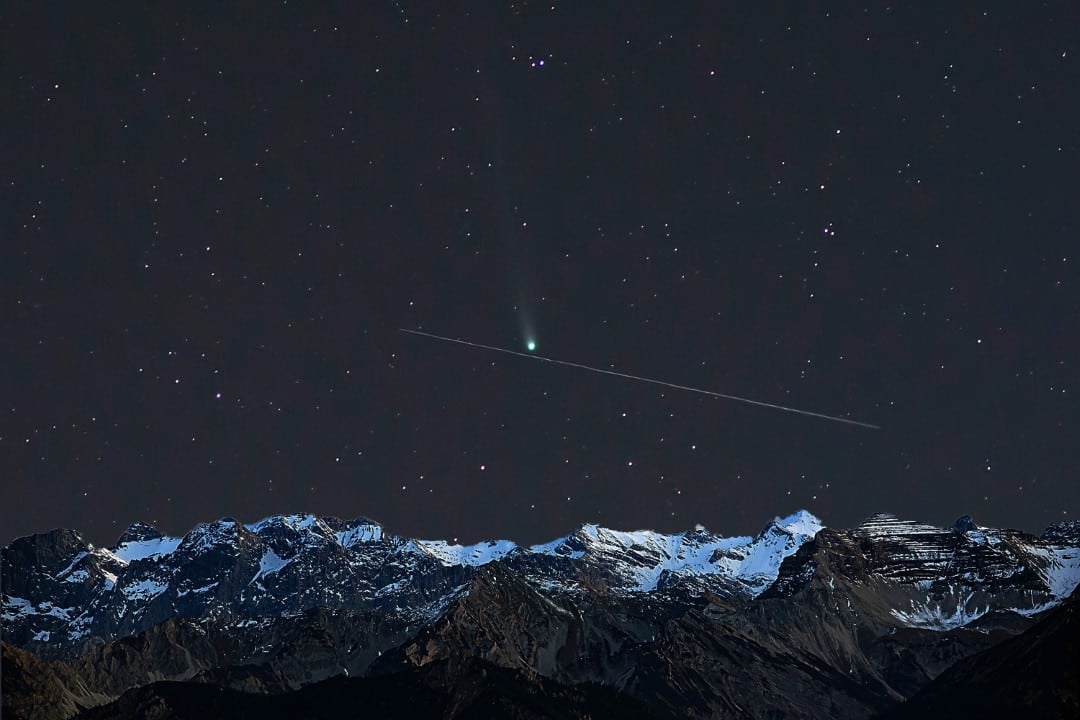
Comet C/2025 R3 (PanSTARRS) will reach its closest point to Sol on April 20, 2026. Especialistas point out that the object can reach enough brightness to be observed with binoculars or, in favorable conditions, with the naked eye.
The discovery took place in September 2025 by the Pan-STARRS system, on Havaí. Sua trajectory will place it between Terra and Sol at the end of April, which may intensify visibility.
Observers expect a new celestial event after a series of striking comets in 2024 and 2025. Previsões indicate variation in brightness, but the forward scatter phenomenon represents a positive factor for greater intensity.
Discovery and orbital characteristics
The Pan-STARRS system detected comet C/2025 R3 on September 8, 2025. Telescópios at Haleakalā volcano captured the first images of the moving object in the night sky.

Subsequent observations with the Telescópio Canadá-France-Hawaii allowed a precise orbit to be calculated. The comet follows a long-period trajectory, coming from Nuvem to Oort.
Its orbit has a high inclination and retrograde direction. The perihelion will occur 76.3 million kilometers from Sol, between the orbits of Mercúrio and Vênus.
The closest approach to Terra is scheduled for April 27, 2026, at approximately 71 million kilometers. Essa configuration favors potential significant increase in brightness.
Brightness and unpredictability predictions
Magnitude estimates vary between 8 and 3 at peak activity. Valores close to 8 require optical instruments, while magnitudes below 3 allow naked-eye detection in dark places.
The forward scatter phenomenon can increase the apparent brightness. Quando positioned between Terra and Sol, the comet reflects light directly to terrestrial observers.
Core activity remains a decisive factor. Liberação of gases and dust forms a coma and tail, but long-period comet behavior is difficult to predict exactly.
Lunar conditions near perihelion are favorable. Lua new on April 17, 2026 guarantees darker skies in the days following the main event.
Visible trajectory in the sky
The comet will pass through constellations such as Pégaso, Peixes, Cetus and Touro throughout April. At the moment of perihelion, it will be positioned at Peixes, below Grande Quadrado and Pégaso.
Hemisfério Norte observers will have a better pre-dawn window later in the month. The object will appear low on the eastern horizon, requiring unobstructed viewing.
At Hemisfério Sul, visibility improves after sunset in early May. Posição highest in the afternoon sky makes it easier to follow with simple equipment.
Proximity to Sol represents a challenge in certain periods. Solar glare can overshadow the comet at times close to perihelion.
Conditions by hemisphere
Differences between hemispheres determine different observation strategies. No Norte, focus is on the morning sky between mid and late April.
In Sul, including Brasil, transition to night sky occurs after April 27th. Horários post-dusk in early May offers ideal conditions.
Light pollution in urban areas reduces chances of detection. Locais rural areas or astronomical parks provide a more suitable environment.
Apps and star maps help with precise location. Ferramentas digital indicates exact position according to date and observer coordinates.
Forward Scatter Phenomenon Explained
Forward scatter happens when dust particles reflect sunlight directly into the Terra. Configuração specific geometric amplifies brightness by several magnitudes.
Historical cases show widened and intense tails under similar conditions. Previous Exemplos have seen a notable increase in visibility.
For C/2025 R3, alignment occurs at the end of April 2026. Pico of the effect coincides with greater proximity to Earth.
Final result depends on the amount of material ejected by the nucleus. Active Cometas produce dense tails that maximize light reflection.
Comparison with recent passages
The years 2024 and 2025 recorded memorable comets. 12P/Pons-Brooks, known as Cometa from Diabo, broke away in April 2024 with visible eruptions.
C/2023 A3 (Tsuchinshan-ATLAS) shined brightly in October 2024. C/2024 G3 (ATLAS) was featured in Hemisfério Sul in January 2025.
C/2025 A6 (Lemmon) approached the limit of natural visibility. Sequência of events raised public interest in new comets.
C/2025 R3 follows a similar pattern of long-period objects. Potencial of brightness positions it as the possible main celestial attraction of 2026.
Practical tips for observation
- Choose locations far from cities to reduce light pollution.
- Use medium-range binoculars for easier initial location.
- Consult astronomy apps for exact real-time coordinates.
- Prioritize nights without a full moon or significant interference.
- Shoot images with long exposure cameras when possible.
- Follow astronomical bulletins for brightness and position updates.
Local weather conditions influence observation success. Paciência and planning increase the chances of capturing the phenomenon.
Pan-STARRS system and contributions
The Pan-STARRS uses 1.8 meter reflector telescopes on the Havaí. Programa systematically maps the sky in search of moving objects.
Discoveries include several recent prominent comets. Automação allows broad coverage and early detection of new bodies.
System also monitors potentially dangerous asteroids. Contribuição covers planetary security and observational astronomy.
International partnerships validate findings quickly. Complementary Observações refine orbits with high precision.
Astronomical events in 2026
The year has other attractions in store besides the main comet. Chuvas of meteors and planetary conjunctions complement the observational calendar.
Passage of C/2025 R3 reinforces the unpredictable nature of comets. Dados collected helps improve models of future behavior.
The scientific community follows developments in real time. Observações contribute to knowledge about the composition of Nuvem and Oort.
Public interest tends to grow as perihelion approaches. Observatórios can organize collective follow-up sessions.
Preparation for follow-up
Amateur astronomers organize equipment in advance. Wide-field Telescópios are ideal for diffuse objects like comets.
Astronomical photography gains space during this period. Stable Equipamentos capture details of the developing coma and tail.
Local clubs hold observation meetings. Troca of experiences enriches the participation of beginners and experts.
Visual safety rules must be strictly followed. Nunca point optical instruments directly at the Sol.
The passage of comet C/2025 R3 (PanSTARRS) offers a rare opportunity to connect with distant cosmic events. Fenômeno reinforces human fascination with visitors from the outer solar system.



