
Atypical behavior of the 3I/ATLAS jet intensifies questions about the origin of the object By Carolina Costa
3 min read
 |
The interstellar comet 3I/ATLAS remains one of the most debated space objects of 2025. Interest around this celestial body increased significantly after its closest approach to Terra, recorded on December 19.
One of the aspects that most intrigues the scientific community is the “antiglue”, a jet of material that projects in an unusual way. Diferente of most comets, the 3I/ATLAS anticola points in the direction of Sol, defying conventional explanations.
This phenomenon has reignited intense debates and raised new hypotheses about the mechanisms that drive such behavior. Its enigmatic nature consolidates 3I/ATLAS as a priority focus for future observations and studies.
Comet 3I/ATLAS intrigues scientists
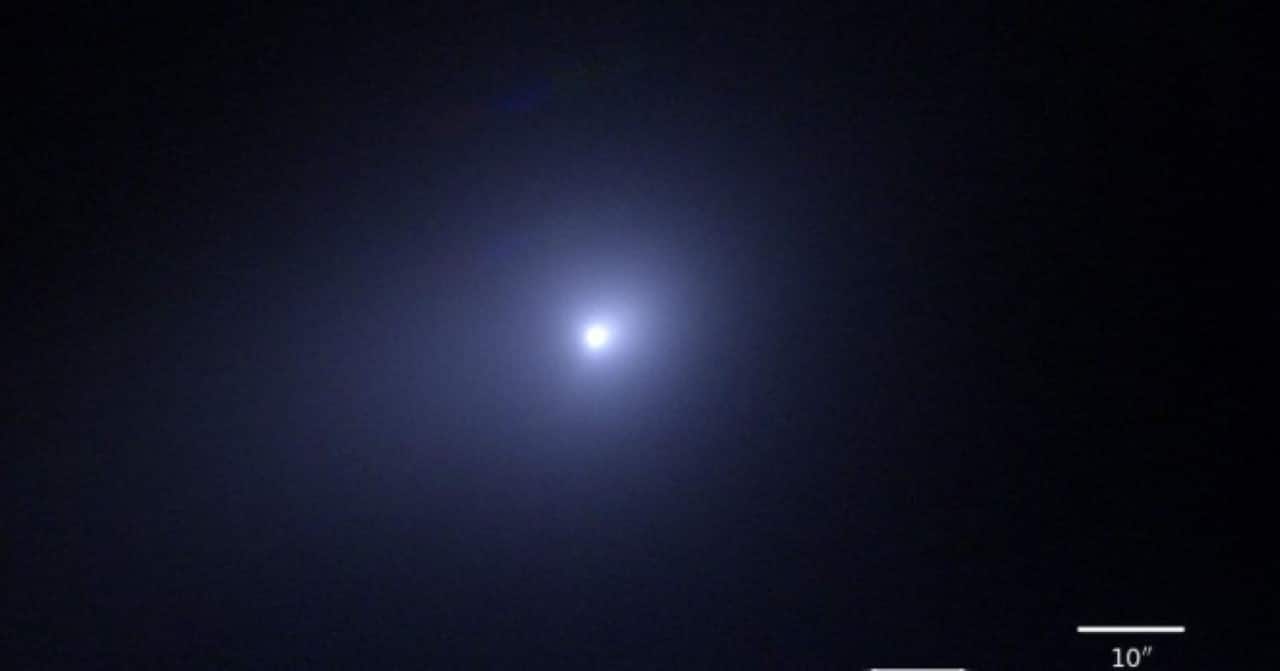
Scientists from several institutions continue to closely monitor comet 3I/ATLAS. Recent measurements on its anti-glue provide data that challenge existing astrophysical models.
The peculiarity of the jet that extends in the opposite direction to that expected keeps the object at the center of discussions about its formation and the forces that act on interstellar comets.
Unusual anti-glue dynamics
The 3I/ATLAS antiglue exhibited atypical behavior in the period after perihelion, when the comet was closest to Sol. Nesse interval, the jet extended several hundred thousand kilometers.
This considerable expansion in the direction of Sol contradicts the typical pattern of cometary tails, which generally move away from the star. Tal observation raised serious doubts about the exact composition of the object.
The way in which dust and gas are distributed around the comet nucleus is also the subject of questioning. Anti-glue suggests a greater complexity than initially anticipated for the interaction of these materials.
Interaction between dust and gas in space
Dust released by a comet’s nucleus can be pushed by the gas at high speed. Ela can travel vast distances and progressively lose speed due to the pressure exerted by solar radiation.
This process helps understand how a jet of dust can expand so much, even in scenarios where the gas is not prominently visible. Dust has its own dynamics, remaining visible for long periods.
On the other hand, the gas interacts differently in the space environment. Sua’s trajectory is strongly influenced by the solar wind, a stream of particles that emanates from Sol and shapes the path of material released by the comet’s nucleus.
The comparative analysis between the behavior of dust and gas has become central to understanding the 3I/ATLAS anti-glue, revealing the particularities of each type of matter in space.
The role of sublimation in the nucleus
In natural comets, outgassing is a common process, usually triggered by the sublimation of ices. Quando the comet approaches Sol and heats up, the ice turns directly into gas, driving the formation of jets.
A notable example of this mechanism is the presence of frozen carbon dioxide (CO2), which, when sublimated, contributes to the ejection of material. Esse process is fundamental to the formation of the gaseous jets observed in many comets.
Telescópio Hubble Revelations
Observations made by Telescópio Espacial Hubble provided crucial data about anti-glue. Elas indicated the presence of moving gas more than 5,000 kilometers away from the 3I/ATLAS nucleus.
This finding is considered unusual and adds a new layer of complexity to the analysis of the phenomenon. The presence of gas at this distance demonstrates that the jet is not only composed of entrained dust, but also of active gaseous components.
This evidence raises the question whether the material’s ejection speed would be significantly higher than expected for a common sublimation process. The focus of the investigations becomes the real speed at which the material is expelled from the comet.
Hypotheses about jet propulsion
Astrophysicist Avi Loeb, from Universidade of Harvard, hypothesized that anti-glue could be associated with a technological propellant. The idea suggests that the jet’s high launch speed could be explained by an artificial mechanism.
In this scenario, gas flow could be maintained in unusual directions and on even larger scales, supported by a thruster that would exceed the capabilities of natural processes. Essa perspective, although controversial, fuels the debate about the nature of the object.
Projections for future analyzes
Comet 3I/ATLAS will maintain its relevance to research for years to come, driven by the challenging behavior of its anticola. The phenomenon will continue to test the limits of current models of cometary jets pointing to Sol.











