

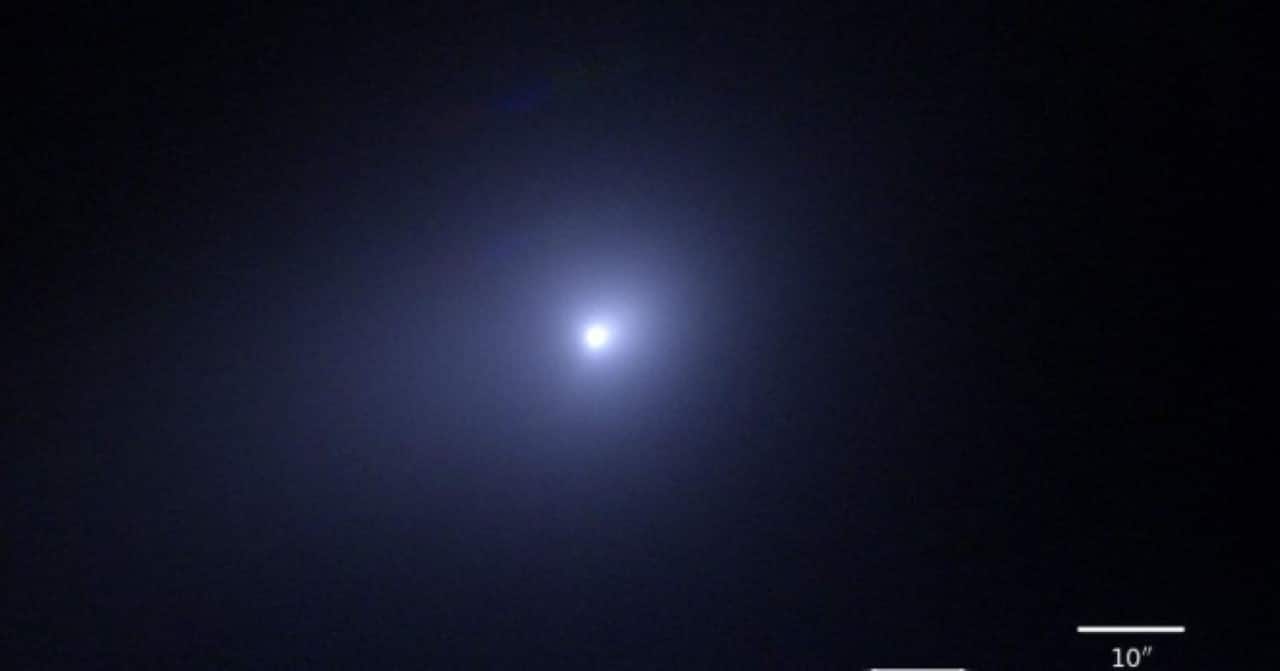
Comet 3I/ATLAS, the third interstellar object confirmed to have passed through Sistema Solar, remains visible in the terrestrial sky at the beginning of 2026.
The object has an apparent magnitude of around 15.6 on January 1st, a value that requires optical equipment for precise location. Astrônomos professionals and amateurs have been recording images in different regions of the planet since the end of 2025.
Observations indicate the current position in the constellation Câncer, favoring viewing on the eastern horizon before dawn. The comet maintains a safe distance from Terra, without any risk of collision.

Discovery and confirmation of interstellar origin
Scientists detected comet 3I/ATLAS on July 1, 2025 using the ATLAS telescope, installed on Río Hurtado, on Chile. Initial Análises of the orbit revealed excessive speed in relation to Sol, a typical characteristic of objects coming from interstellar space.
The hyperbolic trajectory differentiated the body from common comets of Sistema Solar, which follow elliptical orbits. Dados collected by ground and space observatories confirmed the classification as the third known interstellar object, after ‘Oumuamua and Borisov.
Orbital characteristics and current trajectory
The comet follows the path that took it to perihelion, the closest point to Sol, still in 2025. Atualmente, it moves to external regions, gradually approaching the orbit of Júpiter.
Projections indicate high relative speed, higher than the escape of Sistema Solar. The object is expected to cross Júpiter’s sphere of gravitational influence in March 2026, about 53 million kilometers from the planet.
- Predicted minimum distance from Júpiter: 53.61 million kilometers
- Date of closest meeting: March 16, 2026
- Relative speed at the point: approximately 66 km/s
- Current position: beyond the orbit of Marte, in an outward direction
These parameters allow continuous monitoring by large telescopes.
Observation conditions in early 2026
Astronomers recommend observing in the pre-dawn sky during January and February 2026. The comet appears low on the eastern horizon, requiring locations with little light pollution and clear skies.
Medium aperture telescopes, starting at 15 centimeters, capture the object with long exposures. Aplicativos of astronomy help with exact location, updating coordinates daily.
Visibility progressively decreases as the comet moves away from Sol and Terra. Regiões from the southern hemisphere have an initial advantage due to their relative position in the sky.
Professionals use CCD cameras to record variations in the tail’s brightness and structure. Amadores contribute images that complement international databases.
Close encounter with Júpiter in March
The high point of the passage occurs on March 16, 2026, when the comet reaches a minimum distance of Júpiter. The Juno probe, in polar orbit around the planet, is positioned to record the event in detail.
Large ground-based telescopes, such as those installed on Havaí and Chile, monitor the approach in real time. The gravitational interaction may slightly alter the object’s future trajectory.
Scientists await data on possible fragmentation or emissions of material during the passage. The high speed makes the encounter unique for studies of orbital dynamics.
Monitoring by space probes
Several space missions recorded images of the comet along its trajectory. The Europa Clipper probe captured the object in November 2025, more than 160 million kilometers away.
Missions on Marte, such as ExoMars and Mars Express, obtained additional data during their close passage to the red planet. Observações at different wavelengths reveal the chemical composition of the surface.
The Juice probe, destined for Júpiter, is expected to receive data delayed until February 2026 due to distance. Esses records help understand sublimation processes in interstellar objects.
Studies on composition and behavior
Spectroscopic analyzes indicate the presence of ice and volatile materials typical of distant comets. The comet exhibited unusual anticola near Sol, a phenomenon that prompted additional studies into natural propulsion.
Recent measurements estimate a diameter of between 600 and 800 meters, a value lower than initial projections. The apparently compact structure differentiates the object from Sistema Solar’s fragile comets.
Researchers monitor variations in brightness that may indicate rotation or surface activity. Dados collected until January 2026 contribute to models of the evolution of interstellar bodies.
Scientific importance of the passage
The presence of an interstellar object offers a rare opportunity to study primordial material from another star system. Composição chemistry reveals information about planetary formation in distant regions of the galaxy.
Coordinated observations between international space agencies expand knowledge about the dynamics of the interstellar medium. The passage of 3I/ATLAS reinforces the need for early warning systems for visiting objects.
Hyperbolic trajectory studies improve gravitational interaction models at larger scales. The accumulated Dados serves as the basis for future missions dedicated to intercepting similar objects.
The comet continues its journey beyond the orbit of Urano, remaining detectable until mid-2027 with advanced equipment. Registros obtained in 2026 are part of permanent databases for astronomical research.



