
Vice President JD Vance recently ignited a political firestorm during a press conference in early 2025, staunchly defending U.S. Immigration and Customs Enforcement (ICE) following an operation in Minneapolis that resulted in the death of a woman. His remarks, which lacked supporting evidence, have drawn widespread criticism and intensified the ongoing debate surrounding immigration enforcement tactics and accountability.
Vance asserted that the deceased woman had “interfered in a legitimate law enforcement operation,” adding without proof that she must have been “a little bit manipulated” and “radicalized.” These claims, made amidst heightened tensions around immigration policies, quickly sparked a national discussion about official narratives versus eyewitness accounts in such incidents.
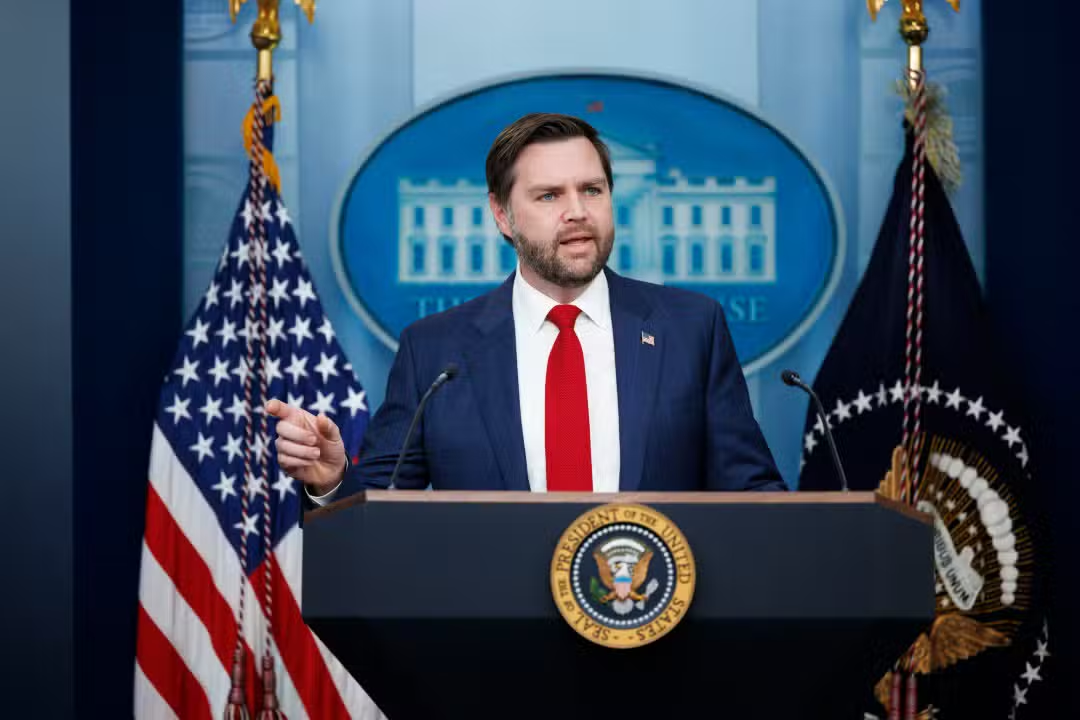
The Vice President further escalated his rhetoric, accusing the woman of being “part of a broader left-wing network to attack, raid, assault, and make it impossible for our immigration agents to do their job.” This unsubstantiated allegation has been condemned by civil rights organizations and legal experts, who emphasize the importance of due process and factual accuracy in public statements by high-ranking officials.
The incident in Minneapolis marks a critical moment for the administration’s stance on immigration, prompting renewed calls for transparency and independent oversight into ICE operations. The lack of verifiable evidence for Vance’s claims has left many questioning the motivations behind such definitive accusations.
Vance’s controversial defense draws swift condemnation
Vice President Vance’s swift defense of the ICE agents involved and his characterization of the deceased as “radicalized” have been met with immediate and forceful condemnation from various advocacy groups. Human rights organizations argue that such statements prejudge an individual and undermine public trust in official investigations, especially when no evidence is provided.
Critics highlight that making grave accusations about a deceased individual without substantiation sets a dangerous precedent. They contend that it shifts focus from the circumstances of the death and potential accountability of law enforcement to an unproven narrative designed to discredit the victim and anyone protesting immigration policies.
Unsubstantiated claims about interference and radicalization
Vance’s assertion that the woman was “radicalized” and “interfered” with the ICE operation has raised serious questions about the basis of his information. In 2025, public discourse is increasingly sensitive to allegations of radicalization, especially when used to describe civilian involvement in protests or observations of government actions.
Legal experts point out that “interference” in law enforcement operations typically requires specific actions that obstruct or impede officers in their duties. Without detailing these alleged actions, Vance’s blanket statement remains open to interpretation and scrutiny, particularly regarding how peaceful observation or protest might be classified.
Calls for an independent investigation intensify
Following the tragic death and the Vice President’s inflammatory statements, calls for an independent investigation into the Minneapolis ICE operation have intensified across the political spectrum. Many demand a thorough and impartial review of the incident, free from political influence, to determine the exact sequence of events leading to the woman’s death.
Advocates for transparency argue that an independent body, rather than an internal review by ICE or another governmental agency, is essential to ensure credibility and build public confidence. They stress the need to examine the tactics employed by agents, the nature of the alleged interference, and the circumstances surrounding the fatal encounter. The outcome of such an investigation is crucial for understanding accountability.
Broader implications for immigration policy and public discourse
The incident and subsequent comments by Vice President Vance are viewed as having significant implications for immigration policy and public discourse in 2025. It underscores the deep divisions within the country regarding immigration enforcement, particularly the role and actions of agencies like ICE in local communities.
The use of terms like “radicalized” in public statements by high-ranking officials also contributes to a polarizing narrative that can stigmatize activists and observers. This approach risks discouraging civic engagement and further alienating communities that are already wary of federal law enforcement actions.
The ongoing debate is expected to shape future legislative efforts and public sentiment toward immigration reform, emphasizing the need for clarity, evidence, and respect for civil liberties in all government operations.
Political backdrop of immigration enforcement in 2025
The political climate surrounding immigration enforcement remains highly charged in 2025, with debates frequently focusing on border security, migrant rights, and the operational scope of federal agencies. High-profile incidents involving ICE often become flashpoints, drawing intense media scrutiny and public reaction.
The Vice President’s comments reflect a firm stance on prioritizing law enforcement’s authority, often framing any opposition as an attempt to undermine national security or legitimate operations. This perspective is a cornerstone of current administration policy, shaping how such incidents are publicly addressed.
Impact on community trust and civil liberties
The aggressive stance taken by Vice President Vance is likely to further erode trust between federal law enforcement and certain communities, particularly those with significant immigrant populations. When allegations of “radicalization” are made without proof, it can deepen mistrust and create an environment of fear among residents and activists.
Civil liberties advocates emphasize that every individual has a right to protest and observe government actions, provided they do so peacefully and within legal bounds. Accusations that conflate legitimate protest with criminal interference or radicalization threaten these fundamental rights and hinder open civic participation.
