Unpublished data marks the farewell of the interstellar comet 3I/ATLAS from our solar system
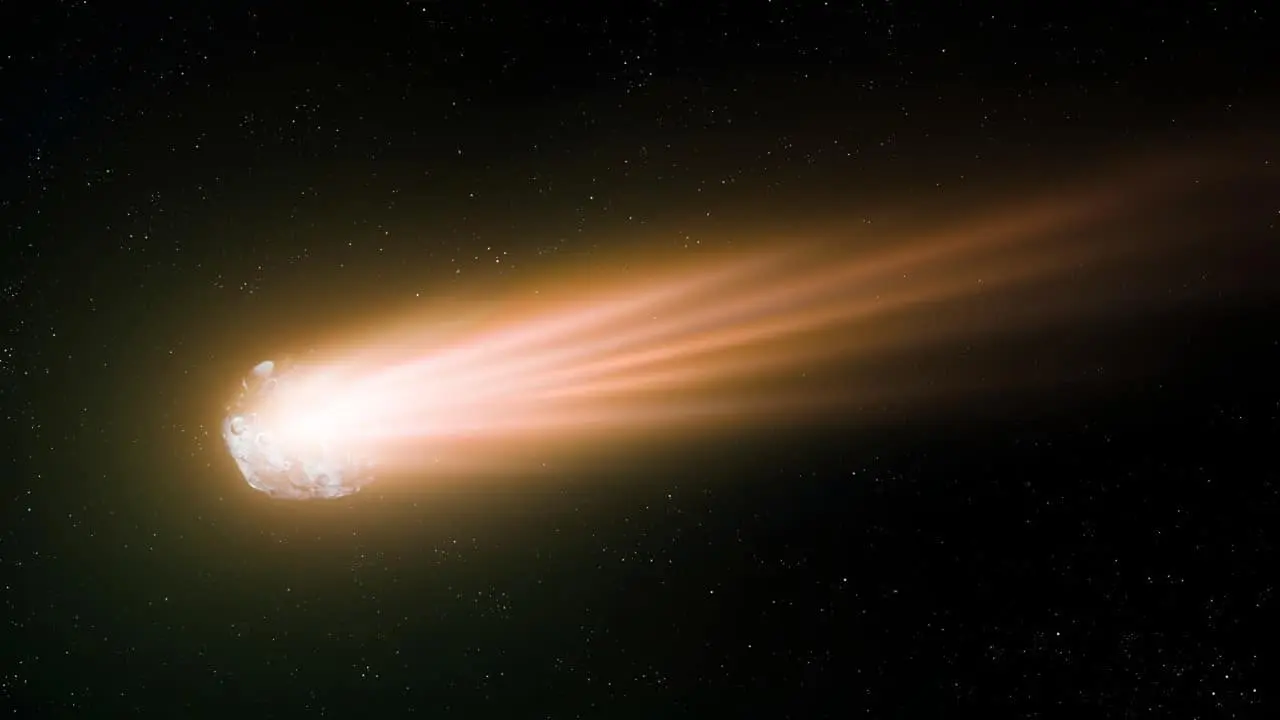
After a memorable passage that mobilized the global astronomical community, the interstellar comet 3I/ATLAS began its journey away from Sistema Solar. The closest approach to Terra occurred on December 19, 2025, at a safe distance of 270 million kilometers. The event concludes a period of intense observation that yielded an unprecedented volume of information about the composition and behavior of objects formed in other stars, leaving a scientific legacy that will be analyzed for years.
Identified on July 1, 2025, 3I/ATLAS was confirmed as the third interstellar visitor ever detected, following in the footsteps of ‘Oumuamua (2017) and 2I/Borisov (2019). Sua hyperbolic trajectory, which indicates an extrasolar origin, was quickly established, allowing observatories around the world to prepare to document each phase of its passage. The monitoring campaign revealed unique features, including the first detection of X-rays in a comet from outside our system, opening new fronts of research into the chemistry of deep space.
The comet now follows a route that will take it beyond the orbits of the giant planets, accelerating towards the interstellar vacuum, from where it came. Sua visit, although brief in cosmic terms, provided a valuable sample of the raw material that makes up other planetary systems in Via Láctea, reinforcing the importance of sky-scanning projects to identify these rare cosmic messengers.

The discovery in the desert of Atacama
The detection of 3I/ATLAS was carried out by the ATLAS telescope system (Asteroid Terrestrial-impact Last Alert System), a network funded by NASA and operated by Universidade of Posicionado in Deserto of Atacama, one of the places with the clearest skies in the world, the Chilean telescope captured the object when it had already entered the orbit of Júpiter. Initial analysis revealed an extraordinary speed, exceeding 200,000 km/h, and an orbital eccentricity greater than 1, characteristics that serve as a signature of its extrasolar origin. Esses data was crucial in issuing a global alert to the scientific community, allowing for rapid and coordinated monitoring.
Shortly after the announcement, astronomers searched image archives from other observatories and found pre-discovery records of the comet dating back to June 2025. The ability to track its route from the initial moments of its approach ensured that no data collection opportunities were missed, maximizing the scientific return from this rare and unexpected visit.
Characteristics of an extrasolar traveler
3I/ATLAS exhibited classic cometary behavior, but with peculiarities that distinguish it from its interstellar predecessors. As it approached Sol, reaching perihelion on October 29, 2025, warming sublimated its ices, forming a coma (the diffuse atmosphere around the nucleus) and a tail of dust and gas.
Spectrographic analyzes revealed a composition rich in organic compounds, such as methanol, in concentrations higher than those normally found in comets from our Sistema Solar. Essa abundance of volatile molecules suggests that the comet formed in a cold region far from its parent star.
The reddish color of the coma indicated the presence of complex organic compounds, possibly processed by cosmic radiation during its long journey through interstellar space. The stability of its activity, without the bursts of brightness or fragmentation seen in other comets, pointed to a cohesive and robust nucleus.
Studies on its trajectory and composition allowed estimating its age to be between 7 and 14 billion years, aligning it with the oldest stellar populations in the galaxy. Isso makes it a primordial relic, potentially older than Sol itself, offering clues about the chemical conditions of the early universe.
Analysis by space telescopes
The passage of 3I/ATLAS was a unique opportunity to mobilize the most advanced space observatories, which provided a multifaceted view of the object. Telescópio Espacial Hubble captured high-resolution images that revealed details of the structure of its teardrop-shaped coma and its tenuous tail, which stretched hundreds of thousands of kilometers. Essas images were essential to estimate the size of its core, which ranged between 440 meters and 5.6 kilometers in diameter, and to monitor dust ejection. At the same time, Agência Espacial Europeia’s XMM-Newton X-ray observatory made a surprising discovery by detecting X-ray emissions from the comet, a phenomenon never before confirmed in an interstellar visitor. Essa emission is likely generated by the interaction between heavy ions in the solar wind and neutral gases in the comet’s coma, a process that could reveal information about the composition of both the solar wind and the cometary atmosphere. Outros instruments, such as the Atacama Large Millimeter/submillimeter
Leia Também



The unprecedented emission of X-rays
The detection of X-rays by the XMM-Newton observatory was one of the highlights of the 3I/ATLAS observation campaign. Embora this phenomenon has already been observed in comets of our Sistema Solar, its confirmation in an object of extrasolar origin opens a new window for the study of these celestial bodies.
The proposed mechanism for this emission is charge exchange, in which highly energetic ions from the solar wind collide with neutral atoms and molecules in the comet’s coma, stealing electrons and emitting X-rays in the process. Analysis of the intensity and spectrum of these X-rays can provide valuable data on the density and composition of the coma, as well as serving as a probe of the properties of the solar wind at points distant from Sol.
Departure route and final destination
Having passed the closest point to Sol and Terra, 3I/ATLAS is now moving away at high speed, following a trajectory that will take it back to deep space. Sua hyperbolic velocity is too great for Sol’s gravity to capture it, ensuring that its visit will be a one-time event with no return.
In the coming years, the comet will cross the orbits of the outer planets, passing through the orbit of Júpiter in 2026 and that of Saturno in 2028. From there, it will continue its journey for millennia, eventually moving away to the point of becoming undetectable by our instruments, returning to its condition as a solitary traveler among the stars.
Comparison with ‘oumuamua and borisov
The 3I/ATLAS visit provided a third and crucial data point for comparing interstellar objects. Ele was different from both ‘Oumuamua, a rocky, elongated object with no visible cometary activity, and 2I/Borisov, which was an extremely active comet rich in carbon monoxide. The intermediate behavior of 3I/ATLAS, with stable cometary activity and an organic-rich composition, suggests that there is great diversity among bodies traveling through the galaxy.
Data collected during the passage of comet 3I/ATLAS will continue to be analyzed by scientists around the world, promising new discoveries about the formation of planets and the distribution of organic matter in Via Láctea. The passage of this cosmic visitor has not only enriched our knowledge, but also improved strategies for detecting and studying future interstellar messengers. The event underscores the importance of sky-scanning observatories, such as the upcoming Observatório Vera C. Rubin, which promise to dramatically increase the discovery rate of these rare objects.
The global scientific community’s preparation and rapid response were exemplary, transforming an unexpected discovery into one of the most successful astronomical observation campaigns in recent years. The legacy of 3I/ATLAS is confirmation that our Sistema Solar is an open door to samples from other worlds, and that we are increasingly equipped to receive them and decipher their stories.