

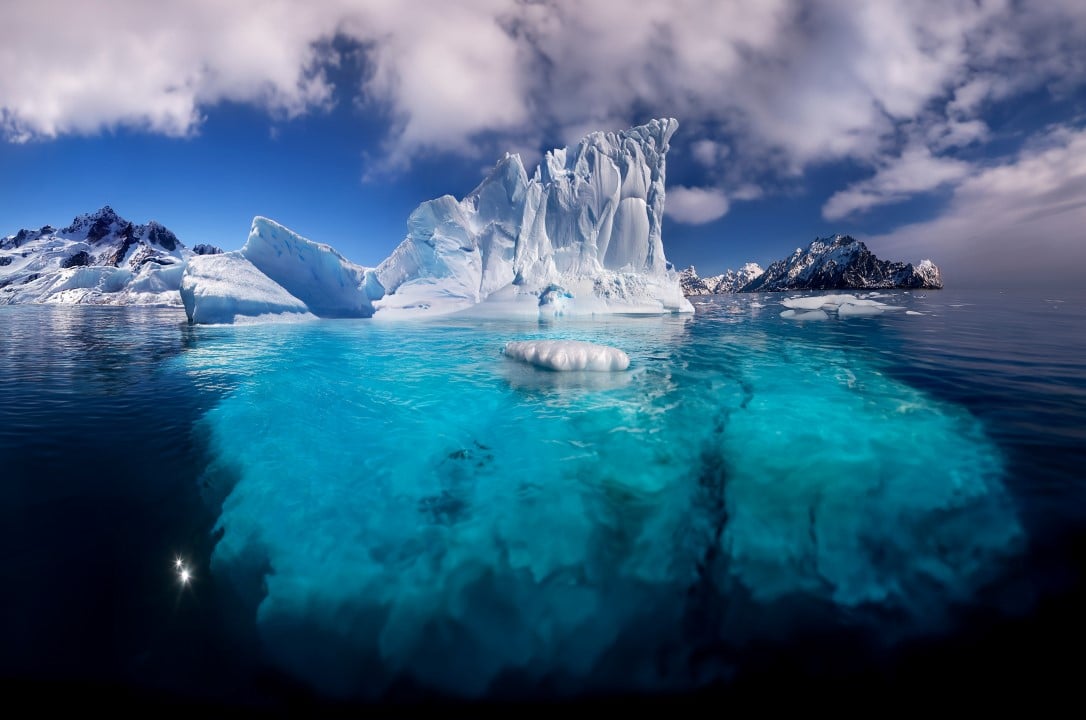
Iceberg A-23A, separated from the Filchner ice shelf in 1986, now has an intense blue color on its surface. Imagens captured by satellites in December 2025 reveal extensive pools of accumulated meltwater. Especialistas point out that these signs indicate an upcoming disintegration of the ice block.
Currently positioned at Atlântico Sul, between the eastern tip of América of Sul and the island South Georgia, the A-23A has significantly reduced in size. Sua area, which reached around 4 thousand square kilometers at its origin, fell to 1,182 square kilometers at the beginning of January 2026. Mesmo thus, the remainder still exceeds the territorial extension of cities like Nova York.
The blue color phenomenon results directly from the accumulation of meltwater in depressions and cracks. Esse process accelerates the internal fragmentation of the iceberg as the water exerts additional pressure.
Recent satellite observations
The Terra satellite, equipped with the MODIS instrument, recorded on December 26, 2025 a vast expanse of blue pits on the surface of the A-23A. Essas formations appear as uniform stripes and areas of liquid water. The following day, a photograph taken from Estação Espacial Internacional showed even greater expansion of these wells.
The observed linear patterns follow directions parallel to the original ice flow when it was still part of the Antarctic shelf. Essas striations were created centuries ago by friction with the rocky bottom. Agora, they channel the flow of meltwater and facilitate its penetration into cracks.
A white area identified on the left edge suggests the occurrence of a blowout. Nesse phenomenon, the pressure of the accumulated water pierces the ice and releases a jet of fresh water into the ocean. Essa release forms a plume of fresh water that mixes with surrounding ice fragments.
🧊🛰️ La black font colors the iceberg A-23A in blue!
—Xplora (@XploraSpace)January 13, 2026
Bien que réduit, il demeure parmi les plus grands icebergs du monde, plus vaste que New York.
Gauche, une image prize on 26/12/25 by MODIS, on satellite Terra.
Adroite, une photo prize le lendemain, depuis l’ISS.pic.twitter.com/Oo5ZeLIHXd
Current environmental conditions
The A-23A sails through waters with temperatures around 3°C, a high value for Antarctic icebergs. Oceanic Correntes moves it to even warmer regions in the Atlântico Sul. Essa trajectory increases the rate of erosion on the submerged edges and exposed surface.
During the southern summer, clearer skies allow for a greater incidence of solar radiation. Warmer air contributes to accelerated surface melting. Esses combined factors make the iceberg’s survival until the end of the season unlikely.
The region close to the island South Georgia acts as an iceberg cemetery. Muitos Antarctic ice floes end their cycle there due to unfavorable thermal conditions. The A-23A follows this common pattern observed in decades of monitoring.
Fragmentation mechanisms
Water accumulated in wells exerts weight that forces existing fissures to open. Esse process creates a cycle in which more water penetrates and widens the cracks. The result speeds up the splitting of the iceberg into smaller pieces.
At the edges, underwater melting causes upward curvature of the ice sheets. Essa deformation forms a kind of peripheral barrier that retains internal water. The pattern known as rampart-moat keeps wells stable for some time before rupture.
Fragmentations that occurred between July and September 2025 have already substantially reduced the original size. The entry into warmer waters in December intensified the process. Observações indicate that total collapse could occur in days or weeks.
Experts follow these events to better understand the dynamics of tabular icebergs. The data collected helps model similar behaviors in other polar regions. Continuous monitoring provides valuable information about environmental changes.
Statements from researchers
Chris Shuman, retired researcher from Universidade of Ele highlights the combined effects of high temperatures in air and water. Shuman interprets visible signs as clear indicators of final stage.
Ted Scambos, from Universidade of Colorado in Boulder, explains that the water in the cracks acts like a hydraulic wedge. Esse mechanism forces the progressive separation of the internal plates. Scambos notes that blue mushy-looking areas result from continuous rupture events.
Walt Meier, from National Snow and Ice Data Center, points out that surface striations direct water flow. Essas old brands influence the current pattern of wells. Meier reinforces that the reduced size does not diminish the iceberg’s relevance for scientific studies.
History of the A-23A
The iceberg broke off the Filchner-Ronne platform in 1986 during a natural calving event. Inicialmente, was trapped in the shallow seabed of the sea of Weddell for more than 30 years. Essa anchorage has preserved much of its original mass for decades.
In 2020, currents released it and began a more active drift. Entre 2023 and 2024, A-23A was considered the largest circulating iceberg on the planet. Sua trajectory included periods of rotation in oceanic vortices before advancing north.
Significant reductions occurred throughout 2025 with large portions breaking. Arriving at lower latitudes exposed the block to thermal conditions incompatible with its stability. The almost 40-year cycle is coming to an end.
Main acceleration factors
- Above-average ocean temperatures for the region favor constant submerged erosion.
- Intense solar incidence during the austral summer increases daily surface melting.
- Hydrostatic pressure from accumulated water causes rapid expansion of internal fissures.
- Sea currents transport the iceberg to areas known for a high rate of disintegration.
These elements work together and reinforce each other. The observed result accelerates the fragmentation process compared to previous phases of the drift.
Monitoring Perspectives
Satellites continue to record daily images of the A-23A to document the final changes. The data obtained contributes to international polar observation databases. Pesquisadores use this information in studies on glacial dynamics.
Complete disintegration will mark the end of one of the longest-lived icebergs monitored. The event reinforces patterns observed in other large tabular blocks. Detailed monitoring allows refinement of predictive models.
The A-23A cycle illustrates natural processes of renewal of Antarctic ice shelves. Eventos of calving are part of the dynamic balance of these structures. Continuous monitoring remains essential to understanding these transformations.



