

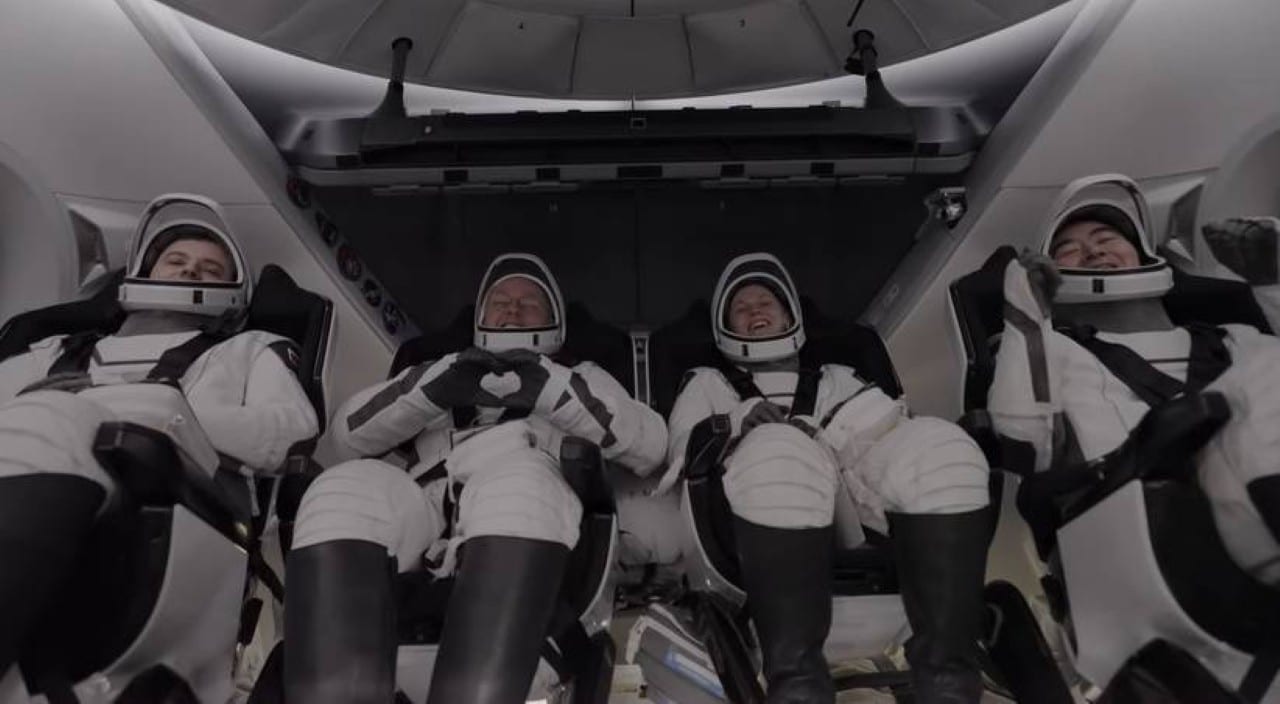
Four astronauts from SpaceX’s Crew-11 mission made a safe landing on Oceano Pacífico in the early hours of this Thursday (15). The early return was due to a medical condition of one of the crew, which remained stable throughout the operation.
The Dragon capsule undocked from the Estação Espacial Internacional (ISS) on Wednesday (14) at 5:20 pm Eastern Time. Re-entry and splashdown occurred approximately 11 hours later, at 00:41 Califórnia local time, near the coast of San Diego.
All crew members exited the capsule smiling and waving to the recovery teams. The operation marked the first medical evacuation in the history of the ISS in 25 years of continuous operation.
Return operation details
The Dragon capsule separated from the ISS without incident and began the deorbiting maneuver sequence. NASA and SpaceX teams monitored all systems in real time during the descent trajectory.
The splashdown occurred under favorable conditions at Pacífico, with recovery teams previously positioned in the area. Navios from SpaceX quickly removed the capsule from the water, following standard procedures established in previous missions.
The four astronauts received immediate assistance to readapt to gravity. Macas were used according to protocol for crew members who remain in microgravity for a long period.
All crew members underwent initial medical evaluations aboard the recovery vessel. Posteriormente, were transported to nearby hospital facilities for further examinations.
Crew composition Crew-11
The Crew-11 mission included professionals from different space agencies. The astronauts spent 167 days in space before their early return.
- Zena Cardman, NASA commander, on her first long-duration space mission.
- Mike Fincke, NASA pilot, veteran with experience on multiple previous expeditions.
- Kimiya Yui, mission specialist at the Japanese agency JAXA, with contributions to scientific experiments.
- Oleg Platonov, Roscosmos mission specialist, responsible for operations on the Russian segment of the ISS.
Each member performed specific tasks during their stay at the station. Activities included maintaining equipment and conducting research in microgravity.
Atmospheric reentry procedures
Reentry of the Dragon capsule involves speeds greater than 22 times the speed of sound. The heat shield protects the structure against temperatures reaching more than 1,900 degrees Celsius.
During the critical phase, a period of communications blackout occurs due to the plasma formed around the capsule. Teams on the ground maintain monitoring by other means until the signal is restored.
The main parachutes opened in sequence to reduce the final descent speed. The impact on the water was cushioned by the Dragon’s buoyancy system.
The operation again demonstrated the reliability of SpaceX’s Crew Dragon system. Esta was one of several successful crew transport missions for NASA.
Current situation at Estação Espacial Internacional
The departure of Crew-11 left only three crew members on the ISS temporarily. The station maintains basic operations with this reduced configuration until the next mission arrives.
The remaining members include NASA astronaut Chris Williams and Russian cosmonauts Sergey Kud-Sverchkov and Sergei Mikaev. Eles assumed the responsibilities of maintaining and monitoring the systems.
NASA considers this situation manageable in the short term. Equipamentos backup guarantees continuity of the station’s essential functions.
The agency plans to accelerate the arrival of Crew-12, scheduled for February, when necessary. Essa mission will restore the full seven-member crew.
Mission history Crew-11
Crew-11 launched on August 1, 2025 from Kennedy Space Center, on Flórida. The original mission had a standard duration of around six months.
During their stay, the crew conducted hundreds of scientific experiments. The research covered areas such as biology, physics and space technology.
A planned spacewalk was canceled the week before the return. The decision preceded the official announcement of the medical condition that led to the evacuation.
The mission accumulated more than 2,600 orbits around Terra. The total distance traveled exceeded 110 million kilometers.
Recovery and next steps for astronauts
Medical teams carried out initial examinations shortly after recovering the capsule. Todos the crew showed normal vital signs and good mood during the procedure.
The member affected by the medical condition will receive specialized care on land. NASA maintains privacy protocols for astronaut health information.
The remaining crew will undergo standard rehabilitation after long missions. The program includes exercises for muscle and bone recovery affected by microgravity.
The astronauts’ families followed the process closely. Reencontros occurred after initial medical evaluations.
Operational importance of the ISS
Estação Espacial Internacional has operated continuously since 1998 as an orbital laboratory. The annual maintenance cost is around 3 billion dollars.
The platform serves as a basis for research that benefits science at Terra. Experimentos include studies on medicines, materials and human behavior in space.
International cooperation remains essential to the operation of the ISS. Agências like NASA, Roscosmos, JAXA and ESA share technical and financial responsibilities.
The station prepares technologies for future missions to Lua and Marte. The data collected assists in the development of long-term life support systems.
Safety measures on space missions
NASA has advanced medical equipment aboard the ISS. However, complex diagnoses require more complete terrestrial resources.
Emergency procedures include quick turnaround options when necessary. The Dragon capsule serves as an escape vehicle in critical situations.
Regular training prepares crews for different scenarios. The simulations range from technical problems to health issues.
The agency maintains partnerships with local hospitals in the landing areas. Essas facilities are prepared to meet post-flight needs immediately.
Perspectives for future rotations
The Crew-12 mission is preparing for launch in the coming weeks. The new crew will carry additional supplies and equipment to the ISS.
SpaceX remains responsible for the commercial transport of astronauts. The Commercial Crew program reduced dependence on Russian vehicles for access to the station.
Other private missions also use the ISS for research. Empresas as Axiom Space plan future expansions of the orbital complex.
NASA works on the transition to commercial stations after the ISS retires. Projetos like Orbital Reef and Starlab advance in development.



