

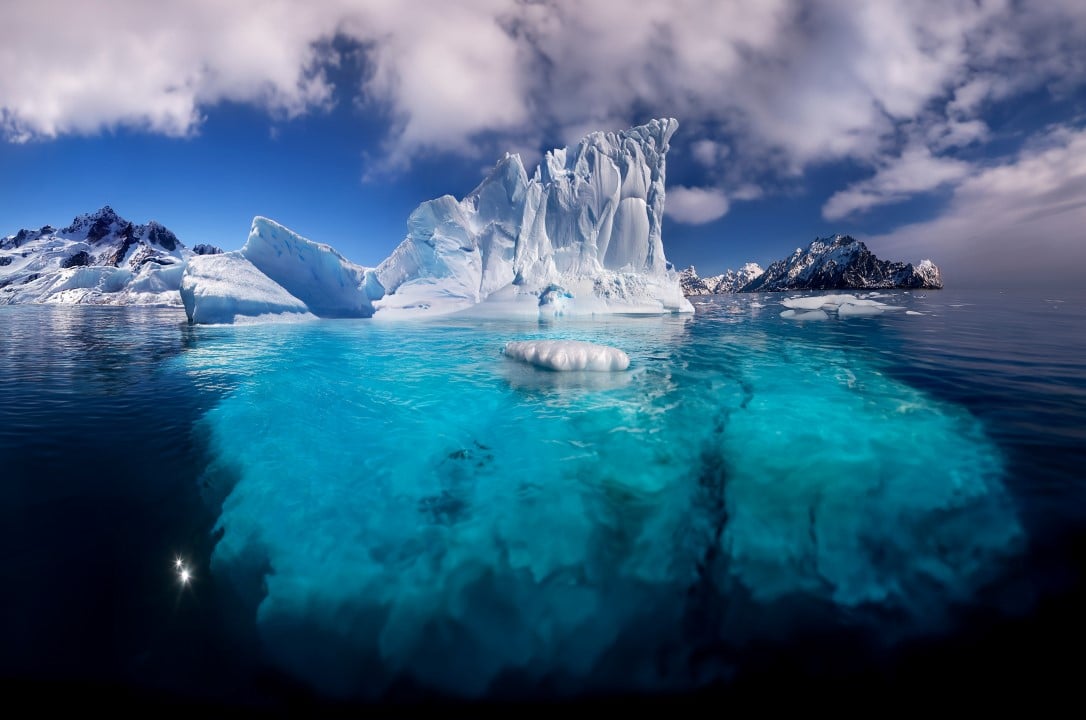
Iceberg A-23A, an ice giant with a history spanning nearly four decades, is displaying dramatic visual signs of its imminent disintegration. Imagens recent satellite images revealed that its surface, previously predominantly white, has acquired an intense blue color due to the formation of extensive meltwater pools. Este phenomenon is interpreted by experts as a harbinger of the final collapse of the bloc, which was once the largest in the world.
Currently sailing through the warmer waters of Atlântico Sul, between América of Sul and the island of South Georgia, the iceberg faces environmental conditions that accelerate its fragmentation. The combination of high ocean temperatures and southern summer heat is triggering surface and underwater melting at a rate unprecedented in its long journey since breaking away from Antártida.
After remaining stranded for more than 30 years on the seabed of Weddell, which helped preserve its mass, A-23A began an active drift in 2020.
🧊🛰️ La black font colors the iceberg A-23A in blue!
Bien que réduit, il demeure parmi les plus grands icebergs du monde, plus vaste que New York.
Gauche, une image prize on 26/12/25 by MODIS, on satellite Terra.
Adroite, une photo prize le lendemain, depuis l’ISS.pic.twitter.com/Oo5ZeLIHXd—Xplora (@XploraSpace)January 13, 2026
Recent satellite observations
Continuous satellite monitoring has been crucial in documenting the A-23A’s rapid deterioration. In December 2025, the MODIS instrument aboard NASA’s Terra satellite captured detailed images showing vast areas of blue pits forming streaks and patches of liquid water across the ice. A day later, a photograph obtained from Estação Espacial Internacional confirmed the expansion of these features.
The linear patterns of the pits follow the original striations formed centuries ago when ice was still part of the Antarctic shelf and flowed over the bedrock. Agora, these ancient marks serve as channels that direct meltwater, facilitating its penetration into deep fissures. On one edge, a white area suggests a “blowout”, an event in which the pressure of accumulated water pierces the ice, releasing a jet of fresh water into the ocean.
The science behind blue coloring
The striking blue hue that now dominates the A-23A landscape is not just an aesthetic change, but a physical indicator of advanced melting processes. The color arises because meltwater, free of air bubbles, absorbs the longer wavelengths of light (red and yellow) and reflects the shorter ones (blue), giving it a vibrant color when accumulated in large volumes.
This water does not remain inert on the surface. Ela seeps into pre-existing cracks and crevices in the iceberg, exerting a significant force known as hydrostatic pressure. Esse additional weight acts like a wedge, forcing cracks open and compromising the structural integrity of the ice block from within.
This process, called hydrofracturing, creates a vicious cycle: the more water accumulates, the more the cracks expand, allowing more water to penetrate and further accelerate fragmentation. It is one of the most efficient mechanisms for the rapid disintegration of large tabular icebergs like A-23A.
Fragmentation mechanisms
The disintegration of the A-23A is driven by a combination of factors acting simultaneously. Underwater melting, caused by water temperatures of around 3°C, erodes the submerged edges of the iceberg. Esse process causes the edges to curve upwards, forming a kind of peripheral barrier that helps retain meltwater on the surface, intensifying internal pressure.
This pattern, known in scientific circles as “rampart-moat”, creates the ideal conditions for melt pits to deepen and exert maximum force on internal fissures. The structure that was once a cohesive mass of ice begins to behave like a set of interconnected plates, ready to separate.
Significant calving events have already been recorded throughout 2025, especially between July and September, considerably reducing the iceberg’s total area, which was originally almost 4,000 square kilometers. The arrival in progressively warmer waters in December only intensified this process.
The data collected during this final stage is of extreme importance to the scientific community. Eles allow researchers to better understand the dynamics of tabular icebergs and improve models that predict how Antártida’s ice shelves might respond to a warming climate, providing valuable insights into the future of polar regions.
Expert analysis of the collapse
Researchers who follow the journey of the A-23A are unanimous in stating that the iceberg is in its final stage. Chris Shuman, researcher at Universidade of Para him, the visual signs captured by satellites are clear indicators that the end is near. Ted Scambos, from Universidade to Colorado in Complementando this view, Walt Meier, from National Snow and
A journey spanning almost four decades
The A-23A’s story began in 1986, when it broke away from the Filchner-Ronne ice shelf in a natural calving event. Logo After its formation, the ice giant was stranded at the bottom of the sea of Weddell, a region of shallow waters that kept it trapped for more than three decades. Essa prolonged anchoring protected it from warmer ocean currents and preserved much of its original mass during a long period of stability.
It was only in 2020 that currents and winds managed to free it, beginning a more active drift towards the north. Entre 2023 and 2024, the A-23A gained notoriety by being classified as the largest iceberg in circulation on the planet. Sua trajectory took him through ocean vortices to the so-called “iceberg alley”, a common route for ice floes moving from Península Antártica toward Atlântico Sul, where they meet their end.
The final destination
The region near the island South Georgia is widely known as an “iceberg graveyard.” Muitos of the large blocks of ice that break off from Antártida end their life cycle there, as warmer waters and strong ocean currents drastically accelerate the melting and fragmentation process. A-23A is following exactly this pattern, observed for decades by scientists monitoring polar ice.
Monitoring Perspectives
Monitoring the A-23A remains a priority, with satellites recording daily images to document its final transformations. The collected data is integrated into international polar observation databases, serving as a detailed case study on the dynamics and life cycle of massive tabular icebergs. The complete disintegration will mark the end of one of the longest-lived icebergs ever monitored, reinforcing knowledge about the natural processes of ice shelf renewal. Esse Detailed monitoring is essential to refine predictive models and understand the complex transformations underway in the polar regions of Terra.



