


Interstellar comet 3I/ATLAS recorded structured activity toward Sol in images captured during a rare alignment with the Sol-Earth axis. Essa configuration allowed detailed observations of organized light patterns, which defy simple object classifications.
Astronomers analyzed the images with a forensic approach, highlighting asymmetric brightness gradients and coherent elongated structures. The phenomenon occurred in January 2026, when the comet was positioned in an alignment that favored direct sunlight.
The observed activity does not show typical chaotic dispersion of random debris. Instead, it reveals confined directional flow, which reduces the number of plausible explanations for the nucleus’ behavior.
Initial discovery of interstellar object
The ATLAS telescope system detected 3I/ATLAS on July 1, 2025, at the observatory located at Río Hurtado, at Chile. The hyperbolic trajectory quickly confirmed its origin outside of Sistema Solar, making it the third interstellar object identified after ‘Oumuamua and 2I/Borisov.
Initial observations indicated high speed and no visible cometary activity in the first few months. As the object approached perihelion in October 2025, signs of gas and dust release began to appear.
Trajectory and passage through Sistema Solar
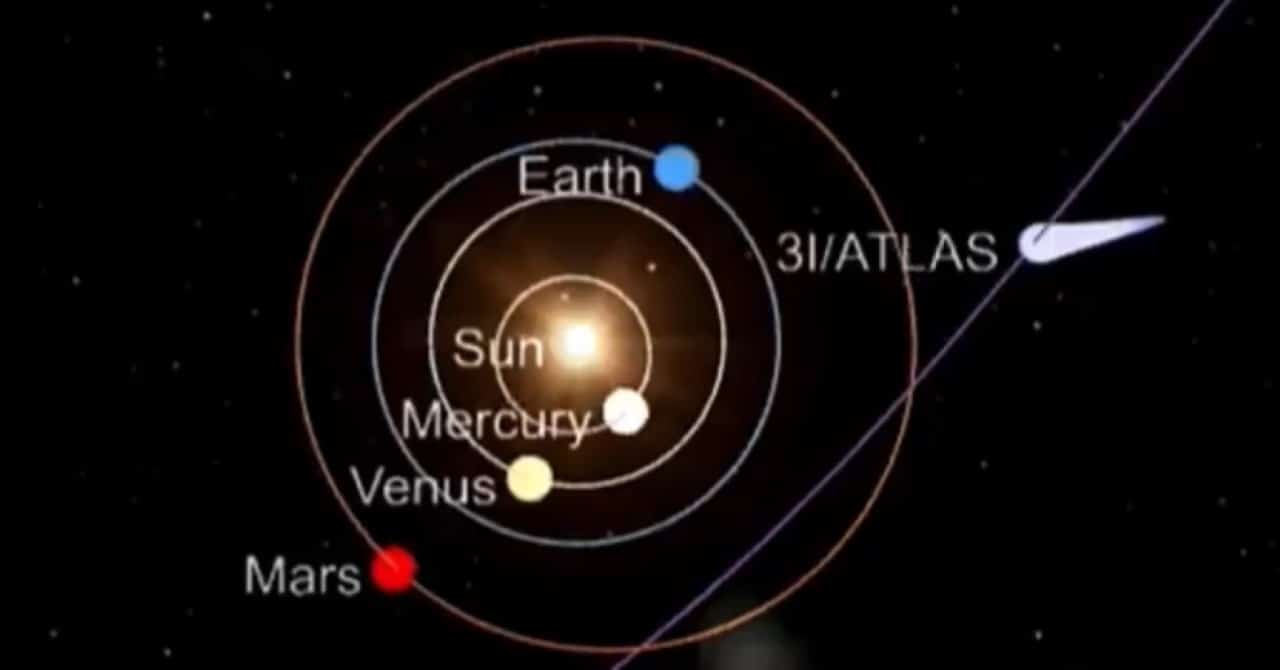
3I/ATLAS reached its closest point to Sol in October 2025, at about 1.35 astronomical units. Posteriormente, passed close to Marte and approached Terra in December of the same year, without posing a risk of impact.
The rare January 2026 alignment positioned the comet almost directly between Sol and Terra. Essa geometry favored the visualization of structures normally hidden by solar glare.
Features observed in recent images
The images analyzed show a brightness gradient intensely concentrated in the frontal region of the object. An elongated structure extends coherently in the opposite direction of movement, maintaining consistent narrowing.
The core remains without clear surface resolution or defined boundaries. Isso suggests the presence of an optical envelope or internal processes that mask structural details.
- Persistent sunward jet even after gravitational deflection at perihelion
- Multiple dust and ion tails extending beyond initial expectations
- Non-gravitational acceleration detected in orbital analysis
- Visible activation triggered exclusively by direct sunlight
Identified chemical composition
Spectral observations of Telescópio Espacial James Webb revealed a high proportion of carbon dioxide in relation to water. The object has eight times more CO₂ than typical Sistema Solar comets.
A greater amount of nickel was also detected compared to iron, differing from patterns observed in local bodies. Essas characteristics suggest formation in a stellar environment different from ours.
Observations by different instruments
Telescópio Espacial Hubble captured detailed images in December 2025, revealing variations in the jets. The JUICE probe, from Agência Espacial Europeia, recorded the comet with navigation instruments during its trajectory to Júpiter.
The Gemini North observatory produced color images that highlight a greenish glow associated with specific molecules. Todas observations converge to non-random structured activity.
Importance of January 2026 Alignment
The alignment allowed full visualization of the face illuminated by the Sol. Astrônomos took advantage of the configuration to collect data on energy transfer mechanisms in the object.
Future similar alignments may corroborate or refute current interpretations. Continuity of observations remains essential to understanding the physical rules that govern 3I/ATLAS.
Comparison with other interstellar objects
Unlike ‘Oumuamua, which showed no cometary activity, 3I/ATLAS developed visible tails and jets. In relation to 2I/Borisov, it exhibits greater structural coherence in material release patterns.
The persistence of the sunward jet represents a rare trait among known comets. Esse behavior limits hypotheses about simple surface sublimation.
Contributions of the ATLAS system
The ATLAS project, funded by NASA and operated by Universidade of Havaí, maintains telescopes at multiple locations. Sua main function involves early detection of potentially dangerous asteroids.
The discovery of 3I/ATLAS demonstrates the system’s ability to identify objects of external origin. Telescopes continue to monitor the comet as it exits Sistema Solar.
Detailed analysis of the directional structure
The observed structure maintains a direction consistent with the solar vector. Sua narrowness and organization are distinguished from isotropic dispersion common in random outgassing.
Experts highlight that the pattern suggests confined material release mechanisms. The brightness asymmetry reinforces the interpretation of a direct response to solar radiation.
The absence of a resolved core prevents definitive conclusions about surface composition. Dados Additional future observations may clarify the nature of the optical envelope.
Continuous Monitoring Perspectives
3I/ATLAS continues on an exit trajectory from Sistema Solar, with a speed that will permanently take it out of the solar gravitational influence. Telescópios ground and space personnel maintain tracking as long as the object remains visible.
New images may reveal developments in activity as the distance to Sol increases. The complete record of the activity cycle will contribute to models of interstellar objects.
The 3I/ATLAS study expands knowledge about the formation of bodies in other stellar systems. Cada observation adds valuable data to the limited base of known interstellar objects.



