
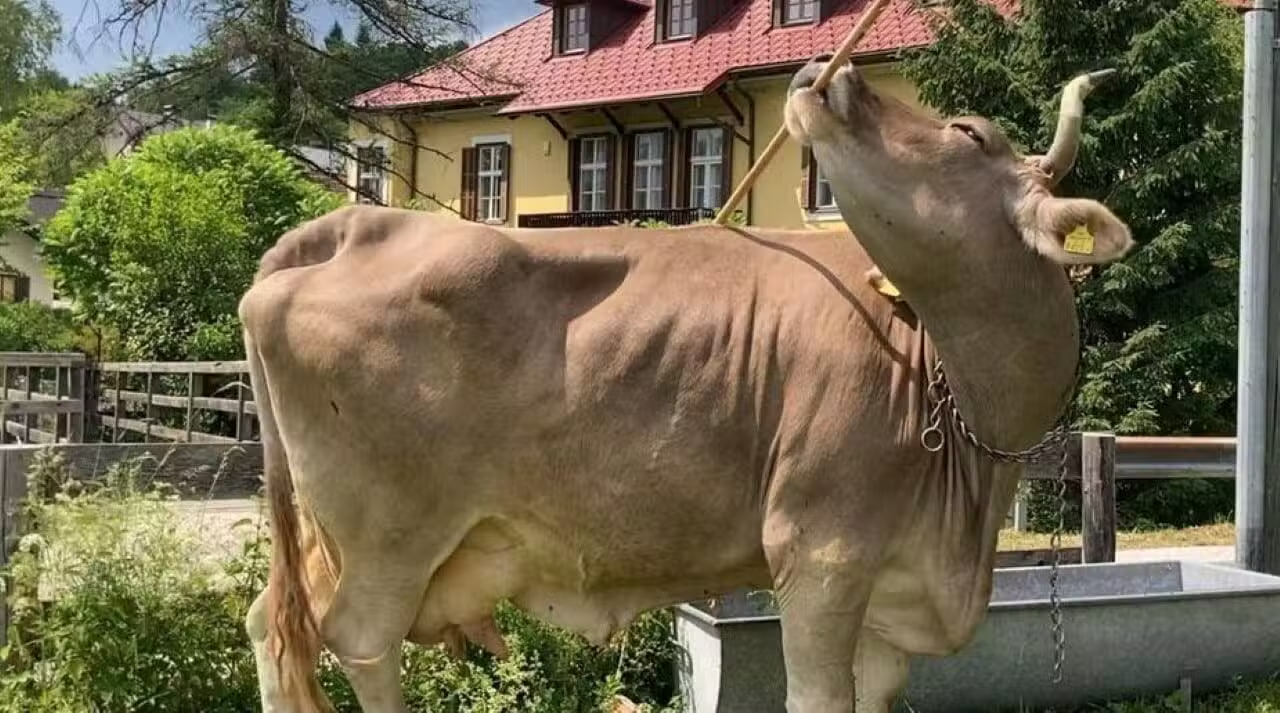
A 13-year-old cow named Veronika, of the Brown Swiss breed, demonstrated the ability to use tools flexibly on a rural property in Áustria. Pesquisadores of Universidade of Medicina Veterinária of Viena confirmed the behavior through controlled experiments. The study, published in the journal Current Biology, records the first documented case of tool use in cattle.
Veronika manipulates objects such as brooms, rakes and branches with her mouth and prehensile tongue to scratch herself in hard-to-reach areas. Ela differentiates the parts of the tool according to the area of the body, using the bristles for more resistant parts and the smooth handle for sensitive areas. Essa adaptation indicates planning and understanding the properties of objects.
The behavior emerged spontaneously over the years, in an enriched environment that allowed the cow to explore and perfect the technique. Diferente of most cattle raised in intensive systems, Veronika lives as a pet, with access to a variety of objects and free time to interact with the environment.
Detailed behavior of Veronika
Veronika uses her tongue to wrap around the handles of objects and position them correctly before holding them sideways in her mouth. Essa technique allows precise control during the scratching movement. Ela direciona a ferramenta principalmente para regiões posteriores do corpo, como garupa, lombo e úbere, áreas propensas a irritações por insetos no verão.
In observations, the cow adjusts the orientation of the tool in anticipation of contact with the skin. Para back and areas with thicker skin, apply rubbing movements with the bristles in forward pulling actions. Já for delicate parts, such as abdominal flaps and the anal region, opt for the smooth handle with gentle touches.
https://twitter.com/BandJornalismo/status/2013824397069451493?ref_src=twsrc%5EtfwExperiments conducted by researchers
The scientists carried out seven sessions with ten attempts each, totaling 76 recorded uses of the tool. Eles positioned an asymmetrical deck broom randomly to test Veronika’s adaptation. The cow demonstrated a consistent preference for the bristles in upper areas, switching to the handle in lower regions.
Statistical analyzes confirmed that the choice of extremity depended on the target body part. Testes as chi-square revealed significance in preference, while linear models indicated interaction between body area and type of tool used. The duration of the events varied depending on the region, but not by the chosen end.
The researchers recorded all behaviors on video for detailed analysis. Veronika maintained high efficiency in all attempts, readjusting the grip when necessary to optimize contact.
Veronika started the habit when she was around three or four years old, initially awkwardly. Over time, he refined his movements, gaining precision over almost a decade of daily practice.
Environment context of Veronika
Veronika lives in a mountain village in the south of Áustria, on the property of an organic baker who treats her like a companion animal. The site offers ample pastures, daily human interaction and access to objects such as fallen branches, rakes and brooms. Essa configuration differs radically from commercial farms, where cattle have a shorter life span and a restricted environment.
The owner observed the behavior about ten years ago and provided additional tools to ease the itching. The absence of productive stress and the cow’s longevity contributed to the development of the skill. Especialistas point out that such enriched conditions favor cognitive expressions in domestic animals.
Comparison with tool use in other animals
Flexible multitool use was consistently known only in chimpanzees until this discovery. Primatas use different ends of sticks for different tasks, such as catching insects or cracking nuts. Veronika replicates this versatility by exploring different properties of the same object.
Similar cases occur in Asian elephants, which manipulate hoses for bathing, and in corvids, known for innovating with objects. Ungulados like horses and buffaloes present anecdotal reports, but without experimental verification as in the case of Veronika.
- Chimpanzees: use modified rods to fish for termites;
- Crows: bend wires to reach food;
- Elephants: use branches as a fly-swatter against flies;
- Dolphins: protect their snouts with sponges when foraging on the seabed.
These examples illustrate that capacity transcends specific evolutionary lineages.
The discovery expands the taxonomic scope of tool use beyond primates and large-brained birds. Bovinos, domesticated around 10 thousand years ago, were rarely evaluated from a cognitive perspective due to the focus on production.
Implications for farm animal cognition
The case of Veronika suggests that cattle have the potential for innovation in solving physical problems when the environment allows it. Ambientes impoverished people in intensive breeding can suppress such behaviors, leading to underestimation of intelligence. Pesquisadores advocate reevaluation of animal welfare based on these capabilities.
Outside experts confirm that the behavior meets strict criteria for intentional tool use. The skill indicates fine motor coordination and mechanical understanding of the properties of objects.
The cow does not represent a genius exception, but it demonstrates latent potential in the species. Outros cattle could develop similar techniques under appropriate space and stimulus conditions.
This observation questions cultural biases that associate cattle with low intelligence. The study encourages searches for similar cases in other underappreciated species.
Discovering and recording behavior
The behavior gained scientific attention after the publication of a book on animal innovation by one of the researchers. Vídeos sent by the public, including one from Veronika using a rake, prompted a visit to the property. The team confirmed authenticity and proceeded with structured testing.
Veronika taught herself, without direct human training. The habit probably arose to alleviate irritations caused by insect bites in the Austrian summer.
The study highlights the importance of enriched environments for the expression of cognitive abilities. Longevidade and freedom of exploration were decisive factors in the development of the technique.