


The interstellar comet 3I/ATLAS, a visitor from another star system, continues to be a source of remarkable scientific discoveries for the global astronomical community. Após passed the closest point to Sol in October 2025, the object, formally designated C/2025 N1 (ATLAS), revealed unusual behavior in its tail. Observações details identified jets of gas and dust that oscillate periodically, a phenomenon that allowed scientists to calculate the rotation of its core for the first time.
Discovered in July 2025 by the ATLAS survey system (Asteroid Terrestrial-impact Sua closest approach to Terra occurred in December 2025, at a safe distance of 270 million kilometers. Desde Therefore, an intensive monitoring campaign has followed its journey away, focusing on characteristics that distinguish it from comets native to our cosmic neighborhood.
The main revelation came from the analysis of a structure known as the anti-tail, which, due to a perspective effect, appears to point towards the Sol. Dentro of this formation, the jets of material ejected by the comet’s nucleus exhibit a regular and predictable pattern of movement. Este dynamical behavior offers a unique window into understanding the physical properties of a celestial body that formed in orbit around another star and now interacts with our Sol.
Anti-tail dynamics and periodic jets
The anti-tail is a relatively rare optical phenomenon observed when Terra crosses the orbital plane of a comet. Nessa specific geometry, the larger and heavier dust particles, which are less influenced by solar radiation pressure and spread along the comet’s orbit, appear to form a tail that extends in the opposite direction to the main ion tail. In the case of 3I/ATLAS, this structure reached an impressive length, measured at around 1 million kilometers.
Within this anti-tail, astronomers have identified jets of matter that change position with surprising precision. The analyses, based on continuous observations, determined that these jets complete an oscillation cycle every 7 hours and 45 minutes. Esse rhythmic pattern is the key to unlocking the secrets of the cometary nucleus, which remains too small to be resolved directly by telescopes.
The observations that allowed this discovery were conducted over 37 nights, between July and September 2025, using Telescópio Gêmeo of Dois Metros in Observatório of Teide, in Tenerife, Espanha. The repetitive movement of the jets works like a clock hand, indicating the rate at which the comet’s nucleus rotates on its own axis, exposing different active regions to sunlight.
This activity is driven by heating of the core surface by Sol. Heat causes volatile ices to sublimate, that is, to go directly from a solid to a gaseous state, dragging dust particles with them. The release of this material from fissures or specific areas on the surface creates the observed jets, whose direction changes as the core rotates.
Unraveling the rotation of the interstellar core
From the 7 hour and 45 minute cycle of the jets, the research team was able to infer the rotation period of the comet’s nucleus. The calculation indicates that 3I/ATLAS completes a revolution around itself every 15 hours and 30 minutes, approximately. The small margin of error in the measurement is associated with the complexities of the observation geometry and the exact orientation of the jets relative to the nucleus. Este data is fundamental, as rotation directly influences the way the comet releases material and develops its coma and tails. The rotational speed helps determine the structural stability of the core, indicating whether the object is at risk of fragmenting due to rotational stress combined with solar heating.
What makes this measurement especially valuable is the interstellar origin of 3I/ATLAS. Unlike the comets of our Cinturão of Kuiper or the Nuvem of Observar as a “virgin” body, which has never before been so close to a star, reacts to the intense heat and radiation of Sol provides an unprecedented basis for comparison. The observed activity, although intense, appears to follow the same physical principles as local comets, suggesting that cometary formation processes may be universal. Continuous analysis of the evolution of these jets will allow us to refine models on the composition and internal structure of cometary nuclei in general.
Observatories join forces for global monitoring
To gain the most complete understanding possible of comet 3I/ATLAS, NASA orchestrated an unprecedented observation campaign involving a fleet of space missions and ground-based observatories. Essa multi-mission approach was crucial for tracking the object from different angles and at multiple wavelengths, allowing scientists to separate the comet’s actual physical characteristics from perspective effects. The Telescópio Espacial Hubble was activated to capture high-resolution images of the nucleus and internal coma, seeking details about the fragmentation and composition of the ejecta. Simultaneamente, the Parker Solar Probe, on its journey close to Sol, obtained a unique lateral view, recording daily images between October and November 2025 that helped map the three-dimensional structure of the dust tail. The Europa Clipper probe, on its way to Júpiter, also turned its cameras on the comet in November, observing it from a distance of 164 million kilometers. Até even instruments orbiting Marte contributed to the global effort. Essa network of space observatories, complemented by ground-based telescopes like those on Observatório and
What the composition of 3I/ATLAS can reveal
The main scientific interest in studying visitors like 3I/ATLAS lies in their chemical composition. Analysis of the light reflected by gas and dust in the comet’s coma allows astronomers to identify the molecules present, such as water, carbon monoxide, carbon dioxide and other organic compounds. Essas substances are the primordial building blocks from which planets formed.
By comparing the abundance of these materials in 3I/ATLAS with that of comets in our Sistema Solar, scientists can investigate whether the “ingredients” for life and planet formation are common throughout the galaxy. Detecções Preliminaries, such as hydroxyl (OH), a byproduct of the breakdown of the water molecule (H2O) by sunlight, confirm the presence of water ice, an expected component in comets.
Further analysis will look for isotopes and complex molecules that may indicate notable differences or similarities with bodies in our own system. The results could strengthen or challenge current theories about the formation of planetary systems, offering a direct glimpse into the chemistry of a protoplanetary disk located light-years away.
Search for technosignatures finds no anomalies
Given its exotic origin, 3I/ATLAS also became a target for Instituto SETI (Search for Inteligência Extraterrestre). The Breakthrough Listen program used some of the world’s most sensitive radio telescopes to “listen” for the object, looking for any narrowband radio signals that could indicate an artificial or technological origin.
On December 18, 2025, the 100-meter Telescópio Green Bank performed a deep scan across a wide range of frequencies, from 1 to 12 GHz. Após data analysis, no signal candidate for a technosignature was detected, reinforcing the conclusion that 3I/ATLAS is an astrophysical object of purely natural origin.
Final trajectory and last study opportunities
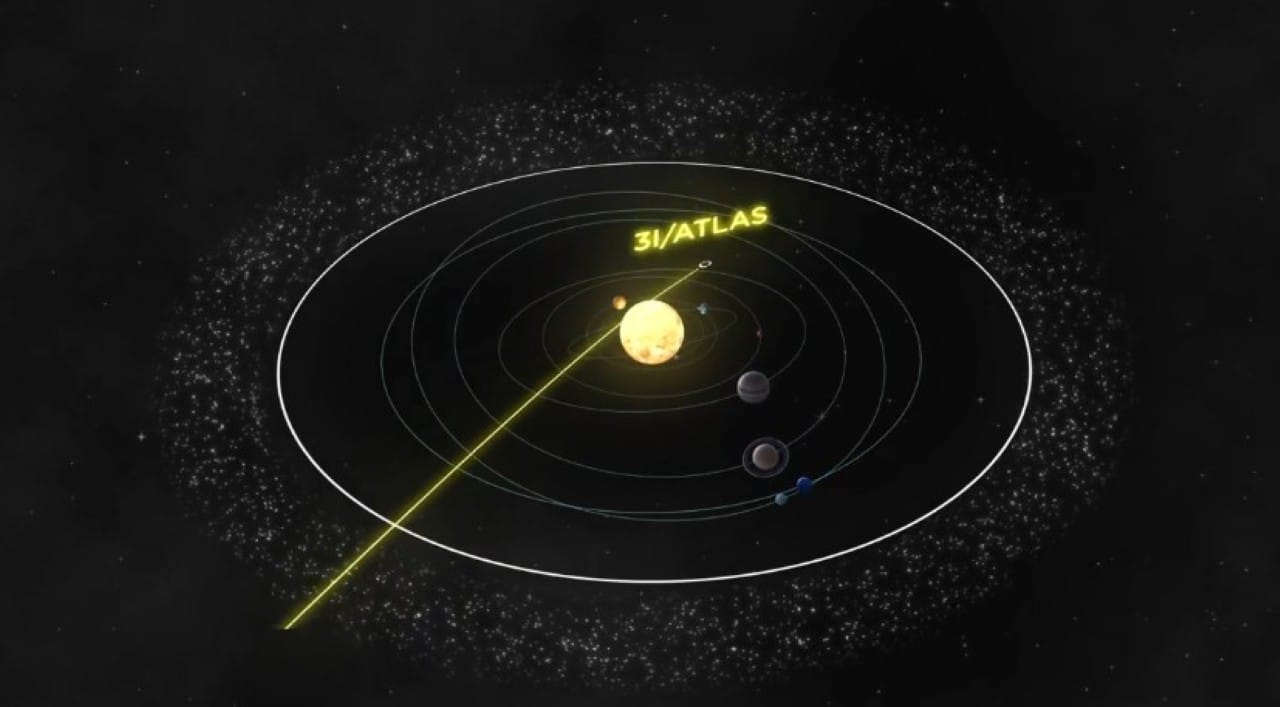
Currently, comet 3I/ATLAS continues its long journey back to interstellar space, from where it will never return. Sua trajectory will take it close to Júpiter in March 2026, an event that will offer new observation opportunities under different lighting angles. Após this gravitational encounter, the object will become progressively fainter, until it disappears from view of even the largest telescopes.
Implications for extrasolar astronomy
The detailed study of comet 3I/ATLAS, the third interstellar object confirmed to visit our Sistema Solar, represents a milestone in astronomy. The observation that it behaves very similarly to native comets, with a nucleus that spins and releases jets of gas and dust when heated, provides powerful evidence that the physical processes that govern the formation of small icy bodies are consistent across different stellar systems.
This apparent universality has profound implications for our understanding of planet formation across the galaxy. Sugere that basic building blocks such as water and organic compounds may be similarly distributed in other protoplanetary disks, increasing the likelihood that planetary systems similar to ours could be common in the universe. Cada new interstellar visitor provides an additional piece to this cosmic puzzle.



