

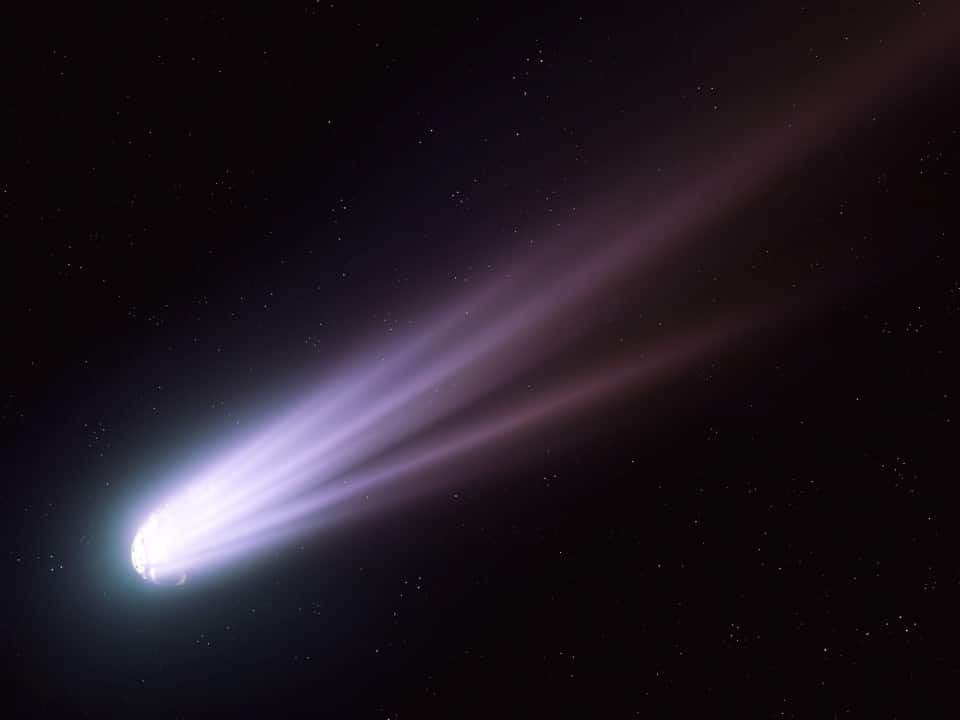
The global scientific community is immersed in the analysis of data collected during the recent passage of comet Tsuchinshan-ATLAS (C/2023 A3), an astronomical event that generated great expectation over the last year. Após its closest approach to Terra and Sol at the end of 2024, researchers are now poring over a massive volume of information that promises to reveal secrets about the formation of the solar system and the composition of primitive celestial bodies. The comet, although it did not reach the spectacular brightness initially predicted for all locations, provided a memorable show for observers at Hemisfério Sul and, more importantly, a treasure trove of data for science.
Discovered in 2023, the object quickly became one of the priority targets for observatories around the world. The long-period trajectory, originating from the distant Nuvem of Oort, indicated that it was a “new” comet, that is, on its first visit to the inner solar system. Essa characteristic makes it an almost untouched messenger of the primordial conditions that existed more than 4.5 billion years ago, justifying the mobilization of technological resources for its in-depth study.
The analyses, which will extend over the coming months and years, seek to decipher the chemical composition of its core, the dynamics of its tail of dust and ions and its interaction with the solar wind. Cada discovery contributes to the construction of a cosmic puzzle about how planets like Terra formed and whether water and organic compounds, essential to life, were brought by these icy travelers from deep space.
What the passage data reveals
The most intense phase of observation of comet Tsuchinshan-ATLAS resulted in an unprecedented collection of data, obtained through a diverse range of techniques and instruments. Photometry, for example, made it possible to precisely measure variations in the comet’s brightness, providing clues about the rate of ice sublimation and the amount of dust released from its nucleus. Já spectroscopy was essential to decompose the light reflected by the coma and tail, revealing the chemical signature of the materials present. Preliminary Análises have already confirmed the presence of molecules such as cyanogen (CN) and diatomic carbon (C2), common in comets, but the search is now for more complex organic compounds. High-resolution Imagens images, captured by ground- and space-based telescopes, are being used to map the structure of jets of gas and dust emanating from the nucleus, helping scientists understand the topography and rotation of this icy body. Combining these different data sets is what will allow researchers to build a three-dimensional, dynamic model of the comet, offering a complete view of its behavior during solar approach.
A Traveler’s Journey from the Cloud of Oort
Comet Tsuchinshan-ATLAS is a classic representative of the objects that inhabit Nuvem of Oort, a vast sphere of icy bodies that surrounds the solar system at enormous distances, far beyond the orbit of Plutão. Esses long-period comets are considered cosmic fossils because they remained in a deep-frozen state, preserving the chemical composition of the nebula that gave rise to Sol and the planets. Sua’s million-year journey to the inner solar system is often triggered by subtle gravitational perturbations, such as the passage of a nearby star.
As it approaches Sol, the increase in solar radiation heats the comet’s nucleus, causing its ices to go directly from a solid to a gaseous state, in a process called sublimation. Esse gas drags grains of dust with it, forming the diffuse atmosphere known as a coma. Solar radiation pressure and solar wind push this material away from the core, creating the iconic dust and ion tails that can stretch for millions of kilometers. Observar this real-time activation, especially on a “new” comet, provides a unique opportunity to study the primordial matter of the solar system.
The complex prediction of cometary brightness
Predicting the luminosity that a comet will reach during its passage is one of the most challenging tasks in astronomy. The intensity of the glow depends on a series of interconnected and often unpredictable factors.
The size of the nucleus and the proportion of ice and dust in its composition are crucial variables. A larger, more active nucleus tends to produce a more extensive and brighter coma.
The way the comet fragments or releases material also directly influences its visibility. Eventos Outburst, sudden explosions of gas and dust, can dramatically increase a comet’s brightness for short periods.
In the case of Tsuchinshan-ATLAS, initial projections were extremely optimistic, but the actual light curve showed a more gradual increase, resulting in more modest naked-eye visibility than expected in some regions, especially at Hemisfério Norte, where its position in the sky was unfavorable during the peak.
Instruments mobilized for observation
The comet observation campaign involved a global network of telescopes, demonstrating modern astronomy’s ability to coordinate planetary-scale efforts to study transient events.
State-of-the-art observatories, such as the Very Large Telescope (VLT) on Chile and the telescopes on the Mauna Kea on Havaí, have been targeted to obtain high-resolution spectroscopic data and images.
Space telescopes, such as the Hubble and James Webb Space Telescope (JWST), have also devoted observation time to studying the comet at wavelengths that are blocked by Earth’s atmosphere, such as infrared and ultraviolet.
In addition to professionals, a vast community of amateur astronomers played a vital role, continuously monitoring the comet’s brightness and morphological changes, providing valuable data that complements observations from major observatories.
Comet’s scientific legacy
Regardless of its final brilliance, Tsuchinshan-ATLAS has already left an important mark on planetary science. The data set collected is one of the most complete ever obtained for a long-period comet from Nuvem of Oort.
This information will serve as a fundamental reference for testing and refining theoretical models on the formation and evolution of comets, as well as improving techniques for predicting their activity and brightness for future events.
Next steps of the research
Astronomers’ work is far from over. Detailed analysis of comet Tsuchinshan-ATLAS data will continue for several years, resulting in scientific publications that will deepen knowledge about these objects. The expectation is that the discoveries will help answer fundamental questions about the origins of our own planet and the possibility of life elsewhere in the universe.
The importance of international collaboration
The study of comet Tsuchinshan-ATLAS highlights the collaborative nature of modern science. The ability to track the object 24 hours a day was only possible thanks to cooperation between observatories located on different continents, sharing data and coordinating observation strategies in real time.
This international synergy not only maximizes the scientific return from rare events like this, but also strengthens ties between researchers of different nationalities, driving the advancement of human knowledge in a collective and unified way. The comet’s legacy will, in part, be a testament to the power of global collaboration.



