

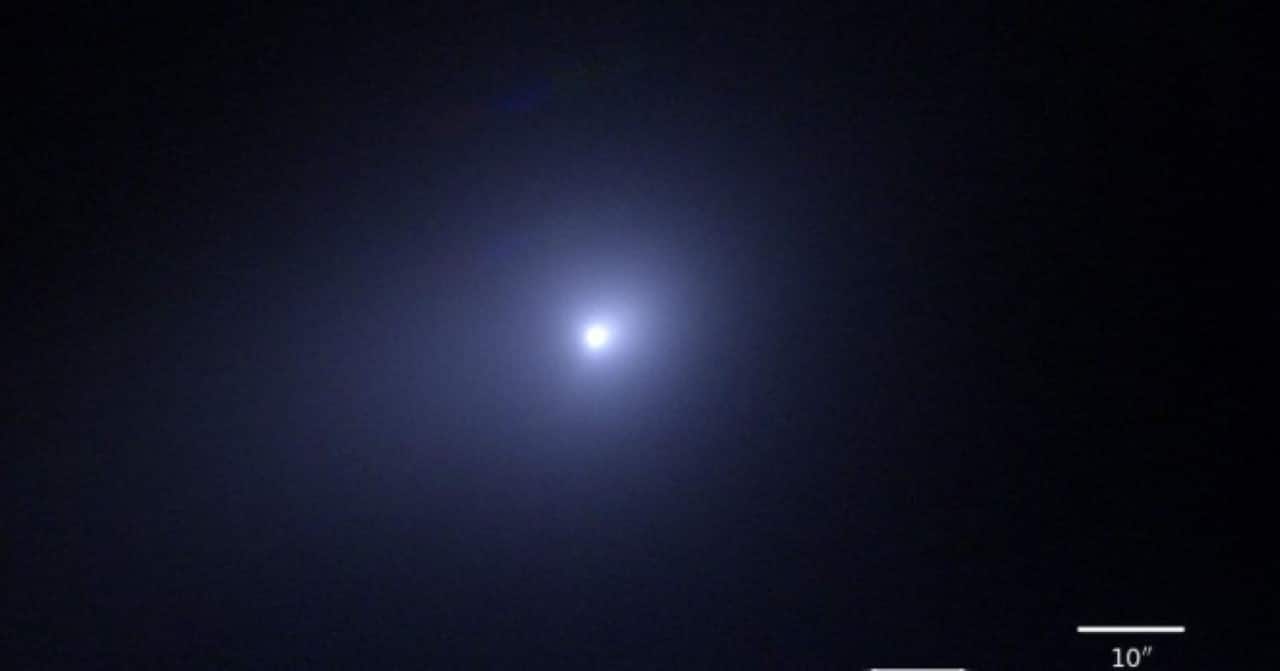
The global astronomical community is preparing to say a final goodbye to comet 3I/ATLAS, the third interstellar visitor confirmed to cross our Sistema Solar. A special live broadcast, organized by Virtual Telescope Project, will mark the object’s farewell on January 22, 2026, the date on which it reaches its opposition, an ideal alignment that provides the best observation conditions from Terra.
Discovered on July 1, 2025 by the ATLAS survey system (Asteroid Terrestrial-impact Last Alert System), the comet follows a hyperbolic trajectory. Isso means that, after passing through the vicinity of Sol, it will be ejected back into interstellar space, on a journey of no return.
The online event, scheduled to begin at 23:00 UTC (20:00 Brasília time), will offer the public the chance to follow images captured in real time by robotic telescopes. The transmission represents the final opportunity for many to observe the comet before its brightness dims to the point where it becomes undetectable by most small and amateur instruments.
The importance of opposition alignment
The opposition phenomenon is a pivotal moment for observational astronomy. Ele occurs when Terra is positioned directly between Sol and a celestial object, such as a planet or comet. Nesta geometric configuration, the observed body appears in the sky in the opposite direction to Sol, rising to the east when Sol sets to the west and remaining visible throughout the night, which maximizes the time available for study and image capture.
In addition to prolonged visibility, opposition minimizes the distance between the Terra and the object, making it appear larger and brighter in our telescopes. The phase angle, which is the angle between the Sol, the object and the observer, reaches its minimum value, resulting in full frontal illumination. The Esse effect, known as the “opposition effect,” highlights details on the comet’s surface and coma, allowing scientists to obtain more precise data about its structure and composition.
The Interstellar Visitor’s Journey
Since its identification, 3I/ATLAS has been a priority target for observatories around the world and in space. Sua high speed and open orbit quickly confirmed its extrasolar origin, making it a messenger from another star system, a rare sample of material from outside our immediate cosmic environment.
The comet reached perihelion, its closest point to Sol, in October 2025, passing at a safe distance of approximately 1.4 astronomical units (about 209 million kilometers) from our star. From then on, it began its long journey away, with its brightness progressively diminishing.
Unlike comets from our own Sistema Solar, which have elliptical orbits and return periodically, 3I/ATLAS is just passing through. Sua trajectory is a unique opportunity to directly study the raw material that makes up distant planetary systems.
A window to other worlds
The passage of objects like 3I/ATLAS, along with its predecessors 1I/’Oumuamua and 2I/Borisov, revolutionized understanding of the formation and dynamics of planetary systems. Cada one of these visitors offers a unique glimpse into the chemistry and physics of its home stars. Enquanto ‘Oumuamua was an elongated, rocky object with no visible cometary activity, and Borisov resembled a classic comet, 3I/ATLAS displays intermediate features that continue to intrigue scientists. Análises spectroscopic tests carried out by James Webb Space Telescope revealed the presence of organic molecules and volatile gases, such as carbon monoxide and cyanogen, in proportions different from those found in comets native to our system. Esses data is critical to understanding whether the building blocks of life are common elsewhere in the galaxy and how they are transported between stars, providing valuable clues about the diversity of planetary environments in the universe.
The contribution of large observatories
Over the past few months, humanity’s most powerful telescopes have turned their lenses on 3I/ATLAS. Telescópio Espacial Hubble captured very high-resolution images that detailed the structure of the coma — the cloud of gas and dust around the nucleus — and the evolution of its tail at different moments of its approach.
These observations were complemented by data from the Very Large Telescope (VLT), at Chile, which performed detailed spectroscopic analyzes of the object’s chemical composition. Até even space missions en route to other destinations, such as Europa Clipper and Juice, which are heading to Júpiter, took advantage of the opportunity to record the comet, collecting valuable information from unique points of view in space.
How to watch the final broadcast
Virtual Telescope Project, an initiative led by Italian astronomer Gianluca Masi, will make live observation available for free on its official YouTube channel. The session will feature commentary from experts, who will explain the details of the phenomenon and answer questions from the public, making the event accessible to both experienced enthusiasts and those curious about the cosmos.
Observation for amateur astronomers
For those with their own equipment, the comet can still be located during the month of January in the constellation Câncer. However, its decreasing brightness requires medium-sized telescopes, with apertures of at least 20 centimeters, and dark skies, away from the light pollution of cities.
Star maps and astronomy apps can provide the exact coordinates for the instrument’s pointing each night. Opposition is the ideal time to try and record the visitor as they will be in their most favorable position in the night sky.
What to expect after parting
After peak visibility in January, comet 3I/ATLAS will continue to move away, and its brightness will rapidly decrease. In just a few weeks, it will become an extremely difficult target, accessible only to the world’s largest professional observatories, which will try to keep track of it as much as possible.
Eventually, it will cross the orbit of Netuno and head towards Nuvem of
The data collected during his brief visit, however, will continue to be analyzed for years. Information about its composition, rotation and trajectory will provide material for dozens of scientific studies, helping to piece together the puzzle of planetary formation.
The 3I/ATLAS detection reinforces the expectation that future observatories, such as Observatório Vera C.



