

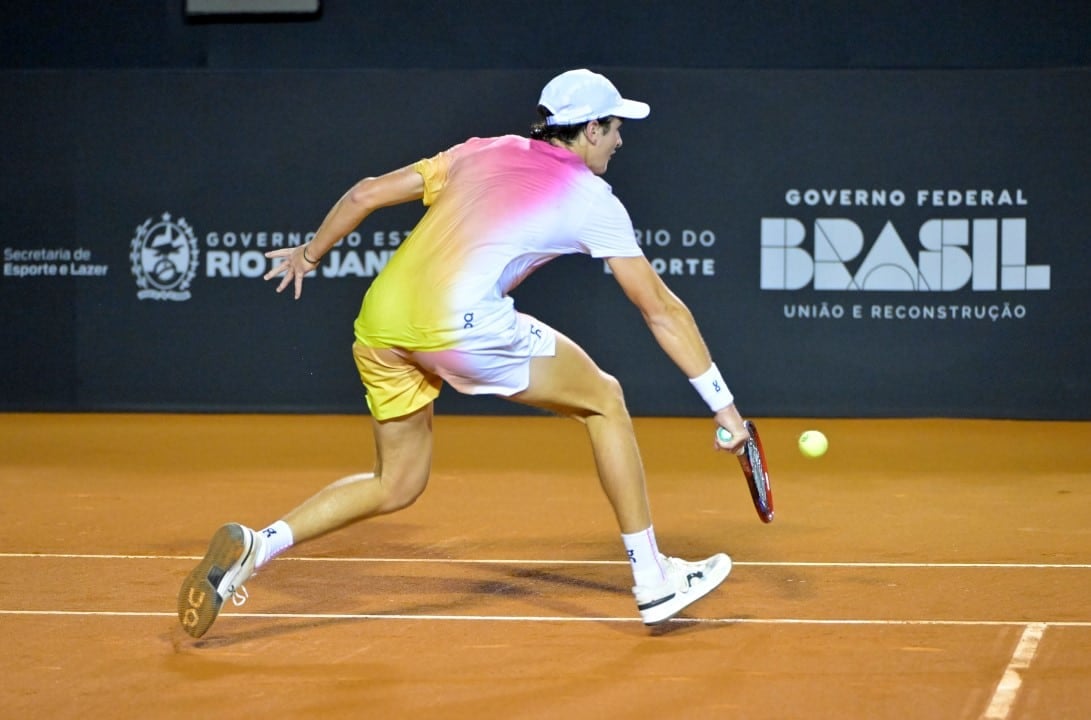
Brazilian tennis player João Fonseca, 19 years old, is in full swing at Rio of Janeiro, where he is carrying out an intensive week of training ahead of the South American clay court season. Após a discreet participation in the first Grand Slam of the year, at Austrália, the young athlete, currently number 32 in the ATP world rankings, focuses his efforts on adapting to clay to defend the ATP 250 title of Buenos Aires and compete at Rio Open, the two main commitments of February.
The preparation takes place on covered courts in the capital of Rio de Janeiro, a necessary measure to overcome the frequent rainy season in the city. The Fonseca technical team considers this transition phase crucial to adjust fundamental technical elements of your game, such as movement on the court, time on the ball and physical resistance, essential characteristics to be successful on clay, a surface that requires longer rallies and greater wear and tear on athletes.
The activity schedule was designed to reestablish the ideal competition rhythm, which was affected by an injury at the beginning of the season. The objective is to ensure that the young talent reaches Argentina in full condition to withstand the marathon of games and the pressure of being the current champion of the tournament, a feat that has placed him in the spotlight of the world circuit in 2025.
Look who showed up!
João is already preparing for the clay tour, as the next tournaments will be Buenos Aires and Rio Open.[Via IG/bvalladao]pic.twitter.com/4HKhaErSxZ
—João Fonseca Updates (@fonsecaupdates)January 24, 2026
Overcoming the physical hurdle at the start of the season
The beginning of 2026 represented a significant challenge for João Fonseca, who revealed he was dealing with a congenital spinal condition. Esse problem required careful management by his medical team and physiotherapists, resulting in his withdrawal from the preparatory tournaments of Brisbane and Adelaide, in Austrália. The absence in these competitions directly impacted his preparation for the Australian Open.
Although he felt no sharp pain during his debut match in Melbourne, the lack of competitive rhythm was a determining factor. The intensity of training had to be reduced in the weeks before Grand Slam, which compromised their performance and resulted in an early elimination. The decision to focus on complete recovery was strategic so as not to compromise the rest of the year.
Now, fully clinically recovered, the athlete focuses on strengthening and mobility exercises, especially in the lower back, to prevent new inflammation. Preventative work is closely monitored by the physiotherapy team, which follows each training session to ensure that the tennis player’s body can withstand the high loads required by the transition to clay, a naturally more exhausting surface.
The player himself confirmed on his social networks that he feels 100% fit to compete, highlighting that the period of forced inactivity in January mainly affected his cardiorespiratory conditioning. The main goal of this week of training at Rio is precisely to restore the body’s necessary resistance to face matches that can last for hours.
The strategy in training for South American clay
The choice to train at Rio in Janeiro, his hometown, allows João Fonseca to maintain proximity to his main technical team and readapt to the heat and humidity conditions typical of the region at this time of year. Mesmo Although training takes place indoors to escape the rain, the sessions are planned to simulate the conditions he will encounter in Buenos Aires and, later, in Jockey Club Brasileiro, the stage of Rio Open.
The tactical focus is on improving service variations and returns, moves that can neutralize more consistent opponents from the back of the court. Lateral movement, one of the pillars for good performance on clay, has been one of the most demanded points during the training sessions, which take place in two periods, in the morning and in the afternoon. Consistency work and building longer stitches are the basis of preparation for a surface that rewards patience and strategy, as well as power. The team seeks to consolidate Fonseca’s aggressive playing style, adapting it to be equally effective on clay.
The mission to defend the crown in Buenos Aires
João Fonseca’s first big challenge will be Buenos Aires’s ATP 250, a tournament that has a special meaning in his career. Foi in the Argentine capital that he won his first ATP-level title in 2025, in a surprising campaign that caught the attention of the tennis world. Defending the points gained in the previous year is vital to remaining among the top 40 in the ranking.
The competition, which officially starts on February 9th, should have the Brazilian as one of the main favorites. The event organization projects that Fonseca will enter as the number four seed, which would guarantee him a theoretically smoother path in the initial rounds, avoiding immediate confrontations with other high-ranking players.
The pressure of being the current champion is seen by the athlete and his team as a motivating factor. Para Fonseca, returning to Buenos Aires is an opportunity to consolidate your status on the circuit and prove that the 2025 title was the beginning of a solid trajectory. The goal is to use the confidence of playing in a place with good memories to rediscover your best tennis.
The challenge of playing at home at Rio Open
Immediately after the campaign at Argentina, João Fonseca returns to Brasil to compete in Rio Open, the biggest and most prestigious tennis tournament in América of The ATP 500, which takes place from February 16th at Jockey Club Brasileiro, promises a very high level bracket and a special atmosphere for the home player. Sendo is the only Brazilian guaranteed entry directly by the ranking, Fonseca carries the expectations of the local fans. Competition will be fierce, with the confirmed presence of big names from the international circuit. The Italian Lorenzo Musetti, current number 5 in the world, heads the list of entries, which also includes the experienced Matteo Berrettini and the charismatic Frenchman Gael Monfils, who is on his farewell tour. Além of them, clay-court specialists such as the Argentines Francisco Cerúndolo and
Sul post-America calendar
The planning for the João Fonseca season does not end with the clay courts. Após the conclusion of the Rio Open, the team is already aiming to return to the fast courts for the important March tournaments in the Estados Unidos. The focus will turn to the Masters 1000 of Indian Wells and Miami.
These events, known as “Sunshine Double”, bring together the world’s tennis elite and distribute a large amount of points. A good performance in América of Sul is considered essential to build confidence and game rhythm before facing the best in the world on North American soil.
Maturity and career management
The way João Fonseca and his team managed his injury at the beginning of the year has been praised by sports analysts, who highlight the young athlete’s maturity. Transparency when communicating the physical problem and patience in following the recovery schedule demonstrate solid and conscious career management.
Evolving technical performance
The clay season will be an important test for Fonseca’s technical maturity. The ability to adapt their aggressive game to a slower surface and build points with more patience will be fundamental to their success. Training at Rio is focused on refining these aspects.
The expectation is that the Brazilian will demonstrate tactical evolution, using more variations of strikes and a more accurate reading of the game to overcome clay specialists and prove his versatility in different game conditions.



