

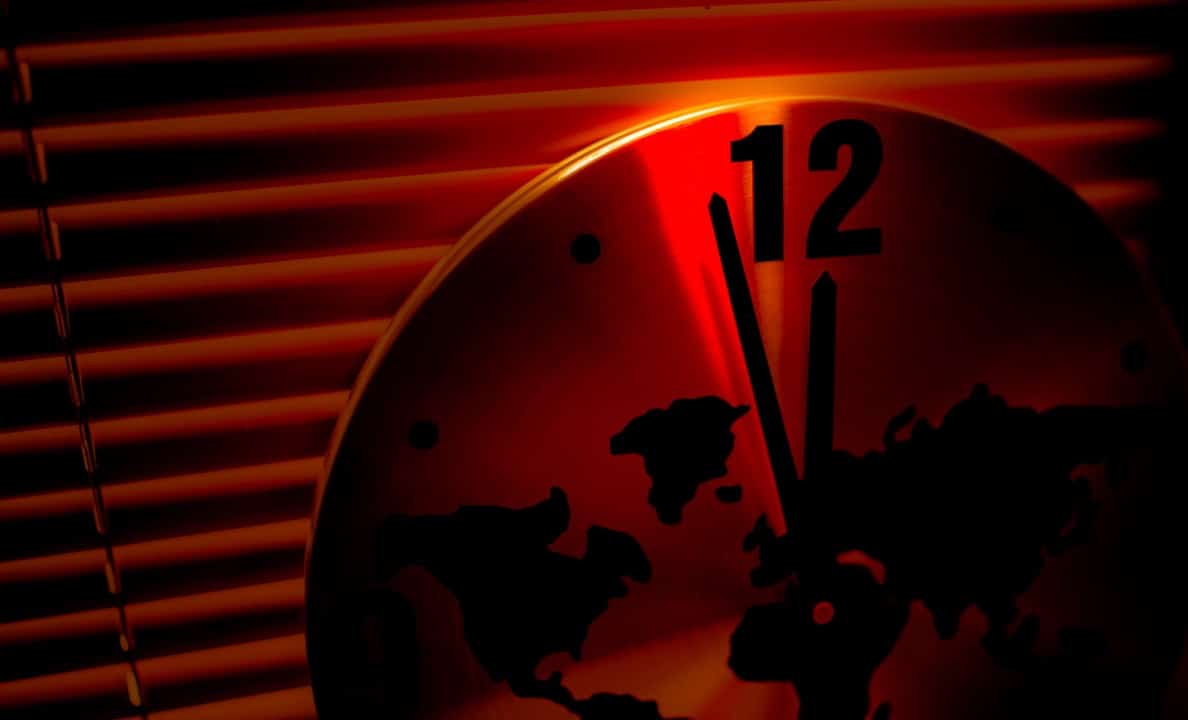
The science and security council of the Boletim of the Cientistas Atômicos announced this Tuesday, January 27, 2026, the new positioning of the apocalypse clock, which now shows just 85 seconds to midnight. Este adjustment represents the most critical point ever recorded since the tool’s creation in 1947, highlighting an acceleration in the existential threats surrounding the planet. The decision was based on the worsening of international conflicts, the collapse of arms control agreements and the persistence of severe environmental crises.
The organization based in Washington, D.C., highlighted that humanity has failed to make significant progress to mitigate the risks that threaten the continuity of civilization. Alexandra Bell, president and CEO of the group, stated during the conference that every second has become vital given the scarcity of time to reverse destructive trends. The new record surpasses the previous mark of 89 seconds set last year, consolidating a trajectory of constant proximity to total global disaster.
The main factors that influenced the advance of the hands include:
The imminent expiration of strategic nuclear weapons treaties between major global powers.
The increase in aggressive nationalism and adversarial stances in different geographic regions.
The inability to contain carbon emissions and the accelerated advancement of climate change.
The uncontrolled development of disruptive technologies that can be used for military purposes.
Nuclear risks and the end of strategic treaties
The imminent expiration of a strategic arms treaty signed in 2010 between the Estados Unidos and the Rússia, scheduled for next week, is seen as one of the most dangerous triggers for the current scenario. Sem this control mechanism, experts warn that there will be no legal or diplomatic obstacles to prevent a new unbridled arms race between the most powerful nations in the world. The regulatory vacuum creates an environment of profound uncertainty, where transparency about arsenals ceases to exist, increasing the chances of fatal miscalculations.
The geopolitical landscape has become considerably more volatile over the past year, with countries adopting more hostile and isolationist rhetoric that hampers international cooperation. Daniel Holz, professor at Universidade of The lack of direct dialogue and the ongoing modernization of nuclear warheads have turned the clock into a barometer of unprecedented instability in the modern era.
🕰️ Jamais l’humanité n’avait été considérée aussi proche d’une “catastrophe globale” depuis la création de l’horloge en 1947.pic.twitter.com/l2QX50efEC
— AlertesInfos (@AlertesInfos)January 27, 2026
Advancement of technologies and cyber disinformation
The influence of emerging technologies and the dissemination of false information via digital media continue to be pillars of support for the existential risk highlighted by scientists. Cyber information warfare compromises the ability of societies to respond cohesively to real threats, such as pandemics and natural disasters, fragmenting the public perception of reality. Esse phenomenon generates political paralysis that prevents the implementation of urgent global security measures.
In addition to disinformation, the use of artificial intelligence applied to defense and surveillance systems introduces variables that humanity is not yet able to fully control or regulate effectively. The integration of these tools into critical infrastructures increases Estados’s vulnerability to invisible attacks, which can quickly escalate to physical confrontations. Boletim warns that technological innovation is advancing at a much faster pace than the creation of ethical and safety standards.
History of clock fluctuations since the Cold War
Since its creation shortly after the end of Segunda Guerra Mundial, the doomsday clock has functioned as a metaphor for human vulnerability in the face of atomic technology. In 1991, with the end of Guerra Fria and the signing of arsenal reduction treaties, the clock reached its maximum distance from midnight, marking 17 minutes of relative safety. Naquela time, cooperation between the then União Soviética and the Estados Unidos signaled a period of optimism and disarmament that seems far from the reality faced in 2026.
However, starting in the 2020s, time began to shorten drastically, passing the symbolic mark of 100 seconds and then 90 seconds due to the war in Ucrânia. The maintenance and subsequent advancement of the points reflect the persistence of prolonged conflicts that drain diplomatic and financial resources from environmental and humanitarian causes. History shows that while the clock may turn back, the current trend is toward a dangerous acceleration toward the upper limit of the dial.
Climate change and environmental urgency
The climate crisis remains a determining factor in the position of the clock, as natural disasters are becoming more frequent and lethal on a global scale. Cientistas observe that, despite constant warnings and international agreements, global temperature reduction targets are not being achieved by the majority of industrialized countries. Sea level rise and ocean acidification are processes that, once triggered, have little room for reversal in the short term.
Food security and access to drinking water are under direct threat, which generates internal social tensions and migratory pressures that could trigger new armed conflicts between nations. The interconnectivity between climate and national security is a central point in the Boletim analysis of the Cientistas Atômicos, which sees environmental degradation as a risk multiplier. Sem a robust and coordinated energy transition, the pressure on the clock will continue to increase annually.
Constant monitoring of biological threats
Surveillance over biological risks, both natural and resulting from laboratory research, also forms part of the technical analysis for adjusting the 85 seconds. The pandemic of previous years demonstrated the fragility of supply chains and the inability of health systems to deal with simultaneous large-scale events. Pesquisadores indicate that biotechnology, although beneficial to medicine, also opens the door to the creation of synthetic pathogens that can be accidentally or intentionally released.
The lack of solid global governance to oversee high-security laboratories is seen as a loophole that humanity cannot ignore. Boletim reinforces that preparation for future health crises must be treated with the same rigor dedicated to nuclear disarmament, given the potential for systemic destabilization. Biodefense cooperation is cited as an area where there is still much room for institutional improvements and transparent scientific investments.
Challenges for international diplomacy
Global leadership faces the challenge of rebuilding mutual trust in a period where traditional communication channels appear to be saturated or broken. Turning back the clock would depend on a renewed commitment to multilateralism and the reactivation of dialogues on strategic security between nuclear powers. Sem a clear change of stance on the part of the heads of state, the dial will continue to record the deterioration of survival conditions on the planet.
Civil society plays a fundamental role in demanding transparency and concrete actions from its governments in relation to climate and disarmament. The doomsday clock is not just a marker of time, but a call to action for populations to understand the gravity of the current historical moment. The adjustment to 85 seconds is a sign that the prevention mechanisms used over the last eight decades may no longer be sufficient for 21st century threats.
The Boletim of the Cientistas Atômicos continues to monitor the variables that influence global security on a daily basis, preparing technical reports that support the position of the hands. The next review will take place according to the evolution of political and military facts, with special attention to the developments of treaties that expire in the coming months. Experts’ hope is that this new warning will serve as a catalyst for urgent political changes that can move the world back from the brink.
The discussions in Washington highlighted that the fate of civilization depends on choices made in the present, and not on an inevitable destiny already traced by past events. Cada country, regardless of its economic power, has a share of responsibility for maintaining global stability and protecting the environment. Today’s adjustment is the most severe in history, but the group of scientists maintains the premise that time can still be recovered if there is coordinated political will.
The countdown to midnight serves as a visual reminder that technology, when not accompanied by diplomatic wisdom, becomes a tool of self-destruction. The world is now entering unknown territory, where the proximity to the catastrophic event requires vigilance never before seen on the part of international institutions. The 85 seconds represent the narrowest margin of safety ever experienced by the human race since the first warheads were tested.



