

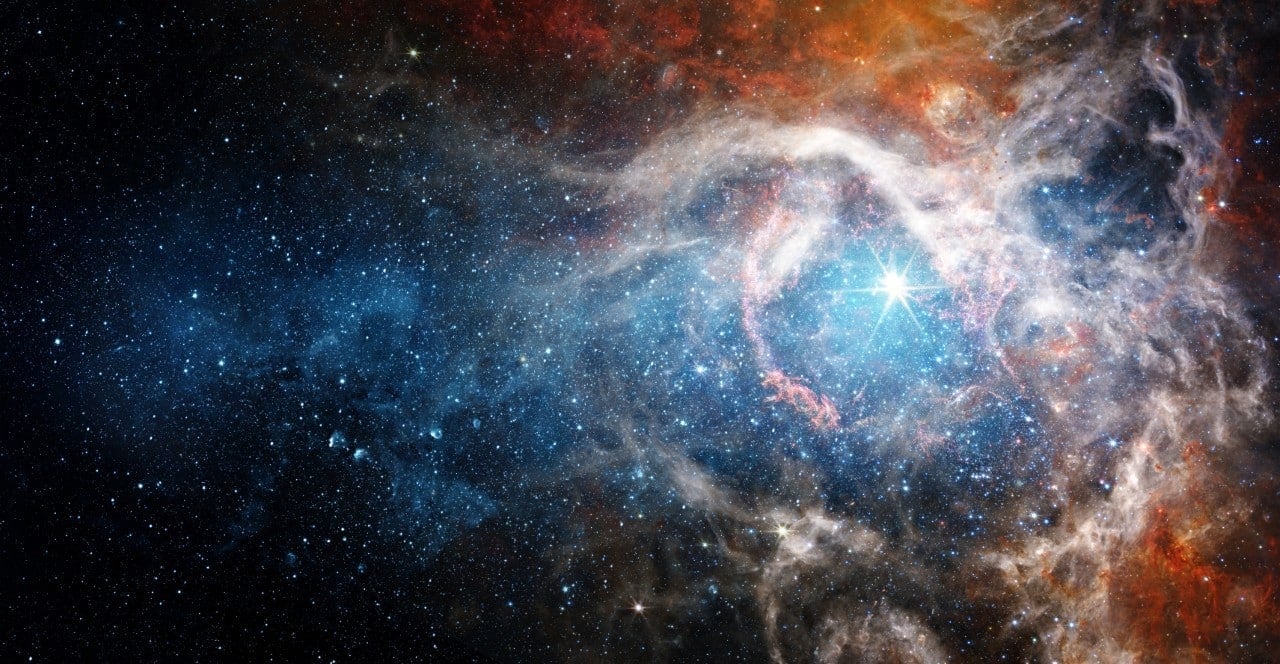
The universe presents different configurations depending on the observation distance adopted by modern telescopes. Imagens obtained by James Webb Space Telescope and Hubble show everything from objects in the solar system to structures billions of light years away. Essas captures provide detailed view of cosmic organization at multiple scales.
Outer space begins just over 100 kilometers above the Earth’s surface. Observações carried out from Estação Espacial Internacional records planetary conjunctions such as those of Vênus and Júpiter without atmospheric interference. The Earth’s atmosphere appears as a semi-transparent layer in these images.
Advances in space telescopes make it possible to record the solar corona during total eclipses and details of the outer gas planets. JWST produced calibrated portraits of Júpiter, Saturno, Urano, and Netuno in infrared. Esses records highlight rings, storms and moons with unprecedented precision.
Solar system in perspective
The solar system occupies the immediate cosmic surroundings of Terra and includes planets, asteroids and comets in orbits around Sol. Representações logarithms of distances show from the inner planets to the Oort cloud and trans-Neptunian objects.
Recent JWST images reveal the gas giants’ complex atmospheres and variations in their ring systems. Complementary Observações indicate that planets can vary in size from dimensions larger than Júpiter to bodies smaller than a thousand kilometers in diameter.
Stars and regions in Via Láctea
Via Láctea contains hundreds of billions of stars distributed in spiral arms and regions of active star formation. Áreas like the nebulae Ômega, Águia, and Sharpless 2-54 display clouds of gas and dust that continually generate new stars.
Ground-based and space-based observatories capture panoramic views of the galaxy with thousands of stars visible to the naked eye. Most stars remain invisible due to their distance or lower brightness, but central regions concentrate denser and more massive objects.
Group Local and neighboring galaxies
Grupo Local brings together more than a hundred galaxies dominated by Via Láctea and Andrômeda in mass and size. Andrômeda surpasses Via Láctea in size, followed by the Triângulo galaxy and the Grande Nuvem of Magalhães.
Grande Nuvem of Magalhães appears as the outer galactic object with the greatest angular extent in the sky. Distâncias range from 165 thousand light years for this satellite galaxy to millions of light years for more distant members of the group.
Close clusters like Virgo
The Virgo cluster is located about 55 million light-years away and represents the largest concentration of galaxies in the cosmic neighborhood. Contém approximately one thousand large galaxies, many of them giant ellipticals without active star formation.
Chains like Markarian align massive galaxies within the cluster. Observações reveals central supermassive black holes, including that of Messier 87 with direct images of the event horizon taken by Event Horizon Telescope.
Active black holes and quasars
Supermassive black holes activate in galactic nuclei and emit jets of plasma on gigantic scales. The quasar Porphyrion has jets that extend 23 million light years, equivalent to hundreds of diameters of Via Láctea.
These jets arise from the accretion of matter into disks around black holes and influence the intergalactic medium. Observações in radio identify these structures as the largest known in the current universe.
Images of the black hole in Messier 87 show persistent photon ring in data from different years. Esses records confirm the existence of the event horizon and properties predicted by general relativity.
Cosmic web on large scales
The cosmic web forms the large-scale structure of the universe with filaments, walls and voids that connect clusters of galaxies. Recent JWST Mapas reveal dark matter with greater precision than that obtained by Hubble in large regions. Esses maps show invisible distribution that supports the formation of galaxies and clusters throughout cosmic time. Superaglomerados and filaments do not remain gravitationally bound and are separated by expansion accelerated by dark energy. Observações of the DESI project trace objects from nearby galaxies to distant quasars across immense volumes of the observable cosmos. Isolated Galáxias occupy giant voids, such as MCG+01-02-015, separated by more than a hundred million light years from its neighbors.
Most distant objects observed
The MoM-z14 galaxy is located at around 33.8 billion light-years and represents the most distant confirmed object to date. Sua light emitted when the universe was just 282 million years old now arrives after cosmic expansion.
The afterglow of Big Bang, known as the cosmic microwave background, appears as the oldest and most distant signal at 46 billion light years. Missões like Planck have refined maps of this radiation at small angular scales over the decades.
- Gas planets: JWST images show detailed rings and atmospheres
- Stellar nebulae: formation regions in Via Láctea with colorful clouds
- Galactic clusters: chains like Markarian in Virgo with dominant ellipticals
- Quasar jets: Porphyrion extends millions of light years in radio
- Cosmic web: filaments revealed in recent dark matter maps
Voids and lonely galaxies
Cosmic voids contain a few isolated galaxies in vast expanses without dense structures. Exemplos as MCG+01-02-015 maintains moderate star formation after billions of years without major mergers.
These galaxies preserve ancient spiral features and can continue producing stars for prolonged periods. Observações indicate that voids occupy a large part of the cosmic volume between dense filaments.



