Lula calls for a pragmatic and united Latin America amid growing political fragmentation concerns
Lula calls for a pragmatic and united Latin America amid growing political fragmentation concerns
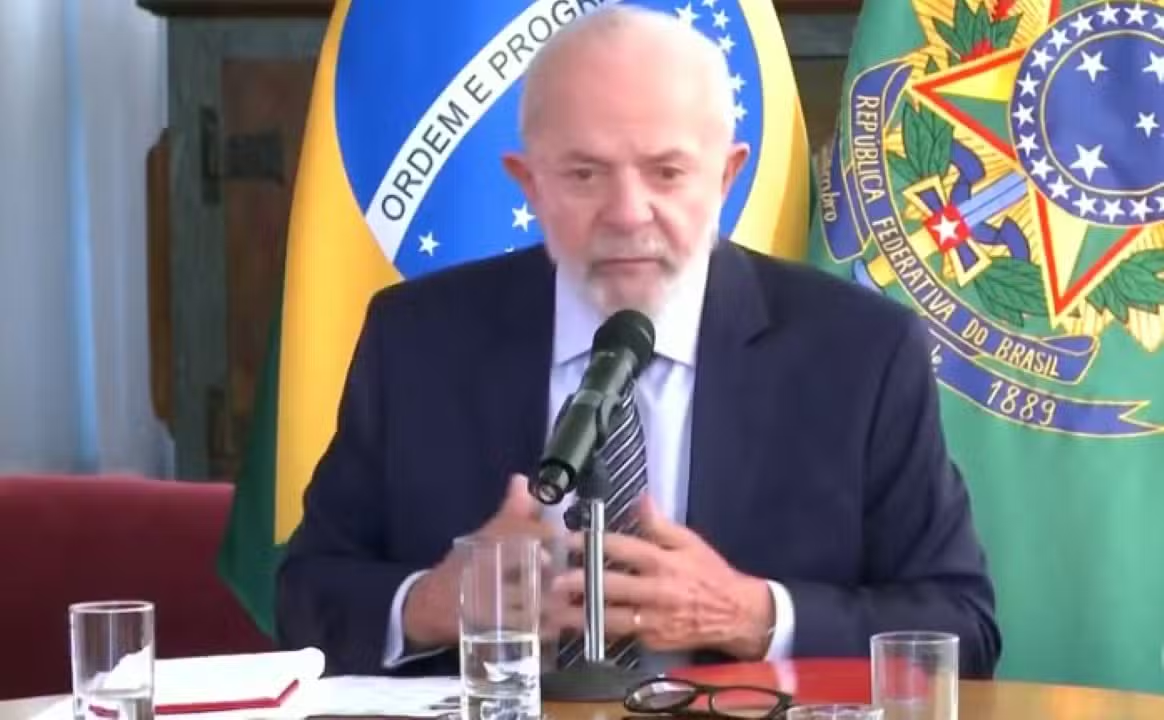
Brazilian President Luiz Inácio Lula da Silva delivered a stark message at the opening of the International Economic Forum of Latin America and the Caribbean in Panama on Wednesday, February 26, 2025, lamenting a profound decline in regional political integration. He emphasized that the collective future of Latin America hinges on its ability to rediscover common ground through dialogue and pragmatism, essential for confronting shared economic, social, and environmental challenges. The president’s address underscored a critical juncture for the region, urging a departure from recent isolationist tendencies towards a more cohesive and self-reliant bloc.
He invoked the historical significance of the 1826 Amphictyonic Congress of Panama, an event that birthed foundational ideals such as peace, peaceful conflict resolution, and equality among states. Despite these visionary concepts, Lula pointed out that they failed to translate into robust, enduring regional institutions capable of fostering genuine unity and collective action across the continent. The aspiration for deep integration, he noted, has often been hampered by internal divisions.
Lula asserted that the current era represents one of the most significant setbacks in integration seen in two centuries, a period marked by political fragmentation and an inability to sustain joint projects. This regression has left the region more vulnerable to external influences and less capable of addressing its intrinsic needs through internal cooperation.
Decrying ideological rifts and external focus
President Lula directly criticized the pervasive political fragmentation within Latin America and the Caribbean, which he argued has crippled the region’s capacity to maintain shared initiatives. He specifically highlighted how persistent ideological disputes have frequently undermined recent integration efforts, diverting the region’s focus away from internal collaboration and towards external interests. This internal discord, he explained, has created an environment where collective progress is often sacrificed for narrower political agendas.
“We permitted conflicts and ideological discussions to impede the coexistence of differing visions,” Lula stated, expressing his concern over the region’s inability to reconcile diverse perspectives. He added, “We have reverted to being a region defined by limits, looking more outward than inward,” a condition that stifles self-determination and coordinated development efforts crucial for collective advancement. This turning inward, paradoxically, has led to a greater reliance on external models that do not necessarily align with regional realities.
Urgent threats and collective failures
In his comprehensive speech, Lula also sounded a strong warning regarding emerging and persistent threats that endanger the region’s stability and progress. Among these, he cited the rise of political extremism, the pervasive manipulation of information, and a striking absence of coordinated responses to critical global crises. These factors, he stressed, exacerbate existing vulnerabilities and impede effective governance across the continent.
The global COVID-19 pandemic served as a potent example of collective failure, illustrating the profound consequences of fragmented responses and a lack of regional solidarity. Beyond health crises, Lula noted that efforts to combat organized crime and mitigate the impacts of global warming continue to be slow, disjointed, and ultimately insufficient, further endangering populations and natural resources across Latin America.



Moreover, the Brazilian leader emphasized that this challenging scenario necessitates a completely new paradigm of regionalism, one that is specifically tailored to the unique realities and aspirations of Latin America. He firmly advocated against the uncritical adoption of external models, stressing that the region must cultivate its own path to development and integration. “We cannot import ready-made solutions that do not reflect our history, our culture, and our needs,” he remarked, underscoring the importance of indigenous solutions and approaches.
Harnessing regional potential for genuine development
Despite the significant challenges, Lula meticulously highlighted the myriad strengths inherent to Latin America and the Caribbean, portraying them as foundational assets for future prosperity. He underscored the region’s immense diversity of energy sources, its robust capacity for food production, unparalleled biodiversity, vast reserves of fresh water, and the abundance of strategic minerals crucial for both the global energy transition and digital transformation. These elements collectively position the region as a vital player on the world stage.
For the president, the fundamental challenge lies in effectively transforming this rich potential into concrete, equitable development that benefits all citizens. He articulated a vision where the region actively adds value to its raw production and strategically generates skilled employment opportunities, moving beyond its traditional role as merely an exporter of primary commodities. This shift, he argued, is essential for fostering sustained economic growth and reducing reliance on volatile global markets.
At the very core of his discourse, Lula unequivocally defined the fight against poverty, hunger, and persistent inequality as the paramount mission for all Latin American governments. “The great war we have to wage is against hunger, poverty, and social exclusion,” he declared, framing these social injustices as the most pressing adversaries. This commitment to social equity, he suggested, must be the driving force behind any meaningful regional integration initiative.
Pragmatism and respect as cornerstones of unity
The Brazilian head of state further underscored that genuine regional integration can only be realized if it is built upon foundational principles of pragmatism, a deep respect for political differences, and an unwavering focus on delivering tangible, concrete results for the populace. He stressed that ideological purity must not overshadow the practical needs of the region’s inhabitants, advocating for solutions that transcend partisan divides.
Lula passionately argued that democratically elected leaders bear the solemn duty of demonstrably improving the living conditions of their respective populations. This responsibility, he highlighted, extends to ensuring that Latin America and the Caribbean continue to thrive as a beacon of peace, uphold democratic values, and consistently engage in constructive cooperation. The region, he concluded, must collectively strive to secure a future marked by stability, shared prosperity, and mutual respect, for the benefit of all its people.
Lula, Latin American integration, political fragmentation, regional cooperation, Panama forum
Veja Tambem em Últimas Notícias

Barcelona negocia com Bernardo Silva após investir R$ 413 milhões na compra de Anthony Gordon

IO Interactive anuncia modo TacSim e garante meses de conteúdo extra para 007 First Light

Zeekr inicia operações na Espanha com quatro veículos elétricos e projeta 600 entregas até 2026

Vazamento de capas confirma design exclusivo do iPhone dobrável da Apple para o mês de setembro

Fabricante BYD anuncia Dolphin G DM-i híbrido com mil quilômetros de alcance para o mercado europeu

Grupo Stellantis desenvolve novos SUVs da Chrysler baseados no Fiat Fastback por US$ 30 mil

Palmeiras vence Junior Barranquilla e Flaco López descobre convocação para a Copa do Mundo ao vivo

Fifa define uso de selos exclusivos nas camisas de jogadores premiados durante a Copa do Mundo

Fim do prazo para declaração do Imposto de Renda 2026 gera alerta sobre multas e bloqueio de CPF

Diretoria do Barcelona contrata Anthony Gordon e prepara oferta milionária por Julián Álvarez

Jovem Kimi Antonelli domina temporada da Fórmula 1 e pai detalha inspiração em Ayrton Senna