

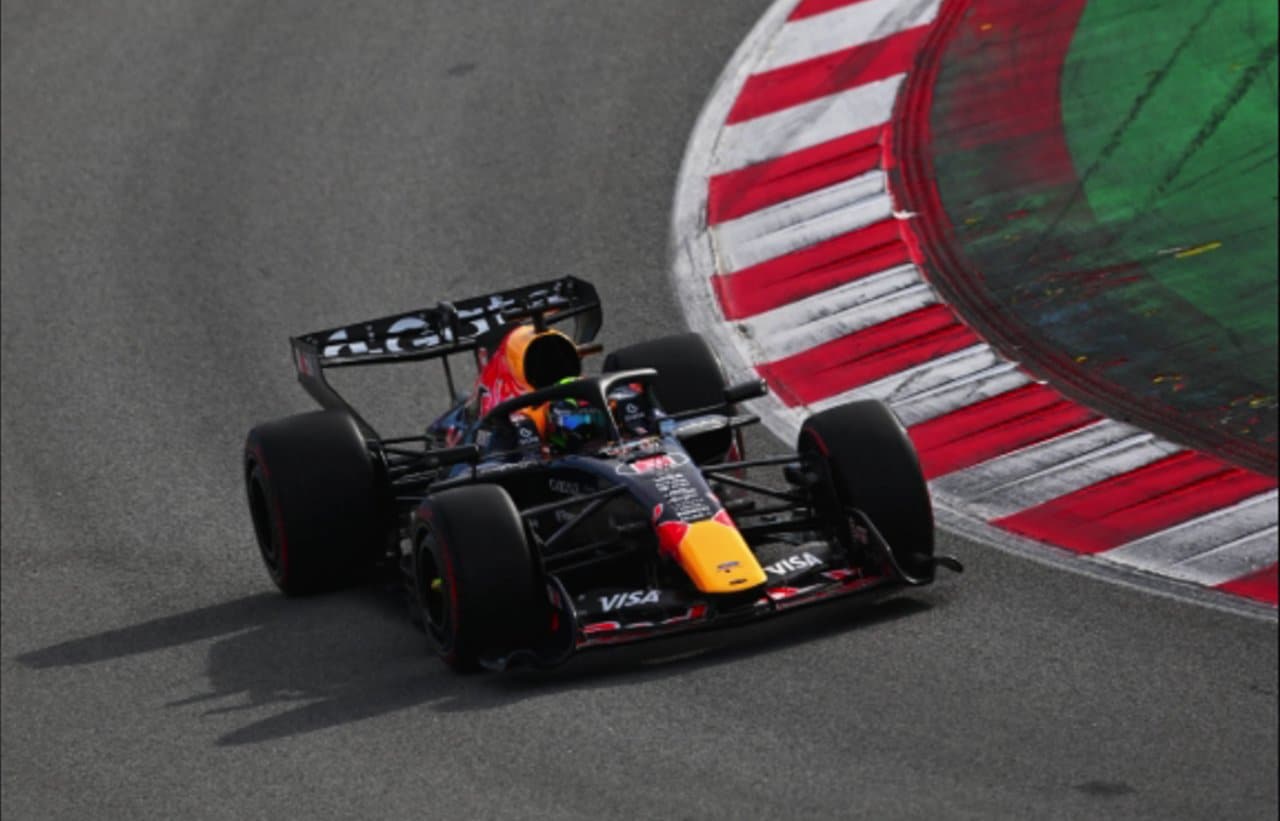
The Circuito of at turn 14.
The crash occurred in the afternoon, interrupting the Austrian team’s testing program. Hadjar, who was completing his 52nd lap, left the cockpit unharmed, as confirmed by the team, but the impact caused significant damage to the rear wing and suspension of the new RB22 model. The incident prematurely ended the driver’s activities, who had stood out with competitive times the previous day.
Amid the unstable weather, only Red Bull and Ferrari chose to face the wet asphalt, seeking to collect crucial data on the behavior of the new cars and wet tires. The other seven teams on the grid, including constructors’ champion McLaren, preferred to remain in the pits, adopting a more conservative stance to avoid unnecessary risks with the new equipment.
🚨 Isack Hadjar has crashed near the end of day 2 of testing.
Driver is OKpic.twitter.com/i8JrERsYix
— RBR Daily (@RBR_Daily)January 27, 2026
Contrasting performance in the Catalan rain
In the morning, before the rain intensified, Max Verstappen took advantage of the dry track to carry out the first checks on the RB22. The four-time world champion set the reference time of the day, with 1min19s578, completing 26 laps focused on systems analysis and collecting basic aerodynamic data. Assim As the precipitation increased, the team chose to collect the car to avoid any type of incident, concentrating the work in the garage until the afternoon session.
Verstappen’s experience in dry conditions provided Red Bull with valuable information for calibrating its simulators on Milton Keynes. The engineering team took the time to analyze airflow and cooling systems, vital aspects under the new technical regulations. Esses initial data is considered fundamental to guide the development of the car throughout the season, even with the setback faced by Hadjar later.
The debut of Lewis Hamilton with Ferrari on Spanish soil
In Ferrari’s garage, Lewis Hamilton had his first official contact with the SF-26 model in wet conditions. The seven-time world champion demonstrated his skill by controlling the car after escaping into the gravel area during his installation lap, avoiding a collision that could compromise the team’s schedule. Focado in long-term tests, Hamilton accumulated 56 laps, contributing data on the durability and mapping of the Italian team’s new hybrid power system.
The Maranello team made the most of the available track time, even with unfavorable weather conditions. The decision to keep its pilots active reflects confidence in the reliability of the SF-26 design. The absence of serious mechanical failures during the sessions allowed Ferrari to collect a significant amount of information, putting it in a position of initial advantage over teams that chose not to run.
Technical impacts of the collision and repairs on the RB22
The collision of Isack Hadjar represents a logistical and technical challenge for Red Bull Racing. Damage to the rear suspension and aerodynamic structure will require thorough analysis by engineers to ensure the integrity of the carbon fiber chassis. A complex repair may be necessary, involving checking the gearbox and mounting points, essential components for the performance and safety of the single-seater.
Depending on the extent of the damage, the team may be forced to use the spare chassis, which would consume valuable testing time. The cost of repairs is also a relevant factor, considering the strict budget cap imposed for the 2026 season. Cada damaged part represents not only a setback in the schedule, but also a financial impact that needs to be carefully managed.
Despite the incident, the French driver maintains prestige within the team. The crash in low-grip conditions is seen as part of the learning curve for a young talent who has been promoted directly to the first team. The philosophy of Red Bull, led by Helmut Marko, has always been to test its pilots under pressure, and what happened will serve as a formative experience for Hadjar.
Team strategies and the absence of Brazilians
The decision by seven of the nine teams not to take to the track this Tuesday highlights a strategic approach based on caution. With a still limited supply of spare parts for the 2026 cars, teams like Mercedes, Alpine, Haas and
Audi, which has the Brazilian driver Gabriel Bortoleto on its team, also chose not to run. The expectation is that the German team and Bortoleto will return to the Spanish route as soon as the weather improves. The absence of a large part of the grid turned the session into an exclusive private test for Red Bull and Ferrari, who took the risk in exchange for more mileage.
McLaren, the current constructors’ title holder, was one of the most notable absences, postponing its first public appearance until Wednesday. The Aston Martin, in turn, awaits the arrival of new aerodynamic components before starting work on Thursday. Já to Williams has confirmed that they will not participate in any activities during this Shakedown in Barcelona.
This diversity of strategies shows how each team manages its resources and priorities in this early and crucial phase of the season. Enquanto some seek to accumulate as many laps as possible, others prefer to optimize garage time and wait for ideal conditions to validate their new technical solutions, making the start of the championship a great unknown.
Particularities of technical regulations and the confidentiality of private tests
Barcelona Shakedown is being held behind closed doors, without the presence of the public or specialized press, a measure to protect the teams’ industrial secrets at a time of major regulatory change. The 2026 season introduces one of the biggest technical revolutions in the history of the Fórmula 1, with new sustainable fuels, reduced chassis dimensions and power units with greater electrical capacity. Nesse scenario, every aerodynamic detail and every engineering solution is kept with the utmost secrecy. The absence of official timing also increases speculation, with rival teams depending on external observers to try to decipher their competitors’ real performance. The organization of the event allows each team to participate in a maximum of three of the five available days, which explains why the grid was not complete on the track, with each team managing its quota strategically to optimize development before the opening of the championship.
The dynamics for the rest of the week
Weather forecasts indicate a significant improvement for the next few days in Barcelona, with the expectation of a dry runway and sunshine from Thursday onwards. Essa change should attract all teams back into action, intensifying the pace of work and allowing race simulations and qualifying tests in more representative conditions.



