

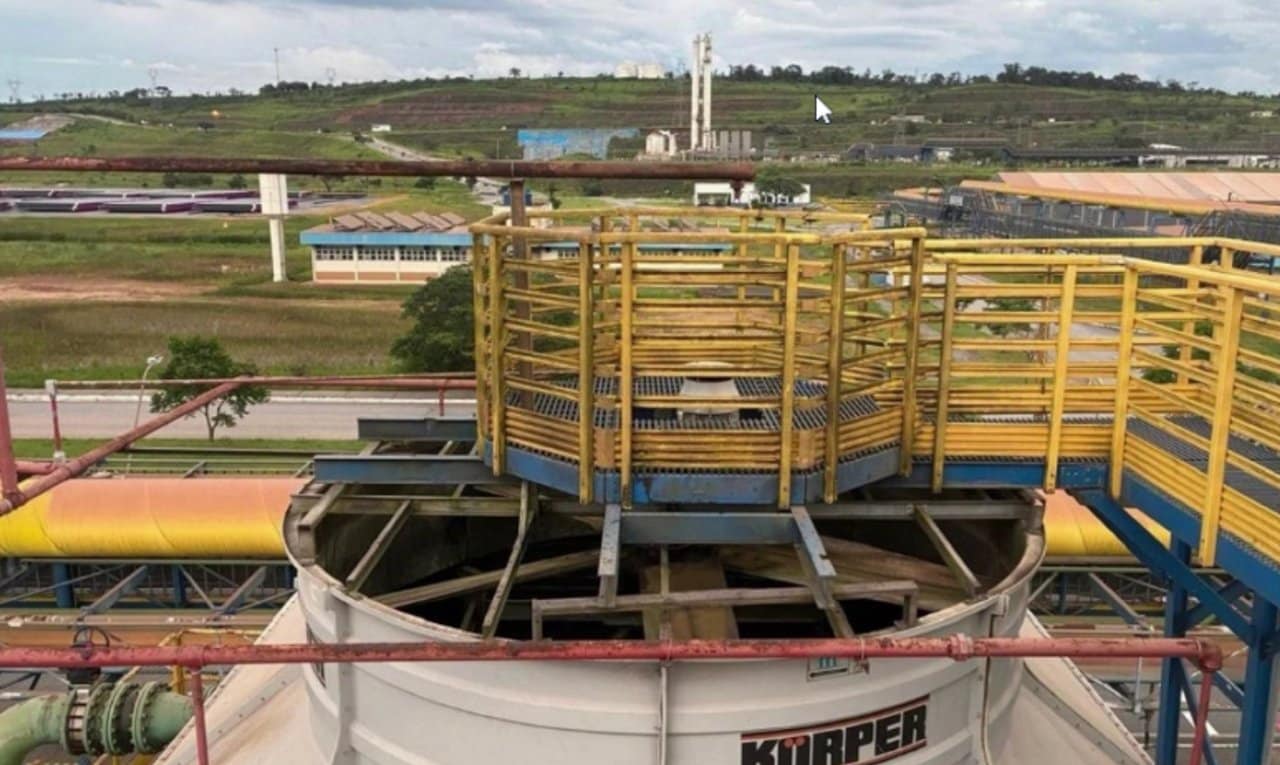
A tragic industrial incident claimed the life of a 40-year-old man this Wednesday, January 28, in a company located on the banks of the MG-155 highway, in the city of Jeceaba, in the Central region of Minas Gerais. The victim, whose identity was not disclosed, was working on installing equipment inside a cooling tower when the machine’s propellers came into operation unexpectedly, without apparent cause, fatally hitting him.
Corpo of Bombeiros Militar (CBMMG) was called and, upon arriving at the scene, found the worker dead. The team acted promptly to recover the body, taking all necessary safety measures given the operational risks and the complex industrial environment. Este regrettable event rekindles important discussions about workplace safety and the maintenance of heavy equipment in industrial plants.
Polícia Civil of Minas Gerais (PCMG) has already begun investigations to determine the exact circumstances that led to the unexpected operation of the propeller and the resulting fatal accident. Peritos technicians were sent to the scene to collect evidence and analyze the details of the incident.
Details of the fatal accident in Jeceaba
The incident occurred while the worker was carrying out a routine installation task, according to reports from company employees. The cooling tower is a large piece of equipment, essential in many industries for temperature control, and its propellers have considerable dimensions and strength, representing a high risk in case of inadequate or accidental operation.
The company, whose name has not been disclosed so far, is collaborating with the authorities to provide all information and documentation relevant to the case. The investigation will seek to determine whether there was a mechanical failure, human error, non-compliance with safety protocols or any other cause that contributed to the sudden activation of the machinery.
Action of rescue teams
Corpo and Bombeiros Militar teams quickly arrived at the scene after the emergency call. The situation required caution and technique, given the characteristics of the manufacturing environment, which often features confined spaces, energized equipment and other risky conditions.
The military prioritized the safety of the area, isolating the accident site to avoid new incidents and guarantee the integrity of other workers and the rescuers themselves. The removal of the body was carried out with specific procedures to preserve the scene for forensic examination, which is essential in elucidating the facts.
Joint work with the medical team present confirmed the victim’s instant death, highlighting the severity of the impact. Coordinated action between firefighters and other agencies was crucial to manage the initial crisis and support the subsequent stages of the incident.
Civil police investigations
Polícia Civil, through its technical expertise, is responsible for collecting all traces and elements that may clarify the causes of the accident. Especialistas in work safety engineering and criminalistics will thoroughly examine the location, the equipment involved and the working conditions.
Documents such as maintenance reports, safety records, training carried out by the victim and other workers, in addition to the company’s operational protocols, will be analyzed. The objective is to reconstruct the sequence of events that culminated in the tragedy, identifying possible failures or negligence.
The investigation may also include analysis of cooling tower safety systems, such as power lockouts (lockout/tagout) and motion sensors, which are supposed to prevent accidental operation during maintenance or installation activities. The results of the investigation will be fundamental in determining legal responsibilities for what happened.
Risks and safety in industrial environments
Accidents like the one that occurred in Jeceaba highlight the dangers inherent in certain work environments and the critical importance of safety measures. Torres cooling systems, with their large propellers and complex mechanical systems, are machines that require rigorous locking and checking procedures before any human intervention.
Attention to occupational health and safety (OSH) is a fundamental pillar for any industrial operation, aiming to protect employees from potential risks. Negligence, whether in preventive maintenance, implementing safety protocols or properly training employees, can have devastating consequences, such as the loss of life.
Regulatory standards and prevention
In the industrial scenario, several Normas Regulamentadoras (NRs) established by Ministério of Trabalho and Emprego govern safety and health. NR-12, for example, deals with work safety in machines and equipment, requiring that they have adequate protection systems to avoid accidents during operation, maintenance and installation. Outras NRs, such as NR-10 (safety in electrical installations and services) and NR-33 (safety and health when working in confined spaces), may be applicable depending on the details of the work environment. Compliance with these standards is a legal requirement and an essential safeguard against tragic incidents. Prevention involves everything from the safe design of machines to constant inspection and a safety culture disseminated among all levels of the team.
Repercussion and responsibilities
The death of the worker in Jeceaba generated consternation in the local community and raised questions about safety in the region’s industries. The victim’s family awaits developments in the investigation to understand what really happened and seek justice.
History of similar incidents
Incidents with industrial machines, although regrettable, are not rare and serve as continuous warnings for the need for constant vigilance. Muitas times, the pressure for productivity can lead to shortcuts in safety procedures, resulting in accidents.
The safety record of companies, as well as strict supervision by competent bodies, are crucial to ensuring that work environments are as safe as possible for all employees. The priority must always be the life and integrity of the worker.



