

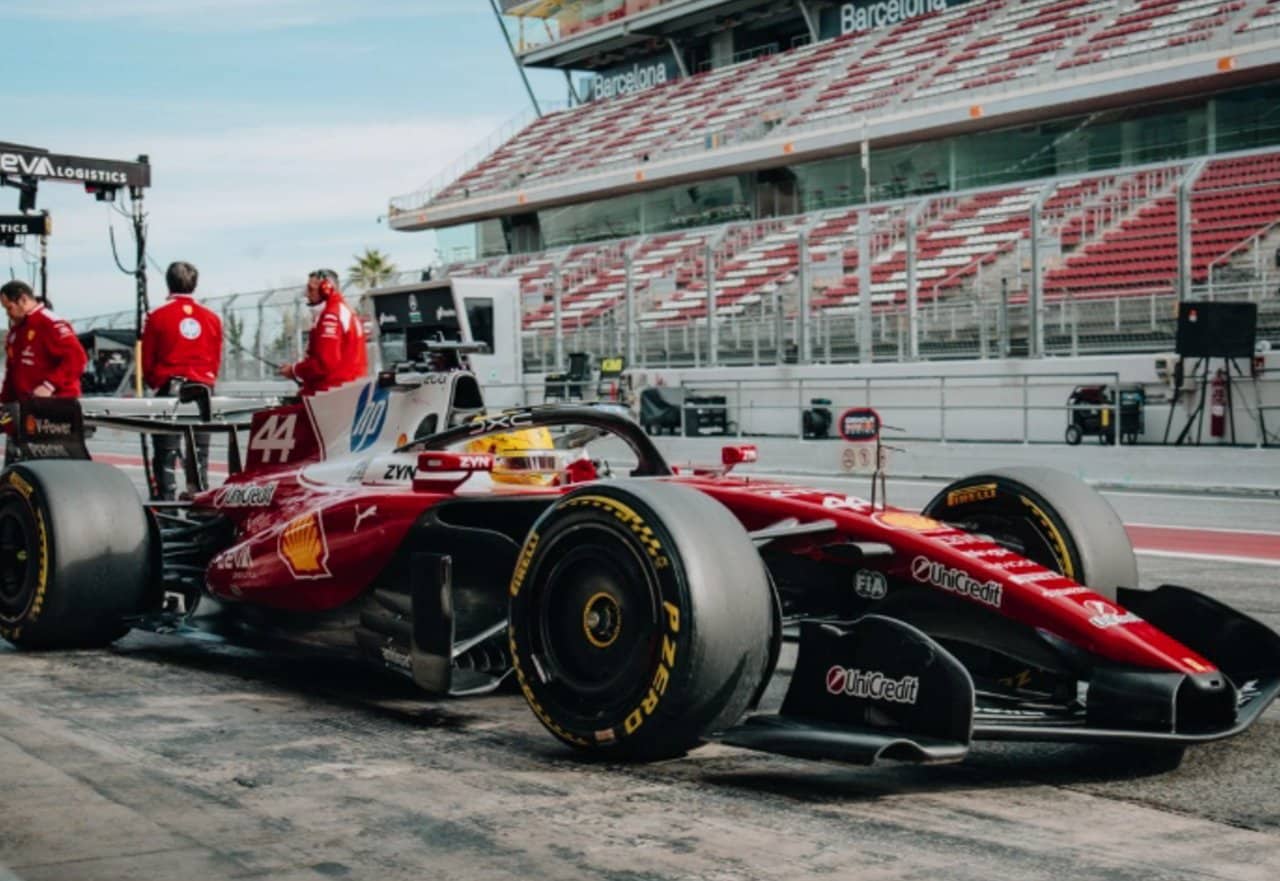
Scuderia Ferrari kicked off its pre-season campaign with a solid performance in Circuito of Barcelona, where the new SF-26 model demonstrated remarkable reliability. Behind the wheel of the car, the seven-time world champion Lewis Hamilton expressed optimism after completing an extensive testing program, signaling a step forward in relation to the difficulties faced by the Italian team in the previous cycle.
The team’s main focus during the first few days at Espanha was accumulating mileage, a crucial objective to validate the durability of the new power unit and chassis components. The ability to keep the car on the track for long periods without significant mechanical interruptions allowed engineers to collect a vast amount of aerodynamic and performance data.
Hamilton, in his second year with the Maranello team, highlighted the importance of building a solid foundation at this early stage. The British driver completed 85 laps in Thursday’s morning session alone, a number that reflects the team’s progress in resolving the reliability issues that limited development at the start of last season.
One week since we launched 👋pic.twitter.com/E04034bAoJ
—Scuderia Ferrari HP (@ScuderiaFerrari)January 30, 2026
Technical evolution and comparison with the previous season
Preliminary data analysis suggests that Ferrari has managed to address some of the key structural deficiencies that have compromised its competitiveness in 2025. Hamilton noted that SF-26 offers a much superior starting point, even with the introduction of an even more complex technical regulation. The integration between the internal combustion engine and hybrid energy recovery systems appears more refined, providing smoother and more predictable power delivery, which was a focus of development during the European winter.
Track engineers confirmed that the car presents a more stable aerodynamic balance, especially in medium and high speed curves, an essential characteristic for success on tracks such as Barcelona. Essa predictability inspires more confidence in pilots to explore the limits of the equipment. The team was able to execute its full schedule, which included electronic systems checks and airflow mapping with different wing configurations, taking advantage of favorable weather conditions.
Driver performance and team mileage
Work on Barcelona was strategically divided between Lewis Hamilton and his teammate, Charles Leclerc. Juntos, the two drivers completed a total of 174 laps throughout the day, surpassing the mileage of direct competitors such as Mercedes and Racing Bulls, which positions Ferrari as one of the most productive teams in this initial phase of preparation.
While Leclerc focused on qualifying simulations on soft tires, recording the third fastest time of the session, Hamilton dedicated himself to longer stints with full tanks of fuel. Essa approach aims to understand car behavior under racing conditions by evaluating the wear of different tire compounds and performance degradation over time.
The collaboration between the two drivers has been fundamental in accelerating the learning process about the new car. Feedback from both is cross-referenced with telemetry data to create a clear development map for the coming weeks, ensuring planned updates are effective and targeted in the right areas.
Adaptation to the new engine and aerodynamic regulations
The new rules imposed by Federação Internacional of Automobilismo represent one of the biggest technical challenges in the recent history of Fórmula 1. Hamilton explained that understanding the interaction between the new wings and the ground effect is an ongoing task that will define the hierarchy of grid forces. The engine has also undergone a significant redesign to adapt to 100% sustainable fuels, requiring a new software map and a riding style that maximizes the efficiency of the power unit’s electrical part. Durante the tests, the drivers experimented with different configurations to find the ideal balance between maximum speed on straights and energy recovery in braking zones, a factor that will be decisive in racing strategies throughout the season.
Programming and logistics for the next phases of pre-season
With the end of activities in Barcelona, the teams at Fórmula 1 are now preparing for the final phase of testing, which will take place at Circuito of Este event will be the last opportunity for the teams to evaluate their update packages in conditions more representative of those they will find in most of the championship.
Ferrari plans to introduce a set of new parts to the Bahrein, developed based on the data and feedback collected at Espanha. Logistics to transport all equipment and personnel to Oriente Médio are already underway, aiming to maximize track time before the season opener.
Expectations for the start of the world championship at Austrália
The optimism shown by Lewis Hamilton after the first kilometers with the SF-26 serves as an indication that Ferrari may be on the right path to becoming a consistent candidate for victories. The British driver believes the team has learned from past strategic and operational mistakes and is better prepared to face a long, hard-fought championship.
The 2026 season will officially begin on March 8th with the Grande Prêmio of Austrália, on the Albert Park circuit, in Melbourne. Até there, work on Maranello will be intense to analyze every detail of the telemetry and refine the car’s setup. Hamilton warned, however, that a good start is not a guarantee of success and that the team needs to maintain focus to not be overtaken by rivals like Red Bull and McLaren, who also showed a promising pace.
Analysis of the impact of the new technical rules on the grid
The new technical regulations were designed with the aim of facilitating battles for position, allowing cars to follow each other more closely without suffering from the loss of aerodynamic pressure caused by turbulence. Hamilton reported that it was already possible to feel an improvement in this aspect when following other cars during some laps in Barcelona, which could result in more exciting races.
The transition to fully renewable fuels also adds a new variable to performance. Ferrari’s partnership with its technology suppliers was crucial in ensuring that the new power unit did not lose efficiency. The teams’ ability to adapt to these changes will be a determining factor in their success in the championship.
Physical and mental preparation of riders for marathon races
For an experienced driver like Lewis Hamilton, preparing for a new season goes beyond working on the track. The Briton followed a rigorous physical training program over the winter to adapt to the greater G-forces generated by the new cars. Work on the Ferrari simulator was also intensified so that it could familiarize itself with the SF-26’s new steering wheel systems and operational procedures.
Stability and harmony within the team are seen as crucial to extracting the team’s maximum potential. With fluid communication between drivers, engineers and mechanics, Ferrari hopes to build a solid foundation to fight for the top podium from the first race of the year, capitalizing on Hamilton’s experience to lead development throughout the extended season.



