

A monumental discovery made by Telescópio Espacial James Webb (JWST) is redefining astronomers’ understanding of the beginning of the universe. A team of researchers at Universidade Texas A&M has identified a compact system of at least five galaxies in the process of merging, an event that occurred just 800 million years after Big Bang. Esta observation provides the most robust evidence to date that complex galactic interactions and the enrichment of space with heavy elements were happening much earlier than cosmological models predicted.
The cluster, dubbed the “JWST Quintet”, is located at a redshift of 6.7, a measurement that indicates its extreme distance and, consequently, its remote age. Analysis of the data revealed not only the imminent collision of the galaxies, but also a vast halo of oxygen-rich gas surrounding the entire system. The presence of “metals” — the astronomical term for elements heavier than hydrogen and helium — outside individual galaxies points to an accelerated process of cosmic evolution, driven by these violent gravitational interactions.
The detection was carried out as part of the Advanced Deep Extragalactic Survey (JADES) program, which uses James Webb’s unprecedented infrared sensitivity to peer into the most remote epochs of the cosmos. Antes From this observation, the scientific consensus was that mergers involving multiple galactic systems would be common phenomena only billions of years later in the history of the universe. The discovery therefore forces a fundamental review of the formation timelines of large cosmic structures.
🚨ATTENTION: Telescópio Espacial James Webb finds two of the most distant galaxies ever seen, when Universo was around 330 million years old and traveled around 13.4 billion light years to reach Scientists say these galaxies are currently more…pic.twitter.com/FBicttpmdc
— KTX (@KTX_Official)November 14, 2023
A cosmic cluster in frenetic activity
The observed system is a true cauldron of cosmic activity. Detailed analysis of JWST images has identified more than 17 distinct galaxy-sized clusters within an extremely compact region of space, with separations of just tens of thousands of light-years between the main components. The total stellar mass of the system is already estimated at 10 billion times the mass of our Sol, a surprising value for such a young structure.
What impresses scientists most is the rate of star formation. The Quinteto galaxies are producing new stars at a combined rate of approximately 250 solar masses per year. To put Para into perspective, our galaxy, Via Láctea, forms on average just one or two solar masses annually. Essa Intense activity positions the system far above the main star formation sequence for galaxies at this time, indicating that the merger is funneling enormous amounts of gas into the central regions, fueling a burst of star birth.
The mystery of early metal enrichment
One of the most significant aspects of the study is the detection of an extensive halo of ionized gas, rich in oxygen, that extends throughout the system, connecting the colliding galaxies. Elementos heavy objects like oxygen are forged in the cores of massive stars and are released into space through supernova explosions. Encontrar these metals distributed on such a vast scale and so early in cosmic history was something unexpected.
The prevailing theory suggests that the enrichment of the intergalactic medium is a slow process, driven mainly by galactic winds that expel material from isolated galaxies. However, in JWST’s Quinteto, evidence points to a different, much more efficient mechanism: gravitational interactions during the merger are literally ripping gas and stars out of galaxies, scattering their metallic contents into the surrounding space. Esta is direct observational proof that collisions are a fundamental driver for the chemical “pollution” of the early universe.
Reviewing models of evolution of the cosmos
The existence of JWST’s Quinteto directly challenges the predictions of cosmological simulations about the rate of assembly of the most massive galaxies. Current models indicated that the formation of such complex and densely populated structures should take billions of years longer to occur. The discovery suggests that the process of hierarchical growth, where smaller structures merge to form larger ones, can happen much more quickly and explosively in certain regions of the early universe.
This observation also helps solve another astronomical puzzle: the existence of massive, “dead” (quiescent) galaxies, which had already ceased their star formation, observed at later times, about 1 to 2 billion years after Big Bang. Sistemas like JWST’s Quinteto may be the direct precursors of these galaxies. Intense fusion quickly consumes the entire reservoir of gas available to form stars, leading to fuel exhaustion and consequent inactivity of the resulting galaxy. Quinteto therefore represents a snapshot of a crucial transitional phase in the life of the most massive galaxies.
The researchers, led by Weida Hu and Casey Papovich of Texas A&M, emphasize the need to update theoretical models to incorporate the role of multiple mergers as an accelerating mechanism for galactic evolution. The research, published in the prestigious journal Nature Astronomy, opens a new chapter in the study of the formation of cosmic structures. The work included the collaboration of an international team and used data from the GOODS-South field, one of the regions of the sky most studied in astronomy.
The unique capability of the James Webb telescope
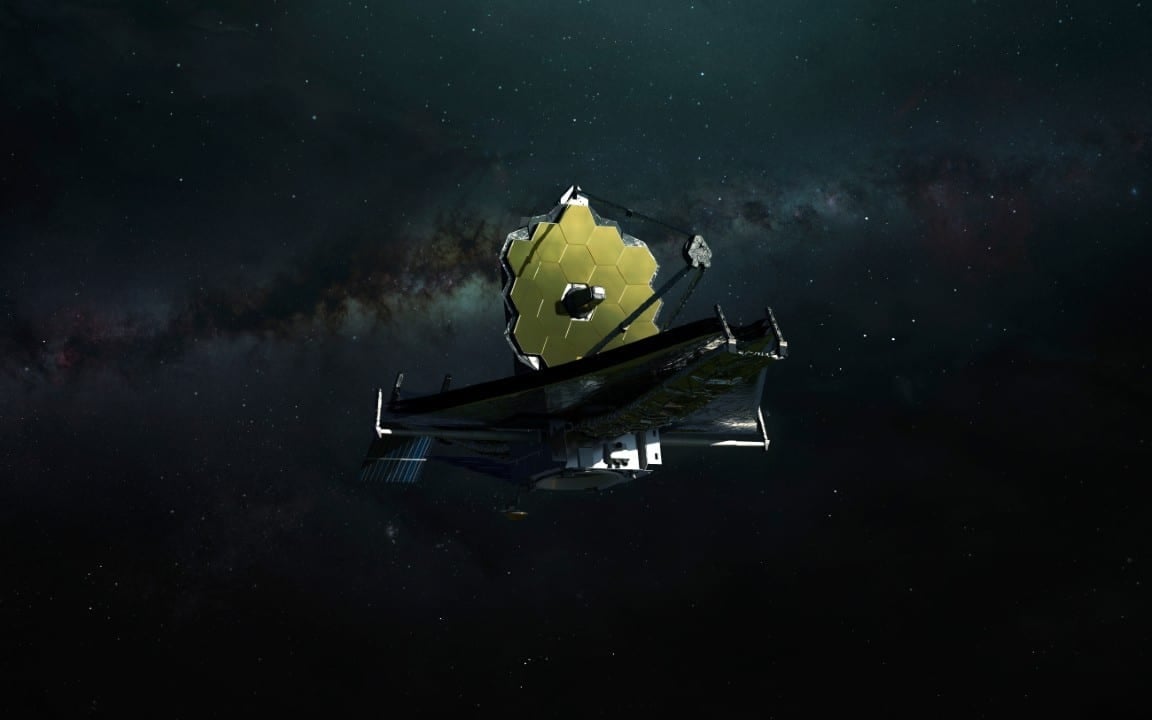
This discovery was only possible thanks to the technological capabilities of Telescópio Espacial James Webb. Operando 1.5 million kilometers from Terra, its 6.5-meter mirror is optimized to capture infrared light. Essa radiation, invisible to the human eye, can penetrate the dense clouds of cosmic dust that obscured the view of previous telescopes, such as the Hubble, which operate mainly in visible and ultraviolet light. The ability to see in infrared allows JWST to observe the most distant objects in the universe, whose light has been stretched to longer wavelengths due to cosmic expansion. Sem this infrared vision, the structure and chemical composition of Quinteto would remain hidden, and understanding of how quickly the early universe evolved would remain incomplete.
Next steps in the investigation
The research team is already planning new observations of JWST’s Quinteto. The objective is to use the telescope’s spectrographs to map in detail the movement of gas and stars within the system. Essas velocity measurements, or kinematics, will allow scientists to build a three-dimensional dynamic model of the merger, shedding light on the exact mechanisms that are driving star formation and metal distribution. Esses data will be crucial to refining computer simulations and deepening understanding of how the universe’s first large galaxies formed and evolved so quickly.
Technical details of the observation
The images released by the research team use pseudo-colors to highlight the different components of the system. The five main galaxies, identified as ELG1 to ELG5, are clearly visible, along with the diffuse nebulosity of the gas halo that surrounds them. The extreme compactness of the system is a key factor, as the proximity between galaxies intensifies gravitational tidal forces, accelerating the fusion process and the exchange of material between them, a fundamental phenomenon for the rapid development of the structure.
The direct connection to inactive galaxies
Systems that undergo such an intense and rapid merger phase, such as Quinteto, are prime candidates for becoming the massive, quiescent galaxies found at later times. By consuming all of its gas in a single, massive burst of star formation, the resulting galaxy runs out of fuel to continue generating new stars. Ela then becomes a “red and dead” structure, composed mainly of older stars. Esta discovery provides a crucial observational link between the active and passive phases of galactic evolution, resolving an apparent discrepancy between theoretical predictions and recent observations of inactive galaxies in the young universe.



