

Nissan officially announced the arrival of the new generation of the Kicks to the national market, in a strategic move to reinforce its presence in the competitive compact SUV segment. The model, produced in the Complexo Industrial of
With this renewal, the Japanese manufacturer seeks to regain consumer attention and expand its market share, which has become fierce in recent years with the arrival of new competitors and the updating of already consolidated models. The strategy is clear: to offer a complete package that combines style, technology and the brand’s already known mechanical reliability.
National production will not only meet domestic demand. The new Kicks manufactured in Brasil will be exported to more than 20 countries in América Latina, consolidating the importance of the Resende plant as a production and export hub for Nissan in the region. The expectation is that the updated design and onboard technology will make the Brazilian SUV more competitive in international markets, expanding its global reach.
Renewed design and new dimensions
The main transformation of the new Nissan Kicks is in its design. The front has been completely redesigned, adopting thinner and more tapered full LED headlights, which are integrated into a wider and more imposing front grille, in line with the brand’s new visual identity. The bumper was also modified, giving the vehicle a more modern and robust appearance, with new air intakes and details that reinforce its sporty character.
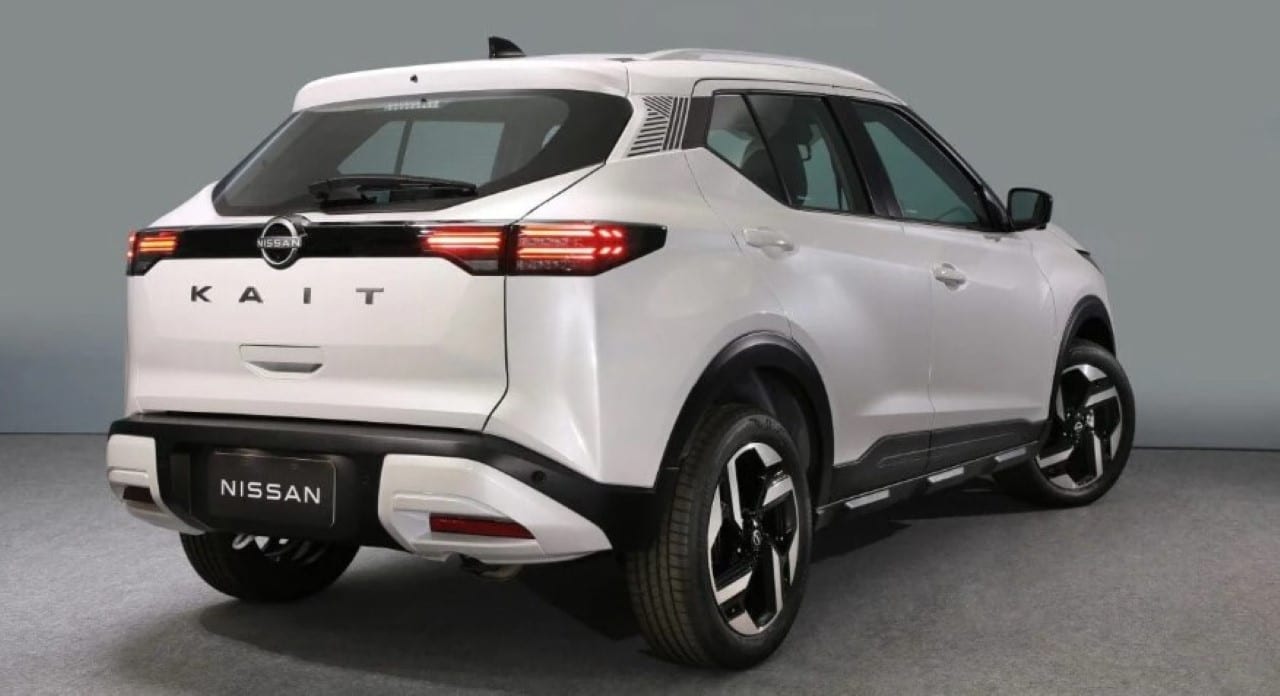
At the rear, the change is equally notable with the adoption of LED taillights with a three-dimensional effect, interconnected by a glossy black stripe that runs across the entire trunk lid. In terms of dimensions, the Kicks maintains competitive measurements for the category, measuring 4.30 m long, 1.76 m wide, 1.59 m high and with a wheelbase of 2.62 m, ensuring good internal space for occupants. The trunk remains one of the highlights, with a capacity of 432 liters, surpassing some of its main rivals.
Interior with more technology and comfort
The SUV’s cabin also underwent a profound modernization, with a focus on technology and improving the perception of material quality. The dashboard has been redesigned and now has a soft-touch finish on the top, raising the standard of cabin sophistication and providing a more pleasant experience for driver and passengers.
The big technological highlight is the new floating multimedia center, which can reach 9 inches in the most expensive versions. The system offers wireless connectivity for Apple CarPlay and Android Auto, a growing consumer demand and an important differentiator in the segment, eliminating the need for cables.
In addition to multimedia, the top versions have a 7-inch partially digital instrument panel, which displays information from the on-board computer in a clear and customizable way. The steering wheel is also new, with a flat base and a more ergonomic grip, housing the autopilot and audio system controls.
Engine and performance data
Under the hood, the Nissan kept the well-known 1.6 aspirated four-cylinder engine, which underwent updates to meet new emissions standards. Quando fueled with ethanol, the propellant delivers 113 horsepower at 5,600 rpm and a torque of 15.3 kgfm at 4,000 rpm. With gasoline, the numbers are 110 hp and 15.2 kgfm, respectively.
The mechanical set always works in partnership with the CVT automatic transmission, which simulates six gears, prioritizing comfort and fuel economy in everyday use. Acceleration from 0 to 100 km/h is achieved in around 12 seconds, an adequate number for the vehicle’s urban proposal, but which does not stand out for its sporting performance compared to rivals with turbo engines.
Regarding consumption, official data from Inmetro indicate ethanol averages of 7.8 km/l in the city and 9.4 km/l on the highway. With gasoline, values rise to 11.3 km/l in the urban cycle and 13.7 km/l on the highway, positioning it as one of the most economical compact SUVs in its category.
This energy efficiency, combined with the robustness of an aspirated engine, represents a potentially lower long-term maintenance cost, a significant selling point for many consumers looking for a reliable and economical family vehicle for everyday use.
Versions and equipment list
The new Kicks arrives on the market in different versions to suit different price ranges, starting with the entry-level configuration Active, going through the intermediate ones Sense and Desde the most basic version, the SUV is already well equipped, offering essential safety items such as six airbags (front, side and curtain), stability and traction controls, and hill start assistant, ensuring the protection of all occupants.
Intermediate versions add items such as 17-inch alloy wheels, an 8-inch multimedia center, a rear camera and parking sensors. The Advance version stands out for its 7-inch digital panel and the face-to-face key with push-button start, adding more convenience and technology. The most complete configuration, Exclusive, incorporates the Nissan Safety Shield package. Este system includes semi-autonomous driving technologies, such as forward collision warning with braking assistant, rear cross traffic alert, blind spot monitoring and the 360° vision system with moving object detection. The Completam package includes digital air conditioning, seats with synthetic covering and a premium sound system from the Bose brand, with speakers integrated into the driver’s headrest, providing an immersive sound experience unique in the segment.
Suspension adjustments for the Brazilian market
One of the strengths of the Nissan Kicks has always been ride comfort, and the new generation seeks to further improve this feature. The brand’s engineering team made specific adjustments to the suspension for the Brazilian market, calibrating springs and shock absorbers to better deal with the irregularities of the national asphalt. The aim was to find an even more refined balance between comfort for passengers and stability in curves and at higher speeds. The result of this calibration is a vehicle that absorbs well the impacts of potholes and ditches, transmitting little vibration to the cabin, which makes driving in urban centers much more pleasant. At the same time, body roll in curves was contained, giving the driver a feeling of safety and predictability, even in an SUV with a higher center of gravity.
Positioning against direct competitors
The new Nissan Kicks enters one of the most disputed segments of the Brasil. With the renewal, it positions itself to compete more aggressively with sales leaders. Sua strategy is based on offering an attractive design, a good equipment package from the entry-level versions and the recognized mechanical reliability of the Japanese brand.
Compared to competitors such as the VW T-Cross and Chevrolet Tracker, which rely on turbo engines for superior performance, the Kicks focuses on lower maintenance costs for the naturally aspirated engine and fuel economy. Contra o Hyundai Creta, it competes directly in design and technology, while offering comfort and a spacious trunk as differentiators in relation to the Jeep Renegade.
Market and export strategy
With competitive prices, Nissan seeks to position the new Kicks as one of the best cost-benefit options in the category. The brand aims to attract both consumers looking for their first SUV and those looking for a well-equipped and safe family vehicle, reinforcing its image of innovation and quality.
Strengthening production in Resende for export is also a fundamental pillar of the strategy, demonstrating Nissan’s confidence in the Brazilian operation’s ability to deliver a high quality product to demanding markets throughout América Latina.



