

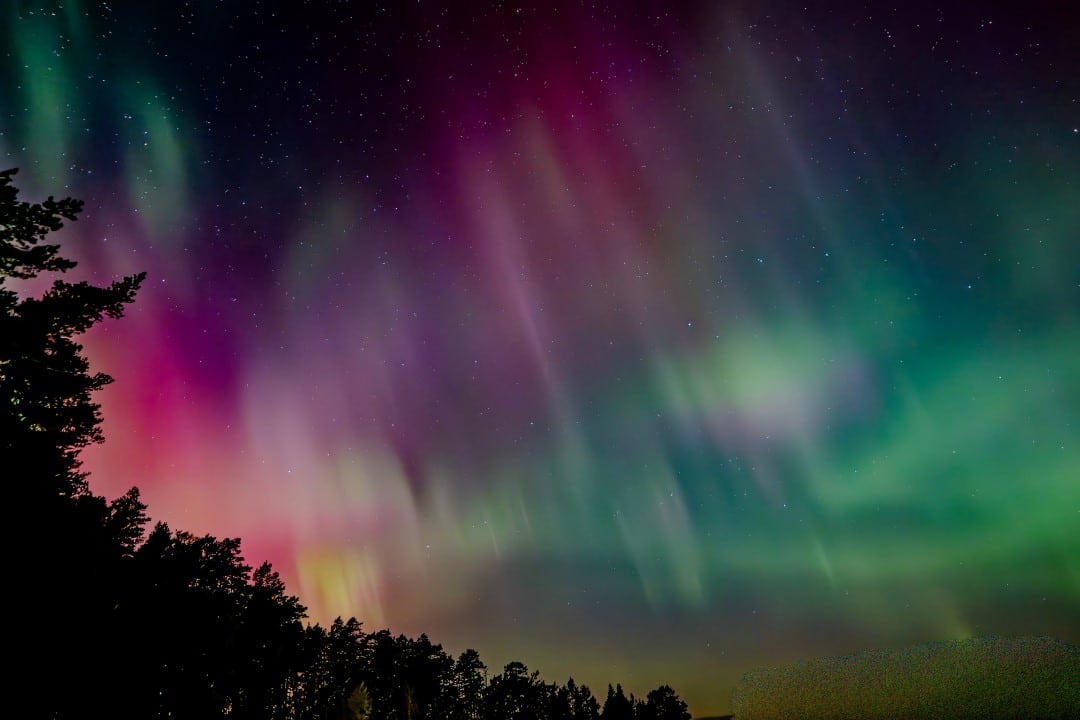
Japanese astronaut Kimiya Yui of Agência of Exploração Aeroespacial of
These images were shared shortly before the anticipated return of the Crew-11 crew, who left the ISS on January 15 due to a medical issue for one of the members. The evacuation marked the first time in the station’s 25-year history that a mission was terminated for health reasons.
The ISS was temporarily left with just three astronauts after the departure of Crew-11, made up of Yui, the Americans Zena Cardman and Mike Fincke, and the Russian Oleg Platonov. NASA chose to accelerate the launch of Crew-12 to reinforce the orbital team.
Capturing the aurora from Earth orbit
Kimiya Yui described the experience as a special gift before her return to Terra. Ele recorded the phenomenon during an orbital passage that allowed a clear view of the polar lights. Auroras occur when solar particles interact with Earth’s atmosphere, creating intense light displays.
The timelapse video highlights the curvature of the planet and the contrast between the natural and artificial lights of the cities below. Yui mentioned that the capture made him happy, especially when imagining the public’s reaction when they saw the images. Esse type of record is common among astronauts, but gains relevance due to the timing close to the end of the mission.
Astronaut shares incredible view of the Northern Lights seen from Estação Espacial Internacionalpic.twitter.com/ESuGRdMaxL
—Astronomiaum (@astronomiaum)January 15, 2026
Unprecedented medical evacuation of Crew-11
NASA announced the evacuation of Crew-11 on January 8, 2026, after identifying a health condition in one of the crew that required immediate return. The agency has not released details about the affected astronaut or the exact nature of the problem, prioritizing medical privacy.
SpaceX’s Dragon capsule undocked from the ISS and splashdown occurred safely off the coast of Califórnia on January 15. Todos the four members disembarked in good general condition, despite the shortening of the planned mission to six months.
This decision left the station with a reduced team of three astronauts: the American Christopher Williams and the Russians Sergey Kud-Sverchkov and Sergei Mikayev, arrived via Soyuz MS-28 in November 2025. Eles maintained essential operations, including maintenance and scientific experiments.
The temporary reduction in personnel did not compromise the safety of the ISS, but it limited some research activities. NASA monitored the situation closely to ensure continuity of orbital operations.
Preparations for the launch of Crew-12
Crew-12 was brought forward to restore the ISS to full crew as soon as possible. The launch is scheduled for no earlier than February 11, 2026, starting at Cape Canaveral Space Force Station, at Flórida.
The mission uses the Falcon 9 rocket and the Dragon capsule from SpaceX, with takeoff scheduled for 6 am local time. The exact date depends on the progress of the Artemis 2 mission, which carries out simultaneous tests and shares logistical resources.
The four Crew-12 astronauts undergo final quarantine and intensive training. Eles will perform scientific experiments, routine maintenance and spacewalks during their six months on the station.
- Jessica Meir (NASA): Comandante of the mission, marine biologist on her second trip to the ISS.
- Jack Hathaway (NASA): Piloto, selected in 2021, on his first space flight.
- Sophie Adenot (ESA): Especialista of mission, French engineer on orbital debut.
- Andrey Fedyaev (Roscosmos): Especialista of mission, Russian cosmonaut on his second stay on the ISS.
Operational context of Estação Espacial Internacional
The ISS has operated continuously since 2000, with regular international crew rotations. Missões like Crew-12 are part of NASA’s Programa Comercial and Tripulação, which has private vehicles for transportation.
The station hosts experiments in microgravity, biology and technology, contributing to preparations for future missions to Lua and Marte. Collaboration between NASA, Roscosmos, JAXA and ESA remains essential, even during periods of operational adjustments.
Phenomena such as auroras are frequently observed from orbit 400 km high. Eles provides valuable data on solar interactions and atmospheric protection from Terra.
Importance of orbital observations of auroras
Northern lights seen from the ISS provide a unique perspective on geomagnetic activity. Images of Yui highlight color variations caused by different excited atmospheric gases.
Records like this help scientists monitor solar storms that could affect communications and electrical grids on Terra. The ISS orbit allows for captures of multiple daily polar passes.
These moments also reinforce the human aspect of long space missions. Astronautas frequently shares visuals to connect audiences with orbital exploration.
Transition between missions on the current ISS
The arrival of Crew-12 will mark the beginning of Expedição 75, with a brief overlap for knowledge transfer. The expanded team will resume a full research and maintenance schedule.
NASA prioritizes the Artemis 2 mission in coordination with commercial launches. Recent Testes ensure release window compatibility.
Operations on the ISS remain stable with the current reduced crew. Atividades include systems monitoring and preparation for docking the next capsule.
The capture of the aurora by Yui remains a remarkable record of the transition period. The images circulate widely, illustrating the beauty of Terra seen from space.
Prospects for space operations in 2026
The year 2026 begins with adjustments to the ISS routine, but maintains a focus on continuous science. Commercial Missões such as Crew-12 demonstrate the maturity of NASA’s program.
International collaborations support human presence in low orbit. Eventos such as medical evacuations, although rare, are managed with established protocols.
Observations of natural phenomena from the ISS enrich global knowledge. Elas complement data from satellites dedicated to solar monitoring.



