

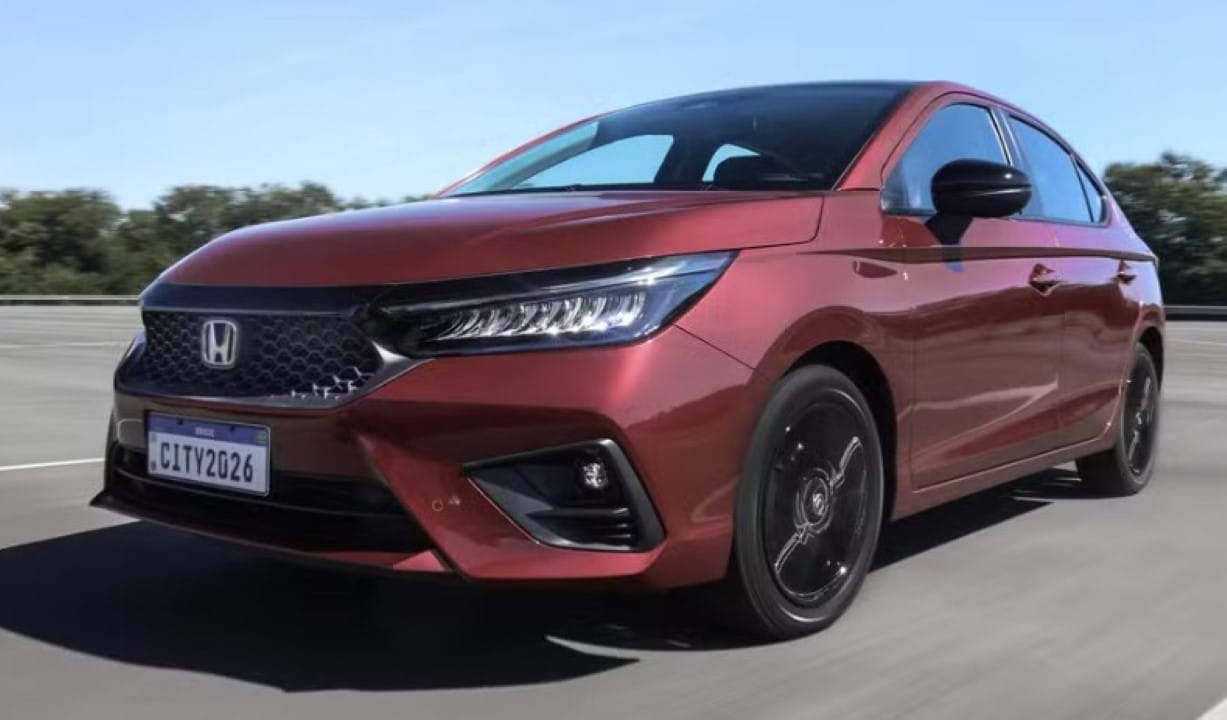
Honda officially announced the arrival of the new version Sport for the City Hatchback line, positioning the model as the most complete and expensive option in the family on the national market. Priced at R$154,800, the configuration features a look with darkened details and a robust package of technology and safety equipment to justify its value, which puts it on a direct collision course with entry-level compact SUVs.
Despite the “Sport” nomenclature, the mechanical set remains unchanged in relation to the other versions. The model is equipped with a 1.5 naturally aspirated direct injection engine, which delivers 126 horsepower, managed by a CVT automatic transmission. The automaker’s proposal focuses on refining the onboard experience and offering a differentiated visual appeal, without making changes to the vehicle’s performance.
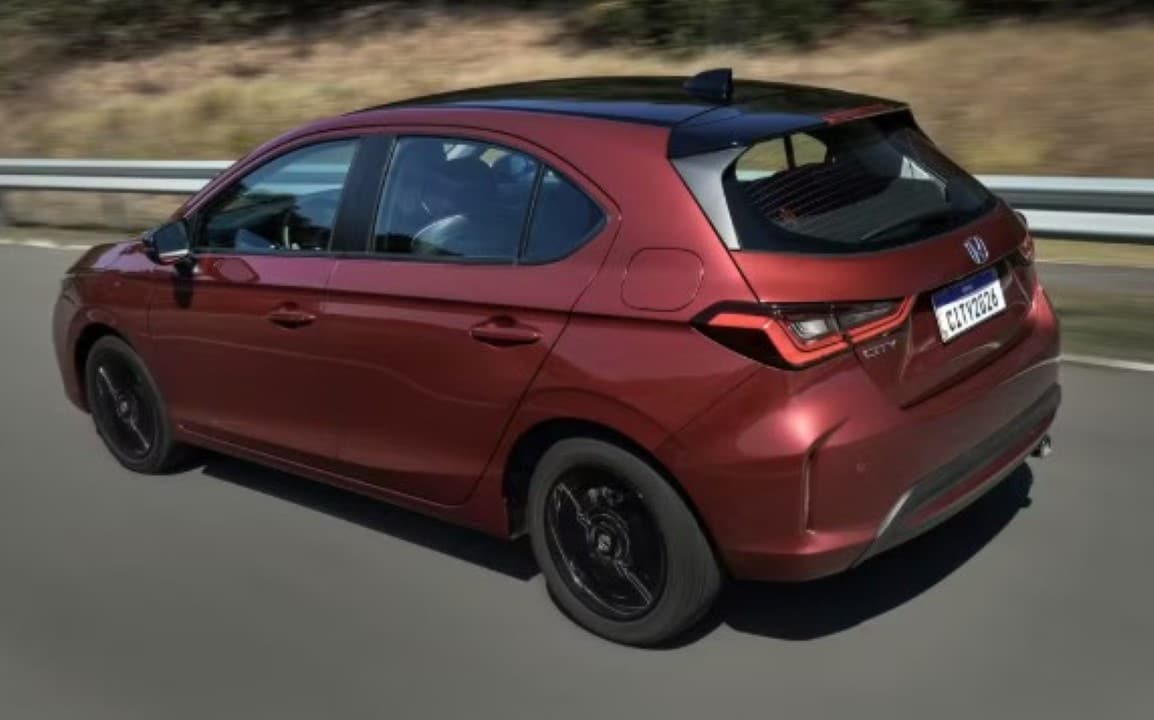
The new variant arrives to compete in a fierce segment, vying for the preference of consumers who also consider models such as Volkswagen Polo Highline and Hyundai HB20 Platinum Plus. However, its price positioning makes it an alternative to sports utility vehicles, raising the debate about the cost-benefit between a fully equipped premium hatch and an entry-level SUV.
Visual details and the sporting proposal
The differentiation of the Sport version focuses on aesthetic details. The model incorporates a glossy black finish on several parts of the body, such as the roof, exterior mirror covers, front grille and 16-inch alloy wheels. Esses elements contrast with the vehicle’s main color and give it a more aggressive and modern appearance, in line with the name’s proposal.
Internally, the finish also receives special attention, with linings that mix high-quality materials and contrasting stitching to reinforce the sporty atmosphere. Contudo, Honda chose not to make mechanical changes. The suspension, steering and braking system are the same as the Touring version, prioritizing comfort and drivability for everyday use instead of a more rigid calibration focused on dynamic performance.
Technology and security as main arguments
One of the greatest strengths of the Honda City Sport is the inclusion of the complete suite of driver assistance technologies, known as the Honda Sensing. The Este system is an important differentiator in the compact hatchback segment and serves as one of the main selling points to justify the higher price of the version.
The active safety suite includes advanced features such as adaptive cruise control (ACC), which adjusts speed and distance from the vehicle in front, and a collision mitigation braking system (CMBS), which can automatically apply the brakes to avoid or reduce the impact of a frontal accident.
Completing the package are the lane keeping assistant (LKAS), which makes subtle corrections to the steering wheel to keep the car centered, and the lane avoidance mitigation system (RDM), which acts more incisively if the vehicle leaves the road. Automatic high beam switching (AHB) is also part of the system, adjusting the lighting so as not to dazzle other drivers.
Analysis of the mechanical assembly and efficiency
Under the hood, the Honda City Sport maintains the 1.5 DI DOHC i-VTEC Flex engine, an aspirated unit with direct fuel injection that already powers the rest of the line. Ele develops up to 126 horsepower and 15.8 kgfm of torque when fueled with ethanol. The transmission is a CVT automatic, which simulates seven gears and offers a smooth drive, focused on comfort and energy efficiency. The absence of a turbo engine, present in many direct competitors, can frustrate drivers looking for a more vigorous throttle response, especially when speeding up and overtaking. However, the strong point of this set is its low fuel consumption. According to data from the Inmetro, the City Hatchback records averages of 13.2 km/l in the city and 15 km/l on the highway with gasoline, figures that place it among the most economical models in its category and represent a significant benefit for daily use, reducing long-term operating costs.
Internal space and versatility on board
The Honda City Sport stands out for its generous internal dimensions, surpassing most of its direct competitors in the compact hatchback segment. With a wheelbase of 2.60 meters, the vehicle offers excellent legroom for passengers traveling in the back seat, allowing adults to sit comfortably even on longer journeys.
Versatility is increased by the exclusive Magic Seat seat modularity system, an inheritance from other models of the brand. Essa technology allows different configurations for the rear seats, which can be folded down to create a flat surface or elevated to transport tall objects on the car floor, such as plants or small bicycles.
Although the 268-liter trunk is one of the smallest in its category, the flexibility offered by the Magic Seat compensates for this limitation in many practical situations, making the car adaptable to different cargo transport needs.
The cabin’s finish uses good quality materials in the areas of greatest contact, and the ergonomics are well resolved, with all controls easily accessible to the driver. The driving position is comfortable and the well-calibrated suspension competently filters irregularities in the ground, ensuring a smooth ride for all occupants.
Convenience items in the top-of-the-line version
As the most equipped version, the City Sport features a complete list of comfort and convenience items. Entre The highlights are the electronic parking brake with Auto Hold function, which adds practicality in urban traffic, and the induction cell phone charger, eliminating the need for cables. The model also has digital air conditioning, push-button start with a face-to-face key, full-LED headlights and electrically folding rear-view mirrors, reinforcing its premium proposition.
Price positioning in the market
With a value of R$154,800, the Honda City Sport falls into a complex price range. The amount places it not only as one of the most expensive compact hatchbacks in the Brasil, but also positions it as a direct competitor to entry-level and intermediate versions of compact SUVs, such as the Chevrolet Tracker, Hyundai Creta and Jeep Renegade, vehicles that attract consumers due to their greater ground clearance and perceived robustness.
The Honda strategy is clear: to captivate the customer who values a complete package of technology and safety and a refined finish, but who does not insist on the body shape of a sports utility vehicle. The purchasing decision will depend on the priorities of each consumer, who will need to consider whether the hatch’s attributes justify the investment over an SUV in the same price range.
Points of attention in daily use
Despite its qualities, Honda City Sport presents some points that require attention. One of them is the low height in relation to the ground, with just 14.4 cm of clearance. Essa characteristic, common in hatchbacks, can result in the front bumper scraping in ditches, higher speed bumps and steep garage ramps, requiring extra care from the driver on Brazilian roads.
Another point is the multimedia center. Embora has an 8-inch screen and wireless connectivity for Apple CarPlay and Android Auto, its graphical interface and resolution already seem a little dated compared to more modern 10-inch systems present in competitors. The image quality of the reversing camera, especially in low-light environments, is also below expectations for a vehicle in this price range.



