

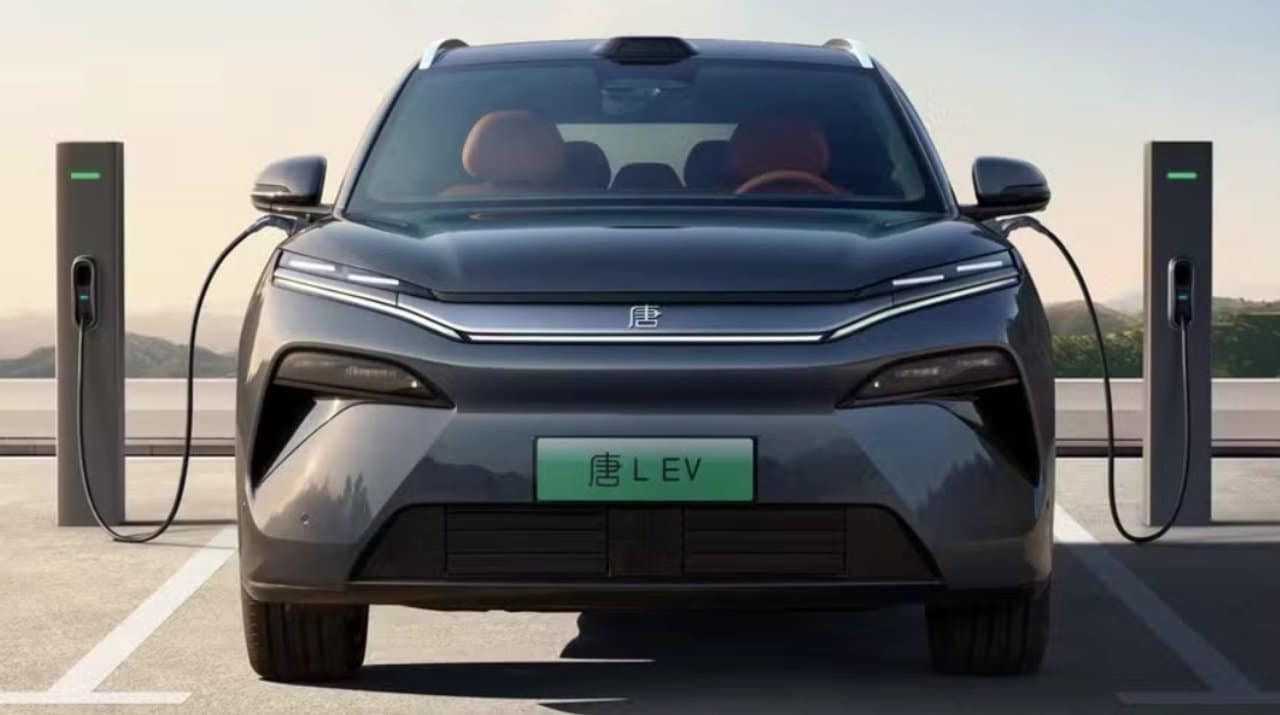
BYD revealed the second generation of its ultra-fast charging system, increasing power to an unprecedented 1360 kW. The new technology, known as Flash Charging, is designed to add approximately 400 kilometers of range to compatible electric vehicles in just five minutes of connection, a milestone that brings the charging experience closer to that of fueling combustion cars.
The development represents a significant step forward in the race to eliminate range anxiety, one of the main obstacles to the mass adoption of electric vehicles. Documentos leaked internals at China confirm that the system was optimized to deliver this performance in real use conditions, surpassing the results previously obtained in controlled tests.

The compatibility of the new charger is guaranteed by the brand’s own Super e-Platform architecture, which operates at a high voltage of 1000 volts. The Essa platform already equips the manufacturer’s high-performance models, such as the Han sedan and the Tang SUV, preparing the ground for the dissemination of technology across its product line.
The evolution of technology
The first generation of the Flash Charging system, launched in 2025, was already impressive with a power of 1000 kW, allowing similar autonomy gains, but with maximum performance often restricted to test environments. Upgrading to 1360 kW not only increases peak power, but also improves system efficiency and practicality. The new version supports recharge rates greater than 10C, a measure that indicates the speed at which the battery can be charged in relation to its total capacity, being one of the highest values in the industry.
In addition to the increase in power, the hardware has been improved. The cables now have a more advanced liquid cooling system, which has reduced their weight to approximately 2 kg, making it easier for users to handle. Intelligent energy management at stations has also received improvements, with the storage capacity of each unit doubled. Isso allows more than 20 vehicles to be loaded in sequence without significant losses in efficiency, optimizing flow in high demand locations and reducing queues.
Technical specifications of the new equipment
The charger’s design was designed to optimize space, adopting a “T” shape that occupies just 1.5 square meters of area, facilitating its installation in dense urban centers, where space is a valuable resource. Sua internal structure houses state-of-the-art liquid cooling systems, essential for keeping component temperatures stable during operation at extreme power. Esse Strict thermal control not only ensures process safety, but also extends the service life of equipment and vehicle battery. The technical specifications place the device as a global reference, including a maximum power of 1360 kW, support for voltages of up to 1000 volts and the ability to perform more than 20 consecutive recharges with maximum performance. The combination of these factors sets a new standard for public charging infrastructure.
Vehicles compatible with the Super e-Platform
The Super e-Platform is the technological basis that allows full use of the power of the new charger. Essa high voltage architecture is being introduced into series production with the updated versions of the Han and Tang models.
The Han EV, for example, is equipped with a 580 kW engine in an exclusive configuration, capable of taking the sedan to a top speed of over 300 km/h and accelerating from 0 to 100 km/h in just 2.7 seconds.
Following similar performance parameters, the Tang EV combines high power with the internal space of a family SUV, while maintaining high energy efficiency. The expectation is that other models in the BYD line will receive progressive adaptations to become compatible with the platform, which also allows the integration of Blade batteries with chemistry optimized for ultra-fast recharges.
A comparison with competing solutions
To contextualize the advance, the Supercharger chargers from Tesla, one of the most widespread networks globally, currently operate with maximum powers approaching 400 kW. Isso makes BYD’s solution nearly three times more powerful at peak performance.
Other Chinese manufacturers are also developing fast charging technologies, but few have reached the megawatt level in a commercially viable way. BYD consolidates its leadership by integrating the development of station hardware with its own batteries, creating a cohesive and optimized ecosystem.
This competitive advantage translates into a direct practical benefit for the driver, which is the drastic reduction in stopping time on long journeys. The practicality becomes comparable to that of traditional vehicles, eliminating one of the main psychological barriers to migrating to electric mobility.
The advanced cooling system also plays a crucial role in preserving battery health by minimizing cellular degradation. Testes The manufacturer’s internal data indicates that the energy storage capacity is maintained even after multiple intensive and ultra-fast recharge cycles.
Expansion plans and infrastructure at China
BYD plans to install more than four thousand of these new chargers throughout China. The implementation plan prioritizes regions with high population density and the country’s main highways, creating a robust network to support its growing fleet of vehicles.
This charging network will expand access to ultra-fast points in major cities, ensuring that owners of compatible models have broad coverage in the short term. The investment reflects the brand’s accelerated growth in its domestic market, with infrastructure following the increase in sales of its electric vehicles. Parcerias strategies with local energy operators facilitate implementation, integrating new stations into existing networks and accelerating the activation schedule.
Presence and prospects for the Brazilian market
At Brasil, BYD has already announced the installation of approximately 800 fast charging points to strengthen the support infrastructure for its locally sold models, such as the Dolphin and Yuan Plus. The company is still evaluating the adoption of this more powerful version, with 1360 kW, in the national territory, a decision that will depend on market developments and demand for even faster recharges. The expansion of the dealership network and partnerships with energy distributors position the brand as a protagonist in the energy transition of the Brazilian automotive sector.



