

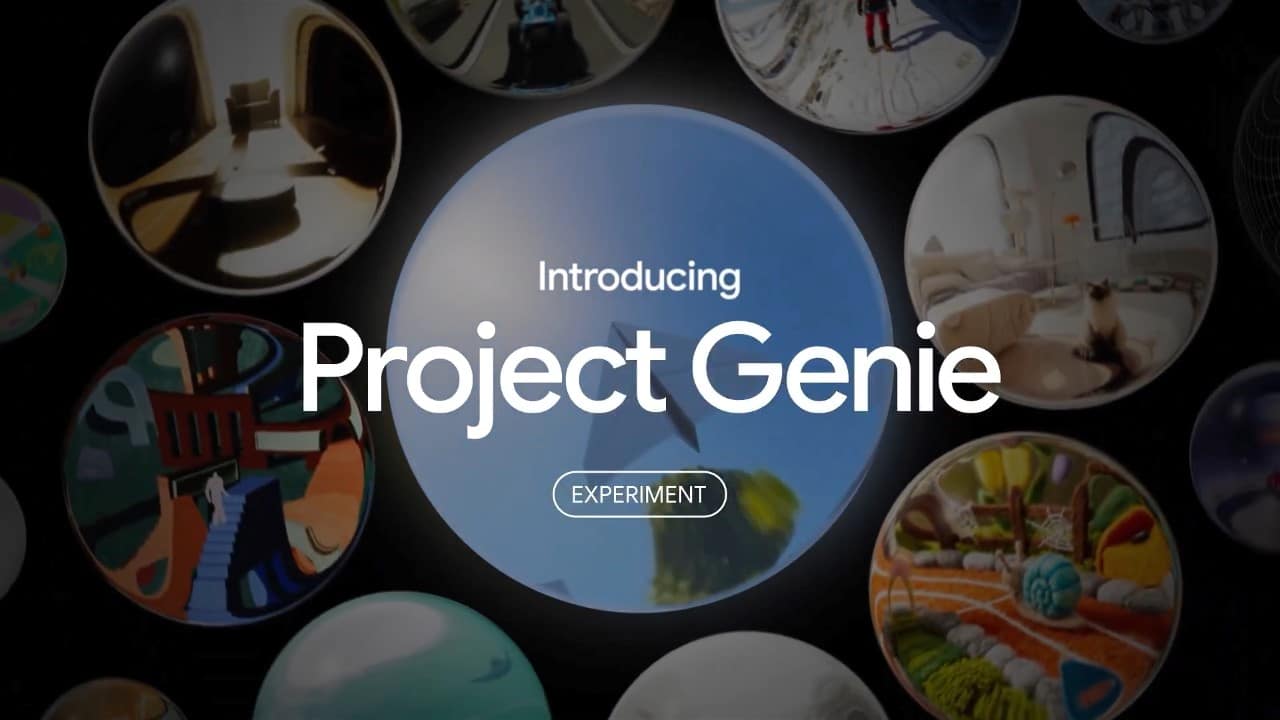
Google DeepMind has begun the gradual release of its newest artificial intelligence tool, Project Genie. The innovative platform allows users to generate and explore fully interactive virtual worlds using simple text commands or sending an image. The official launch took place on January 29, 2026, marking a significant step in the evolution of so-called “world models”.
Initially, access to the research prototype is restricted to a selected audience. Apenas subscribers to the Google AI Ultra plan, residents of Estados Unidos and at least 18 years old, will be able to try the technology in this first phase. The company signaled that expansion to other regions and subscription plans will occur progressively as the platform is improved based on feedback from early users.
Step inside Project Genie: our experimental research prototype that lets you create, edit, and explore virtual worlds. 🌎pic.twitter.com/HQr1FRNlpy
— Google DeepMind (@GoogleDeepMind)January 29, 2026
The tool stands out for its ability to render environments in real time, allowing fluid and dynamic exploration. Creations can be shared within the community, enabling other users to modify and remix existing worlds, fostering a creative and collaborative ecosystem.
How virtual world generation works
The creation process in Project Genie is designed to be intuitive, even for users with no experience in game development or 3D modeling. Tudo begins with a prompt, which can be a detailed textual description of the imagined scenario or a reference image that serves as visual inspiration. The user can specify crucial elements such as the camera perspective, whether in first or third person, and the character’s type of locomotion, such as running, flying or swimming. Once the command is entered, the Genie 3 model, which serves as the brain of the operation, interprets the data and begins rendering the environment. The result is a virtual world with 720p resolution and a rate of 24 frames per second, a balance that prioritizes real-time interactivity over maximum graphical fidelity. Exploration is done through familiar keyboard controls, like the WASD keys for movement and arrow keys for camera control, providing a simple video game-like experience.
The technology behind the Genie 3 model
Genie 3 is classified as a “general world model,” an area of research that Google DeepMind has explored for more than a decade. Diferente than traditional game engines, which operate based on physics rules and interactions pre-programmed by developers, Genie 3 learns these dynamics autonomously. Ele was trained on vast amounts of internet video data, learning to predict how an environment reacts to user actions and what subsequent frames of a scene should look like.
Essa approach, known as autoregressive training, allows the model to maintain temporal and spatial consistency for a limited period of time, typically a few minutes. Isso means that, when moving through a scenario, the model “remembers” what was behind the character and generates coherent transitions, creating a feeling of immersion and continuity. This ability to simulate a nearly infinite variety of worlds and physics represents a notable advancement over previous models, which were more restricted in scope and application, paving the way for training AI agents in limitless virtual scenarios.
Features and interaction modes
The platform offers three main modes of interaction to facilitate users’ creativity. The first is generation from scratch, where the user describes in detail the world they want to see, adjusting the character’s appearance, the environment and the basic rules of movement.
The second mode is interactive exploration. Após the initial generation, the user can freely navigate the scenario while the AI model continuously predicts and renders new elements based on the actions taken, creating an experience that unfolds in real time.
Finally, the “remix” functionality allows users to take creations shared by others and apply new prompts to them. Isso enables the transformation of a medieval castle into a futuristic space station, for example, encouraging collaboration and constant evolution of the generated worlds.
Current limitations of the trial version
As an early-stage prototype, the Project Genie has some important technical constraints that users should be aware of. The most notable limitation is the length of generation sessions, which are currently limited to a maximum of 60 continuous seconds.
In addition to time, the consistency of the virtual world may present flaws in longer or more complex interactions. At times, environments may not strictly follow the laws of physics or the exact details provided in the prompt, resulting in inconsistent or unrealistic visual elements.
The latency in controlling the characters is also a point of attention. Response to commands may vary depending on the complexity of the scene being rendered, and not all movements are executed with immediate precision, which can impact the fluidity of exploration.
It is important to note that the tool does not have traditional game mechanics, such as inventory systems, missions or complex interactions with objects. Essas limitations are expected for an experimental stage technology and should be the focus of improvements in future updates.
First creations and community feedback
The first users with access to the tool have already started sharing their creations, demonstrating the versatility of Project Genie. Alguns were inspired by famous games, generating scenarios that resemble open-world forests or classic platform games, testing the limits of the model’s ability to recreate.
Others explored completely original themes, such as castles made of marshmallows, cosmic landscapes with floating planets, and reconstructions of ancient cities. The model’s flexibility to interpret varied prompts has been one of its most praised points, allowing for a wide range of creative experiments.
Requirements for access to the prototype
To be part of the initial group of Project Genie testers, it is necessary to meet specific criteria established by Google. The main requirement is to be a subscriber to the Google AI Ultra plan, the most advanced and expensive level of the company’s artificial intelligence services. Adicionalmente, access is geographically limited to Estados Unidos, and users must confirm that they are 18 years or older to use the platform. The company informed that the rollout will be gradual, even for those who meet all the prerequisites.
User customization and creative control
Project Genie offers a considerable degree of customization for increased creative control. In the initial “sketching” phase, it is possible to define parameters such as lighting, weather conditions and even dynamic events that should occur in the virtual world.
Uploading reference images acts as a visual shortcut, giving the model a concrete basis to expand and interpret. Durante exploration, it is possible to refine the environment with new prompts, adjusting elements in real time without the need to restart the entire generation process.



