


Scientists have revealed the first continuous, two-dimensional map of the magnetic boundary of Sol, a critical region known as the surface of Alfvén. The feat was made possible thanks to data collected over several years by NASA’s Parker Solar Probe probe, which performed unprecedented dives into the solar atmosphere, known as the corona.
This surface represents a fundamental limit: it is the point where the flow of particles emitted by the star, the solar wind, reaches a speed that exceeds the capacity of the solar magnetic field to contain it. From there, the material irreversibly escapes into interplanetary space, traveling throughout the solar system.
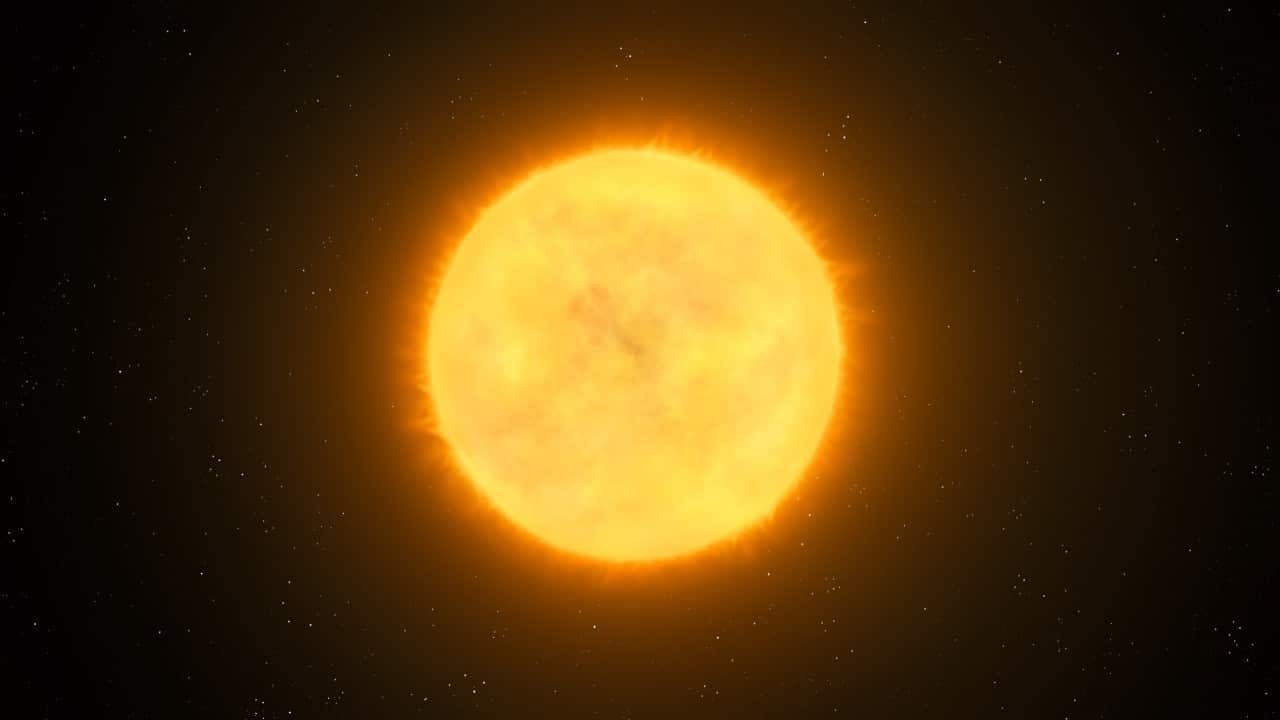
The unprecedented mapping not only confirms the existence and location of this boundary, but also demonstrates that its shape and altitude vary drastically according to the 11-year cycle of solar activity. Understanding these dynamics is essential to unraveling mysteries about the heating of the corona and the acceleration of the solar wind.
Parker Solar Probe’s journey
Launched in 2018, Parker Solar Probe is one of the most audacious missions in the history of space exploration. Seu’s main objective is to orbit the Sol closer than any other human artifact, traversing the solar atmosphere to perform direct measurements. Para survive extreme temperatures, which can reach almost 1,400 degrees Celsius, the probe is equipped with a state-of-the-art carbon-composite heat shield. Sua elliptical trajectory allows it to make quick passes through the corona, collecting valuable data before moving away to cool.
The key instrument for this mapping was SWEAP (Solar Wind Electrons Alphas and Protons), designed to measure the properties of the particles that make up the solar wind. By repeatedly crossing the surface of Alfvén, Parker was able to record changes in the characteristics of the plasma, validating estimates made from remote observations and providing a detailed view of the region where the solar wind is born.
The transformations of solar cycle 25
The probe’s observations covered the ascension phase of the current solar cycle, number 25, which began in 2019 and is approaching its peak of activity. The data revealed that the average surface height of Alfvén increased by approximately 30% during this period.
During solar minimum, when the star’s activity is low, the magnetic boundary appears smoother and closer to the visible surface of Sol. Nesse scenario, Parker needed to get much closer to be able to cross it.
As Sol becomes more active, with increasing sunspots and flares, the surface of Alfvén expands into space and takes on a much more complex and irregular structure, full of bulges and spikes.
A map built with multiple perspectives
Building such a comprehensive map was not the work of a single mission. The researchers employed a sophisticated technique that combined different data sources to create a complete portrait.
Direct measurements of Parker Solar Probe, carried out within the corona, served as the main source of validation, confirming the exact location of the boundary at specific points in its orbit.
This data was integrated with remote observations from the Solar Orbiter mission, a collaboration between ESA and NASA, which studies Sol from an intermediate distance and a different perspective.
In addition, data from spacecraft positioned at the point of Lagrange L1, a stable location between Terra and Sol, were used, which continuously monitor the characteristics of the solar wind that reaches our planet.
The pointed shape of the solar corona
The map confirmed that the solar boundary is far from a uniform sphere. Sua appearance has been described as “prickly” or “wrinkled”, especially during periods of increased solar activity. Essas irregularities are the visual manifestation of complex physical processes occurring in the crown.
The bulges and valleys on the surface of Alfvén are directly linked to the magnetic field structure emerging from the surface of Sol. Acredita It is believed that these pointed shapes are places where magnetic energy is released more intensely, contributing to the acceleration of solar wind particles to speeds that can exceed one million kilometers per hour.
Relevance to space weather
The ability to map and predict the behavior of the surface of Alfvén has direct and practical implications for life on Terra. The solar wind and solar storms, which are more violent coronal mass ejections, constitute what is called “space weather”. Essas bursts of energetic particles can damage satellites, interfere with radio communications and GPS navigation systems, and even overload electrical grids on the ground. Modelos more accurate information about the origin and propagation of the solar wind, fed by these new maps, will allow more accurate predictions about the arrival of severe space weather events, giving time for protective measures to be taken.
Solar boundary details
The concept of the surface of Alfvén was first theorized by physicist Hannes Alfvén, winner of Prêmio Nobel. Ele postulated that there should be a limit in a star’s atmosphere where the energy of the magnetic field equals the kinetic energy of the expanding plasma. Dentro from this boundary, the plasma is magnetically connected to the star, being forced to rotate with it. Fora from it, the plasma breaks free and flows radially into space. The observational confirmation and detailed mapping of this region represent a milestone for heliophysics, solving a decades-old puzzle and opening new fronts of research into the fundamental physics of stars. The complexity revealed in the map, with its dynamic and irregular structure, challenges simpler models and requires new theories to explain energy transfer in the solar corona.
Next steps for exploration
Parker Solar Probe’s mission is far from over. The probe will continue to make passes increasingly close to Sol in the coming years, reaching its maximum approach soon.
Future data will allow us to refine the current two-dimensional map, adding more details and eventually expanding it to a three-dimensional model that includes the polar regions of Sol, which are still little explored.



