

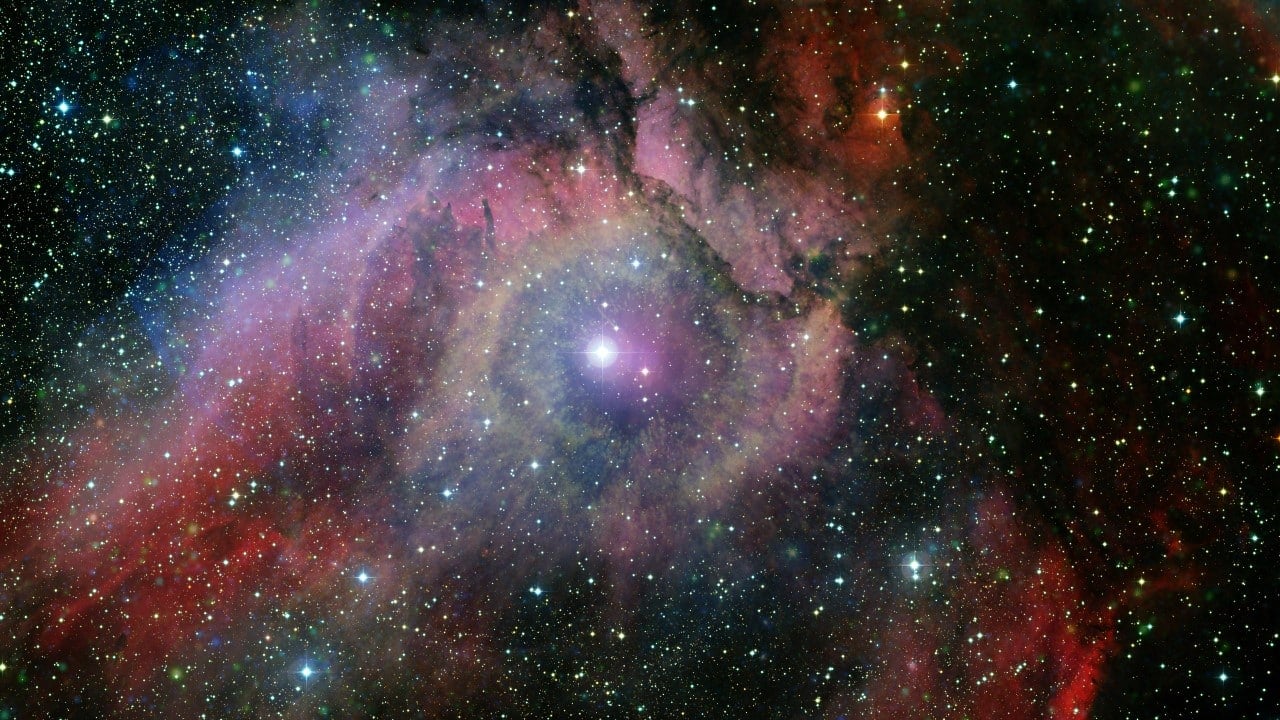
Astronomers at Western Sydney University, in Austrália, have identified a new galactic supernova remnant designated G305.4-2.2 during analysis of data from the Australian Square Kilometre Array Pathfinder telescope (ASKAP). The object, nicknamed Teleios – the Greek word meaning “perfect” – has an almost perfectly circular shape, with 95.4% symmetry, something rare among known supernova remnants. Localizado below the galactic plane, at distances estimated between 2.2 and 7.7 kiloparsecs (approximately 7,170 to 25,100 light years), the diameter varies from 14 to 48 parsecs depending on the estimate adopted. Essa discovery occurred serendipitously as part of the Evolutionary Map of the Universe (EMU) project, which maps the sky in radio waves. The circular morphology highlights Teleios as one of the most symmetrical remnants of Via Láctea, with low surface brightness and spectral index of -0.6, typical of specific evolutionary phases. Observações indicate expansion in a rarefied medium, which preserves the initial symmetry of the stellar explosion. Não there is confirmed detection in X-rays or bands other than radio, which adds layers of complexity to the classification. Additional Pesquisas are needed to determine the expansion speed and confirm the exact type of progenitor supernova.
The structure of Teleios reveals a thin shell with more intense emission at the southeastern edge, suggesting limited interaction with the local interstellar medium. Dados of neutral hydrogen (HI) show a cavity around the object, with a density of less than 0.01 particles per cubic centimeter, favoring the maintenance of the spherical shape.
Characteristics observed in Teleios
The remnant has an angular size of approximately 21.5 arcminutes, with low polarization and high Faraday rotation in the center. Essas properties indicate influence of environmental magnetic fields that contribute to low radio brightness.
- Angular Size: 1320″ x 1260″;
- Spectral index: -0.6 ± 0.3;
- Surface brightness: One of the lowest among galactic remnants;
- Circularity: 95.4%, with thin shell and shiny ring.
Images from ASKAP at 943.5 MHz highlight the symmetry, while observations at lower frequencies confirm the typical non-thermal spectrum of particle acceleration in shock waves.
The absence of pronounced polarization in the shell reinforces the hypothesis of expansion in a homogeneous environment. Sinais faints in Hα and gamma suggest phases of early or advanced interaction with circumstellar material.
IC 443/S249 (from g. to d.) – Nébuleuse de la méduse (à ne pas confondre avec Ab.21 située aussi dans les Gémeaux).
— ⭐ HORIZON Astronomie 🪐 (@alexastro2a)February 9, 2024
Famous supernova remnant.
Difficile de donner une distance, car ses structures peuvent être liées à S249. Estimée between 2.16e+13 km and 6.171e+13 km.pic.twitter.com/nos1fqt2KG
Hypotheses about the origin of the object
The exceptional symmetry of Teleios points to an Ia-type supernova explosion as the most likely scenario. In this case, a white dwarf in a binary system accumulates material until it explodes, generating more uniform expansion.
Other possibilities include supernovae of type Iax, with partial explosions that leave compact remnants. However, distances less than 1 kpc create inconsistencies with the observed size.
The expansion in a rarefied HI cavity explains the preservation of the spherical shape throughout the Sedov phase. Modelos indicate that low densities in the interstellar medium allow initial asymmetries to dissipate.
Comparisons with other remnants
Teleios shares characteristics with remnants such as SN1987A and SNR J0624–6948, which also exhibit circular shapes in low-density environments. Esses objects are located outside the main galactic plane, where interactions with dense clouds are minimized.
Unlike common irregular remnants, such as Nebulosa of Caranguejo, Teleios maintains symmetry due to the homogeneity of the medium. Estudos of Sigma-D ratio position it between average diameters of 30 to 150 pc.
Detection technical details
Observations with ASKAP reveal low integrated flux and high Faraday rotation at the center, which reduces polarization visibility. Imagens combined with MWA data confirm the steep spectrum.
The absence of X-ray emission, despite predictions for phase Sedov, suggests the need for more sensitive telescopes. Sinais in range of Fermi-LAT and H.E.S.S. indicate acceleration of cosmic particles.
Factors that explain the rarity of the form
Most supernova remnants have oval or irregular shapes due to variations in the interstellar medium. Teleios expands in an isotropic region, preserving the initial sphere of the shock wave.
Massive progenitors in binary systems can create previous cavities via stellar winds. Essa pre-cleaning facilitates uniform expansion in all directions.
Implications for galactic studies
The discovery of Teleios enriches the catalog of symmetric remnants and helps in understanding explosions of the type Ia in Via Láctea. Objetos thus serve as laboratories for models of stellar evolution.
Future observations in multiple bands will clarify exact age and distance. The case highlights the importance of radio surveys to identify hidden structures.
Additional observations made
Neutral hydrogen data shows associated cavity between velocities of -34.7 and -20.5 km/s. Esses profiles position Teleios at consistent kinematic distances.
Optical images in Hα reveal weak emission at the edge, compatible with early-phase reverse shock. Esses evidence reinforces the young or late Sedov stage.
Challenges in Accurate Classification
No scenario explains all observations without inconsistencies, such as no predicted X-rays. Modelos evolutionists suggest progenitor masses between 28 and 72 solar masses.
High-resolution surveys will determine definitive dynamic parameters. Teleios remains an enigma that demands further investigation.
Advances of the EMU project in mapping
The Evolutionary Map of the Universe uses ASKAP to cover the southern sky with unprecedented radio sensitivity. Serendipitous Descobertas like Teleios demonstrate the potential for new remnants.
The survey identifies low-brightness objects that previous telescopes did not detect. Esses findings expand knowledge about the distribution of supernovae in the galaxy.
Environment around Teleios
The HI cavity indicates extremely low density, less than 0.1 cm⁻³. Essa rarefaction allows pressure-driven expansion without significant distortions.
Ambient magnetic fields influence the observed rotation of Faraday. Essa setting contributes to reduced radio brightness.
Future research perspectives
Telescopes like eROSITA and future X-ray surveys can detect predicted emission. Medidas of expansion speed will confirm the evolutionary phase.
Multi-messenger studies will integrate radio, optical and gamma data. Essas approaches will clarify the definitive origin of Teleios.



