

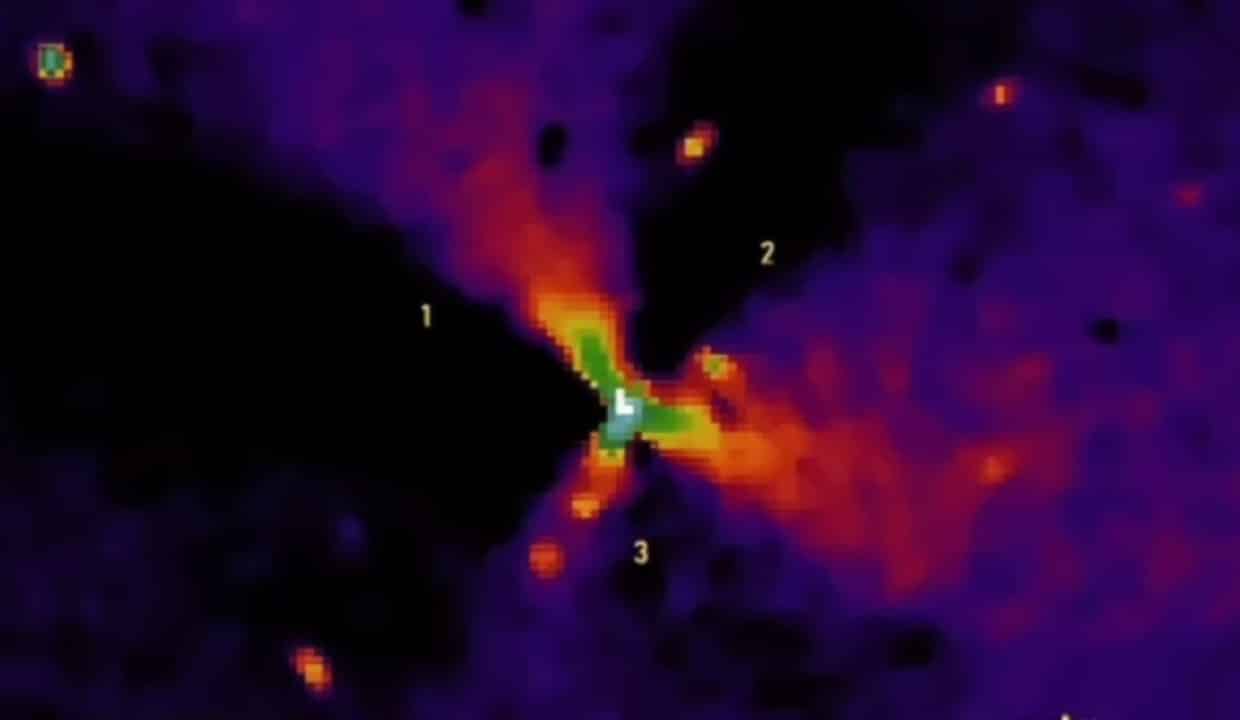
A radio transmission with unprecedented characteristics, coming from the interstellar comet 3I/ATLAS, began one of the largest astronomical observation campaigns in recent history. Agência Espacial Norte-American (NASA) is at the head of a global task force that mobilizes the most advanced telescopes on the planet to investigate the nature of the phenomenon, which does not correspond to any known cosmic pattern.
The signal was classified as anomalous due to its clarity and regularity, which aroused immediate interest in the scientific community. Protocolos of Gabinete of Coordenação of

Despite the mystery surrounding the transmission, high-precision orbital calculations have already confirmed that the comet’s trajectory does not pose any threat to Terra. Essa security allows scientists to focus exclusively on the challenge of deciphering the message, transforming the object’s passage into a unique scientific opportunity.
The characteristics of anomalous transmission
The first detection of the signal occurred on October 24, 2025, captured by the sophisticated antenna network of the MeerKAT radio telescope, located at África of Sul. The emission was isolated at a frequency of 1.6 GHz, clearly standing out from the background noise of space. Análises later confirmed that the source is intrinsically linked to the comet, ruling out any possibility of interference from artificial satellites or terrestrial sources. What makes the event so unique is its modulated structure, which does not resemble the known patterns of phenomena such as fast radio bursts (FRBs) or the rhythmic pulses emitted by pulsars. Especialistas signal processing companies around the world are now conducting detailed spectral analysis, looking for complex patterns or any type of information that may be encoded in the transmission, a standard procedure for signals of unknown origin that defy current astrophysical models.
A global scientific collaboration underway
Under the leadership of NASA’s PDCO, an international collaboration was quickly established to ensure continuous and comprehensive monitoring of 3I/ATLAS. The initiative involves renowned space agencies, such as Agência Espacial Europeia (ESA), and a network of observatories distributed across different continents. Essa global cooperation is key to tracking the comet 24 hours a day, collecting as much data as possible as it passes through our Sistema Solar.
Cutting-edge technological resources were directed to the study of the object. Very Large Telescope (VLT), located at Chile, is focused on spectroscopic analysis of the comet’s coma, the cloud of gas and dust surrounding the nucleus, to determine its chemical composition. Simultaneamente, the space telescopes Hubble and The SETI (Search for Inteligência Extraterrestre) community is also engaged, using their own antenna networks to independently monitor the signal and contribute additional analysis.
The origin of the interstellar visitor 3I/ATLAS
The comet was first identified on July 1, 2025 by the ATLAS program (System of Alerta Final of Impacto Terrestre of Asteroides), a sky scanning project funded by NASA.
Its official designation, 3I/ATLAS, classifies it as the third interstellar object (“3I”) ever confirmed to visit our planetary system, following the discoveries of 1I/’Oumuamua and 2I/Borisov.
The main proof of its extrasolar origin is its hyperbolic trajectory, indicating that its speed is too high to be captured by the gravity of Sol, which confirms that it is just passing through before returning to deep space.
Main hypotheses under scientific investigation
Currently, scientists work with three main lines of investigation to explain the origin of the radio signal. The most likely hypothesis, and the one most accepted by the community, is that of a natural astrophysical phenomenon, but of a type never before documented.
This possibility could involve complex and not yet understood interactions between the comet’s magnetic field and the solar wind, or the presence of specific chemical elements in its composition that, under certain conditions, could generate radio emissions with the observed characteristics.
A second line of research explores the occurrence of an exotic physical process inside the comet’s rocky nucleus. Essa idea is based on the premise that its composition, forged in another star system, could contain materials or structures that react in unexpected ways to the conditions of our Sistema Solar.
The third hypothesis, treated with extreme caution by researchers, considers a technological origin. Embora there is no evidence to support this theory, scientific protocols require that it not be discarded until all natural explanations are rigorously investigated and refuted.
Safe trajectory and closest approach point
Orbit calculations performed by elite monitoring centers such as NASA’s Laboratório from Propulsão to Jato (JPL) provide solid assurance that comet 3I/ATLAS poses no impact risk to our planet. Sua route has been mapped with great precision, allowing attention to turn entirely to science.
The point of closest approach to Terra is scheduled for December 19, 2025. Nessa date, the object will pass at a safe distance of approximately 270 million kilometers, which is equivalent to almost 700 times the distance between Terra and Lua, eliminating any concern.
The importance of ATLAS project surveillance
The early detection of 3I/ATLAS by the ATLAS system highlights the strategic importance of celestial scanning programs. Composto by four telescopes that continuously monitor the sky, the project is essential for identifying asteroids and comets, especially those with unusual trajectories, providing time for the scientific community to organize detailed observation campaigns like the one currently underway.



