

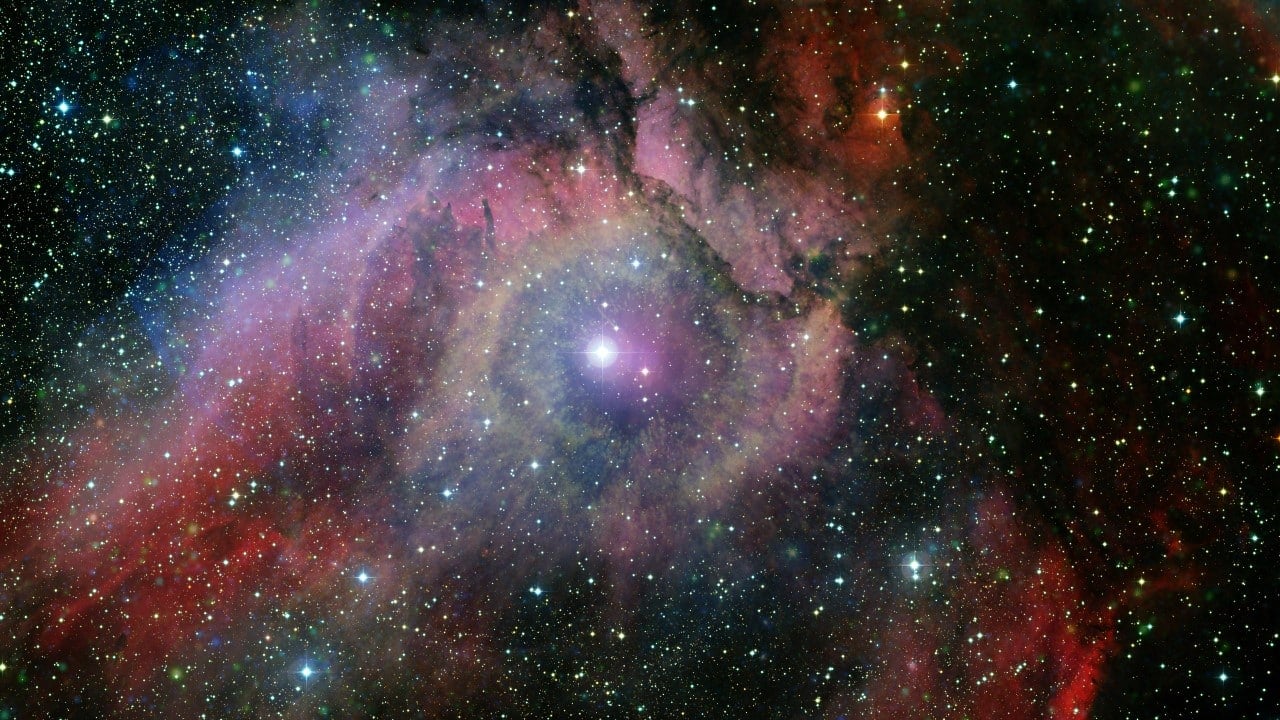
A surprising discovery at Via Láctea has revealed a cosmic object of rare beauty and symmetry. Astrônomos from
The object, officially cataloged as G305.4-2.2, was serendipitously found during the analysis of data collected by the Australian Square Kilometre Array Pathfinder telescope (ASKAP). Its 95.4% circularity positions it as one of the most symmetrical remnants ever observed in our galaxy, offering a natural laboratory to study the physics of these explosions.
IC 443/S249 (from g. to d.) – Nébuleuse de la méduse (à ne pas confondre avec Ab.21 située aussi dans les Gémeaux).
Famous supernova remnant.
Difficile de donner une distance, car ses structures peuvent être liées à S249. Estimée between 2.16e+13 km and 6.171e+13 km.pic.twitter.com/nos1fqt2KG— ⭐ HORIZON Astronomie 🪐 (@alexastro2a)February 9, 2024
Teleios, whose name derives from the Greek word for “perfect” or “complete”, is located at an estimated distance of between 7,170 and 25,100 light years from Terra. The discovery occurred within the scope of the Evolutionary Map of the Universe (EMU) project, which is dedicated to mapping the sky of the southern hemisphere in radio waves with unprecedented sensitivity.
A rare form in the cosmos
The main feature that makes Teleios so special is its geometry. The vast majority of known supernova remnants have irregular, oval, or distorted shapes. Isso occurs because the shock wave from the stellar explosion expands through the interstellar medium, a heterogeneous environment filled with clouds of gas and dust of varying densities. Upon encountering these denser regions, the expansion is slowed unevenly, resulting in an asymmetric structure. In the case of Teleios, its exceptional symmetry suggests that it is expanding into an extraordinarily empty and homogeneous region of space. Análises indicate that the remnant moves within a low-density cavity, which allowed the shock wave to travel outward uniformly in all directions, preserving the initial sphere of the explosion over thousands of years. Essa condition makes it a valuable example for understanding the initial phases of a supernova without the interference of complex environmental factors.
The likely origin of the explosion
The near-perfect symmetry of Teleios offers important clues about the type of event that created it. The most likely hypothesis is that the object is the result of a type Ia supernova, one of the most energetic events in the universe.
This type of explosion occurs in binary systems, where a white dwarf star, the dense core of a star that has exhausted its fuel, sucks matter from a companion star. Quando the white dwarf reaches a critical mass, it becomes unstable and triggers a thermonuclear explosion that completely destroys it.
Ia-type supernovae are known to produce relatively uniform explosions, which is consistent with the spherical shape observed in Teleios. Alternative Cenários, such as partial explosions, are considered less likely as they do not completely fit the estimated size and distance of the remnant.
Technical details of the observation
The identification of Teleios was possible thanks to the advanced capabilities of the ASKAP telescope. Este instrument made it possible to detect the extremely low surface brightness of the remnant, one of the characteristics that made it invisible to previous surveys. Its radio brightness is one of the faintest ever recorded for an object of its class in Via Láctea, which highlights the sensitivity of the EMU project to finding diffuse cosmic structures.
Technical analyzes revealed a spectral index of -0.6, a typical value for remnants where radio emission is generated by electrons accelerated to speeds close to that of light by shock waves. Além In addition, the data shows a low polarization of the radio waves, but a high rotation of Faraday in the center of the object, an effect that indicates the presence of organized magnetic fields in the medium through which the light traveled until reaching Terra.
The environment that allowed perfection
The key to Teleios’s pristine form lies in its cosmic surroundings. Estudos detailed analysis of neutral hydrogen gas in the region confirmed the existence of a vast cavity around the remnant.
The density within this space bubble is extremely low, with estimates pointing to less than 0.01 particles per cubic centimeter. Este near-perfect vacuum allowed the supernova shock wave to expand freely for millennia, without encountering obstacles that could deform its spherical structure.
Comparisons with other stellar remnants
With this discovery, Teleios joins a select group of highly symmetric supernova remnants. Suas properties bring it closer to other notable examples, such as SN1987A, located at Grande Nuvem of Magalhães.
These objects share the characteristic of being expanding in low-density environments, generally located outside the main and most congested plane of the galaxy.
This condition drastically differentiates them from better-known remnants, such as Nebulosa and Caranguejo, whose filamentary and chaotic appearance is a direct result of their violent interaction with the dense interstellar medium around them.
Studying objects like Teleios allows scientists to isolate and analyze the explosion’s intrinsic properties, separating them from the effects of their environment, which is key to refining theoretical models of stellar evolution.
Challenges and next steps in research
Despite advances, Teleios still presents significant puzzles for scientists. One of the main challenges is the lack of confirmed detection of X-rays, an emission that would be expected for a remnant in its evolutionary phase. The lack of this signal could indicate that the surrounding gas is even thinner than predicted or that new-generation X-ray telescopes are needed to capture the faint emission. Next steps in the research will include attempts to measure the expansion speed of the remnant to more accurately determine its age and distance.
The fundamental role of the EMU project
The discovery of Teleios demonstrates the transformative potential of modern radio surveys. The EMU project, utilizing the power of ASKAP, is scanning the sky with a combination of sensitivity and resolution that far surpasses previous instruments.
This technological capability is allowing astronomers to discover an entirely new population of faint and diffuse objects, expanding our knowledge of the frequency and distribution of supernovae in Via Láctea and enriching our understanding of the life and death cycle of stars.



