

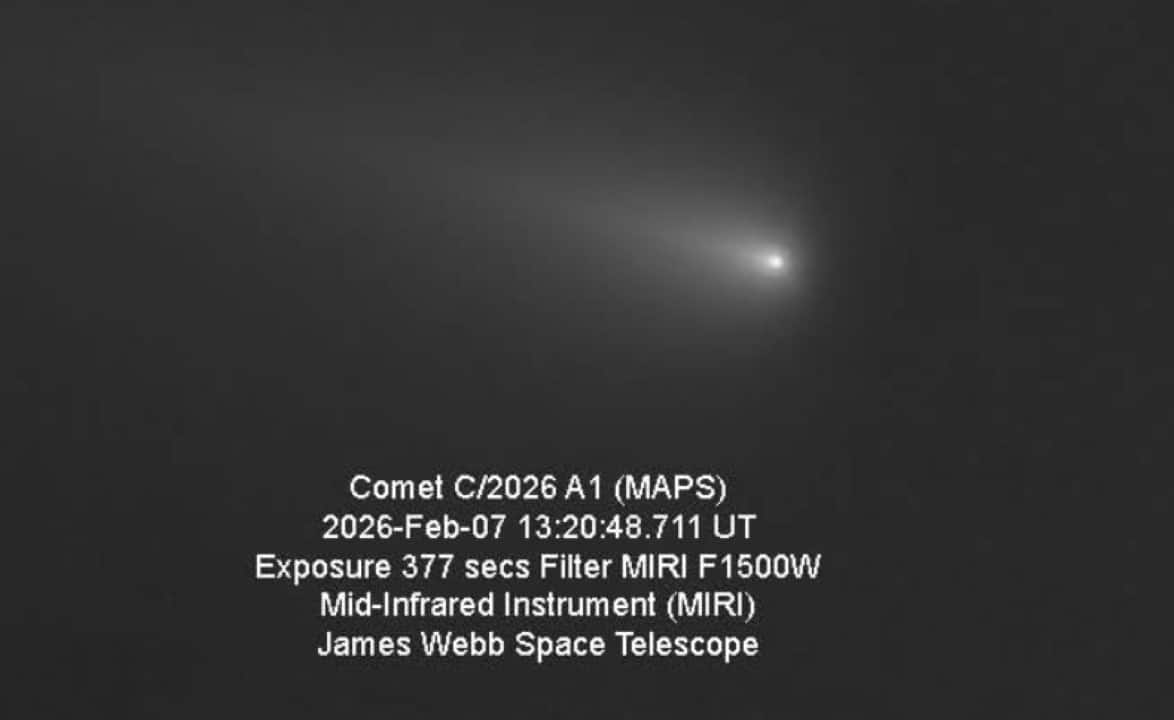
Amateur astronomers discovered comet C/2026 A1 (MAPS) on January 13, 2026, using a remote telescope in the desert of Atacama, at Chile. Este celestial object belongs to the Kreutz family of comets close to Sol and follows a trajectory that will take it to an extreme approach to the star in April this year.
The comet will reach perihelion, the closest point to Sol, at the beginning of April 2026, passing at distances estimated between 750 thousand and 800 thousand kilometers from the solar center. Especialistas indicate that, if it survives high temperatures, it can significantly increase its brightness and become visible to the naked eye, even during the day.
Initial observations show that the comet’s nucleus is considerable in size compared to other members of the Kreutz family. Essa feature raises expectations for a possible rare celestial spectacle in the coming months.
Discovery of comet C/2026 A1
Four French astronomers were operating the MAPS program when they identified the object, initially designated as 6AC4721. The AMACS1 telescope, located at San Pedro of Atacama, captured the first images of the comet about 300 million kilometers from Sol.
Confirmation came quickly from Minor Planet Center, which assigned the official designation C/2026 A1 (MAPS). The initials honor the discoverers Maury, Attard, Parrott and Signoret, highlighting the role of amateurs in astronomical advances.
At the time of detection, the comet had a magnitude of around 17, visible only with professional equipment. Sua elongated and tilted orbit immediately confirmed belonging to the Kreutz group of sungrazers.
☄️🔥 A new Kreutz comet may put on a spectacular show! 🔥☀️
— 3I/ATLAS updates (@Defence12543)February 9, 2026
😱Astronomers are buzzing over Comet C/2026 A1 (MAPS) — a newly discovered Kreutz sungrazer that could briefly become brighter than Venus during its razor-close pass to the
🔭 Discovered on Jan…pic.twitter.com/XEnhxiUKQj
Extreme trajectory and perihelion risks
Comet C/2026 A1 follows a hyperbolic orbit that takes it directly into the interior of Sistema Solar. Cálculos preliminary orbitals point to perihelion on April 4, 2026, with a passage extremely close to the solar surface.
This proximity exposes the core to temperatures exceeding thousands of degrees Celsius. Muitos similar comets disintegrate completely before completing the passage, evaporating under the intense solar radiation.
- Estimated distance at perihelion: about 0.005 AU from the center of Sol
- Approximate speed: greater than 500 km/s on approach
- Orbital period: thousands of years, typical of the Kreutz family
- Main risk: total or partial fragmentation of the nucleus
If resisted, the warming will sublimate large amounts of ice, forming an extensive tail and increasing the brightness dramatically.
Origin in the Kreutz family
All Kreutz comets descend from a single giant nucleus that fragmented about two thousand years ago. Estudos indicate that this megacomet, with a diameter greater than 100 kilometers, ruptured after passing close to Sol between the 3rd and 4th centuries BC.
Resulting fragments returned at different times, generating the large comets recorded historically. Essa fragmentation chain explains the orbital similarity between the current members of the group.
Early observations report multiple bright objects visible simultaneously in broad daylight. Registros of the 11th century mention two large comets that were probably larger fragments of the same progenitor.
Historical examples of large comets
The 1965 Grande Cometa, known as Ikeya-Seki, represents one of the most impressive events of the 20th century. Descoberta just weeks before perihelion, it reached brightness comparable to that of the full Lua and remained visible during the day.
Another striking case occurred in 1882, when the object C/1882 R1 dominated the skies for months. Sua luminosity exceeded a hundred times that of full Lua, allowing easy observation even in urban conditions.
More recently, the 2011 comet Lovejoy narrowly survived a flyby. Observada since Estação Espacial Internacional, it exhibited a long tail and brightness equivalent to that of Vênus at the end of December of that year.
These events demonstrate the potential for larger members of the Kreutz family to generate extraordinary visual phenomena when they manage to complete perihelion intact.
Modern observations with solar probes
NASA and ESA’s SOHO probe has revolutionized the monitoring of grazing comets since the 1990s. The observatory has detected thousands of small Kreutz fragments that disintegrate near Sol.
Most of these objects have a diameter of a few meters to tens of meters. Descobertas of larger fragments, such as the current C/2026 A1, occur less frequently and generate greater scientific interest.
Coronagraphic images regularly capture the destruction of smaller sungrazers. Esses records help to understand sublimation and fragmentation processes in extreme conditions.
Expectations for visibility in 2026
If comet C/2026 A1 survives perihelion, its brightness could increase rapidly in the following weeks. Astrônomos estimate the possibility of naked-eye visibility in the southern hemisphere initially, expanding later.
The position close to Sol during perihelion will make direct terrestrial observations at the critical moment difficult. Equipamentos with adequate sunscreens will be necessary for safe monitoring.
- Best predicted periods: end of March for telescopes, beginning of May for naked eye if it survives
- Starting location: Southern constellations like Fornax
- Main recommendation: never observe Sol directly without certified protection
The astronomical community monitors the object’s orbital and photometric updates daily.
Scientific potential of the passage
The extreme approach will allow detailed studies of the composition of ancient comets. Espectroscopia will reveal elements preserved since the formation of Sistema Solar billions of years ago.
Data collected will help refine models of the evolution of cometary nuclei under thermal stress. Comparações with previous events like Lovejoy will enrich knowledge about the dynamics of the Kreutz family.
Professional observatories around the world are already directing resources towards continuous monitoring. Colaborações international organizations coordinate efforts to maximize coverage during perihelion.
Comet C/2026 A1 represents a rare opportunity to observe in real time processes that normally occur far away in deep space. Resultados will contribute to a broader understanding of the formation and evolution of external Sistema Solar objects.
Preparation for possible celestial spectacle
Astronomy enthusiasts organize observation campaigns in regions with dark skies. Clubes and associations publish safety guidelines to avoid eye damage when attempting to view close to Sol.
Specialized applications and websites offer daily updated ephemeris. Ferramentas like TheSkyLive and NASA platforms provide accurate positions for session planning.
Regardless of the outcome, the discovery reinforces the importance of systematic sky surveys. Programas amateurs like MAPS demonstrate that individual contributions still play a crucial role in contemporary astronomy.



