

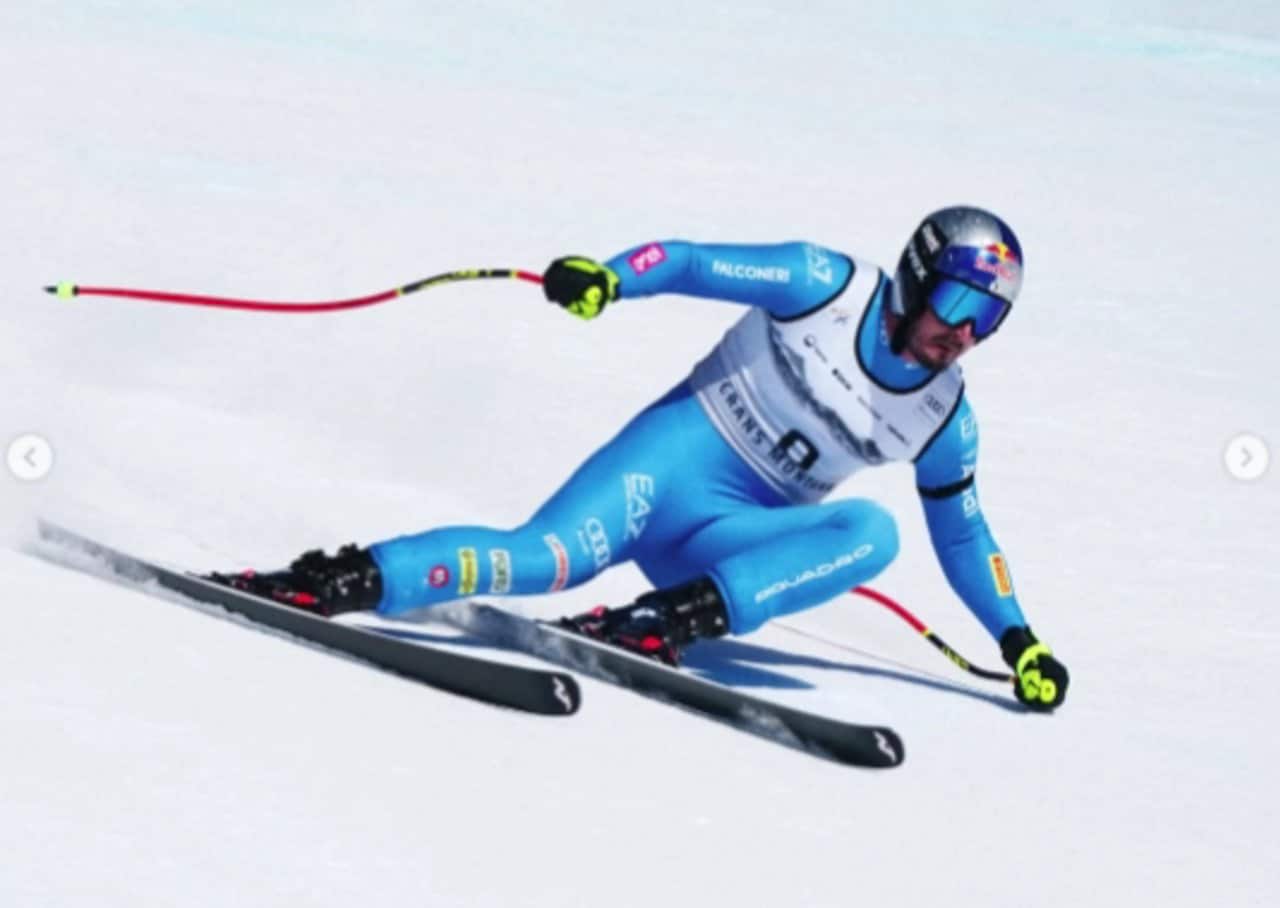
The Italian skier Dominik Paris starred in one of the most tense moments of winter competitions this Wednesday, February 11, 2026, in Cortina d’Ampezzo. The athlete, who was one of the favorites for the podium in the men’s Super-G, suffered an impressive fall after one of his skis came off during the high-speed descent. The incident occurred in front of the local fans, who were watching the veteran’s attempt to win another medal on Italian soil.
The disqualification was confirmed immediately after the accident, as the sport’s regulations require the athlete to complete the route with both equipment and pass through all signaling gates. Paris was coming off a solid performance this season, having won the bronze medal in the downhill a few days earlier. The technical failure abruptly ended the skier’s participation in this specific event, generating immediate concern about his physical condition after impacting the snow.
Preliminary analyzes indicate that the equipment was not adjusted to the correct pressure to withstand the forces exerted during the sharp curves of the Italian route. At the time of detachment, the athlete reached speeds above 100 km/h, which exponentially increases the risk of fractures or ligament ruptures. Felizmente, Dominik Paris managed to slide in a way that minimized direct friction, getting up shortly after the scare without signs of serious injuries.
- The Super-G is the second fastest event on the world alpine skiing calendar.
- The total length of the route in Cortina d’Ampezzo exceeds 2 kilometers of steep descent.
- A total of 42 athletes participated in the starting list for this Wednesday’s competition.
- Pinpoint precision is required, as failing a single obstacle results in automatic elimination.
Technical details about Paris equipment failure
Snow sports experts point out that adjusting ski bindings is an extremely responsible task for technicians and skimen. If the release pressure, known as the DIN index, is set lower than necessary, the ski may release prematurely due to vibration or turn pressure. In the case of Dominik Paris, the left equipment detached at the exact moment he was applying full force to bypass one of the most technical doors in the upper circuit.
The visual impact of the fall was accentuated by the speed at which the Italian was traveling when he lost his lateral balance. Sem the support of one of the feet, the skier was thrown out of the ideal trajectory, colliding with the side protection nets in a controlled manner. The Italian technical team regretted what happened, highlighting that rigorous inspections are carried out before each start, but that mechanical variables can fail in extreme cold conditions or excessively icy surfaces.
Risks of injuries at high speeds in alpine skiing
Skier safety has been a constant topic in international committees due to the increase in the physical power of modern competitors. Casos recent film rescues, such as the American film Lindsey Vonn, reinforce that downhill and Super-G do not allow room for structural errors. The force exerted on the knee joints in a fall at 100 km/h can be compared to urban car impacts, requiring the latest generation of protective material.
Dominik Paris’s luck was praised by expert commentators, who noted the way he “accepted” the fall rather than trying to fight gravity. Tentar regaining balance with just one ski at high speed often results in severe twisting, something the Italian avoided by letting himself slide down the slope. Este incidente levanta novamente o debate sobre a padronização dos equipamentos de segurança e a checagem dupla das fixações antes que o atleta receba o sinal verde de partida.
History of Dominik Paris and the end of his career
Dominik Estas Olimpíadas of 2026 are marked as the final chapter of his professional career, which makes the incident in Cortina even more symbolic for fans. The desire to end his career with Olympic gold at home motivated intense preparation over the last four years, focused precisely on speed disciplines.
Despite the setback at Super-G, the skier’s legacy remains intact due to his consistency in podium finishes from Copas to Mundo over more than a decade. The disappointment visible on his face as he left the track reflected not only the loss of a chance at a medal, but the end of an Olympic cycle in front of his compatriots. Paris still has commitments scheduled, but this Wednesday’s technical failure will certainly be remembered as one of the most unlucky moments in his victorious sporting journey.
How rules and disqualifications work in Super-G
The Super-G, or Super Gigante, modality combines the pure speed of downhill with the maneuvering technique of the Slalom Gigante. Diferente In other events, athletes do not perform training descents on the official route before the competition, which increases the unpredictability of the terrain. Cada competitor has only one chance to go down the mountain, and any error in passing through the gates, delimited by blue and red stakes, invalidates the recorded time.
Paris’s disqualification occurred for exactly this technical reason, as he was unable to cross the next gate after losing his ski. The Federação Internacional and Esqui regulations are inflexible regarding the integrity of the equipment during the test to guarantee equality between participants. The safety protocol was activated immediately after the crash, with track inspectors ensuring that no other competitors descended until the Italian was in a safe zone and the debris was removed.
Climatic conditions and the state of snow in Cortina
Snow conditions at Cortina d’Ampezzo on Wednesday were described as ideal for speed, with low temperatures ensuring a compact and fast surface. However, this type of “aggressive” snow demands much more from the ski bindings, as any slight irregularity in the terrain generates high-frequency vibrations. Atletas who started before Paris commented that the ice was particularly hard in some shaded sections of the mountain, where control became precarious.
The organization of the Jogos of Inverno 2026 invested heavily in preparing the tracks to avoid accidents caused by faults in the terrain. The case of The Italian team’s technical investigation is expected to continue in the coming hours to identify whether there was material fatigue or human error in equipment calibration.
Expectations for the next alpine skiing events
With the departure of Dominik Paris from contention for the podium in the Super-G, attention turned to the competitors from Noruega and Áustria, traditional powerhouses in the sport. The competition continues to distribute medals and the schedule remains intense with women’s events and the finals of other technical categories. The absence of one of the local favorites changes the dynamics of the race, but does not diminish the extremely high technical level presented by the other 41 entrants.
Italian fans still maintain hope in other representatives of the national team, who seek to compensate for the loss of Paris with impressive results in the technical tests. The atmosphere in the Cortina stands remains vibrant, despite the momentary silence that took over the snowy stadium when the idol fell. Winter sport continues to demonstrate its unpredictable nature, where talent and preparation can be subjected to the rigors of a mechanical failure in a matter of milliseconds.
Impact of the drop on the general classification and medal table
The accident of Dominik Paris directly impacts the projections of Itália in the general medal table of Jogos and Inverno. Esperava it was expected that the host country would dominate the men’s alpine skiing disciplines, taking advantage of Cortina’s in-depth knowledge of the slopes. Sem the points and the projected medal of
Other nations, such as Noruega, took advantage of the gap left by the favorite to consolidate their lead in snow statistics. Biathlon and snowboarding also continue to deliver results that move the table, keeping the interest of the global public high. The balance between the European and North American delegations continues to be the keynote of this event, with each technical failure or individual success altering the fate of entire countries in the historic tally of Olympic trophies.
Safety procedures after high-speed accidents
Whenever an elite athlete suffers a fall above 90 km/h, medical safety protocols are activated as a precaution. Mesmo that Dominik Paris has stood up on his own, he must undergo a full neurological and orthopedic assessment in the Olympic village. The goal is to rule out concussions or microfractures that do not present immediate symptoms due to the adrenaline rush common in high-stress competitive situations.
The efficiency of the rescue team in Cortina was praised, with runway inspectors signaling the interruption of the descent within seconds to avoid chain collisions. Esse level of organization is what allows such extreme sports to continue to be practiced with an extremely low fatality rate. Active safety, which includes the containment nets and curve design, worked perfectly in the Paris incident, ensuring that a potentially tragic crash only turned into a bitter disqualification.
Reaction from the coaching staff and performance analysis
The Italian technical committee called a brief meeting after the race to discuss what happened with the staff responsible for Paris’s skis. The tone was one of controlled frustration, recognizing that Dominik was carrying out an aggressive and competitive descent until the moment of failure. The team’s head coach highlighted that the skier was within the leaders’ time in the first sectors, which increases the feeling of a lost opportunity for the local federation.
The focus now turns to psychological support for the athlete, who is dealing with the weight of ending his last Olimpíada with a fall at home. Resilience is a hallmark of Paris, and his team believes he will actively participate in supporting his younger teammates throughout the remainder of the schedule. The individual technical performance will be archived as a lesson on the vital importance of every detail in preparing sports equipment at a high performance level.
The future of alpine skiing in Itália after 2026
The imminent retirement of figures like Dominik Paris marks the end of a golden era for Italian skiing, but also opens up space for new promises. The investment in infrastructure made for these Jogos of Inverno will serve as a basis for the training of new athletes in the coming decades. Cortina d’Ampezzo reaffirms itself as a global center of excellence, capable of hosting events of global magnitude with safety and technical sophistication, regardless of the setbacks suffered by competitors.
The lessons learned from this day of competition will serve to further improve safety and equipment maintenance standards across the European circuit. The sport continues to evolve, and binding and boot technology will certainly undergo further revisions following the data collected from this accident. The Italian public, although saddened by the disqualification of their idol, celebrates Dominik Paris’s courage in defying the limits of speed in search of Olympic glory.



