


The arrival of the Toyota Yaris Cross on the automotive scene intensifies the competition in the compact SUV segment, bringing its flex hybrid engine as its main attraction. The Japanese automaker’s new vehicle, now available to the public, promises to redefine consumption and performance expectations for urban drivers, consolidating the brand’s strategy in the country.
With dimensions that are close to those of the successful Corolla Cross, the Yaris Cross is positioned as a robust and spacious option. Seu launch represents an important step for Toyota, which seeks to expand its participation in a competitive market niche with growing demand.
This compact hybrid flex SUV, the first of its kind to be offered on the market, is a reflection of Toyota’s investment in more sustainable and efficient technologies. The proposal is to offer a vehicle that combines the versatility of an SUV with the environmental and economic benefits of a hybrid propulsion system, adapted to the reality of national fuels.
Performance and savings for cities
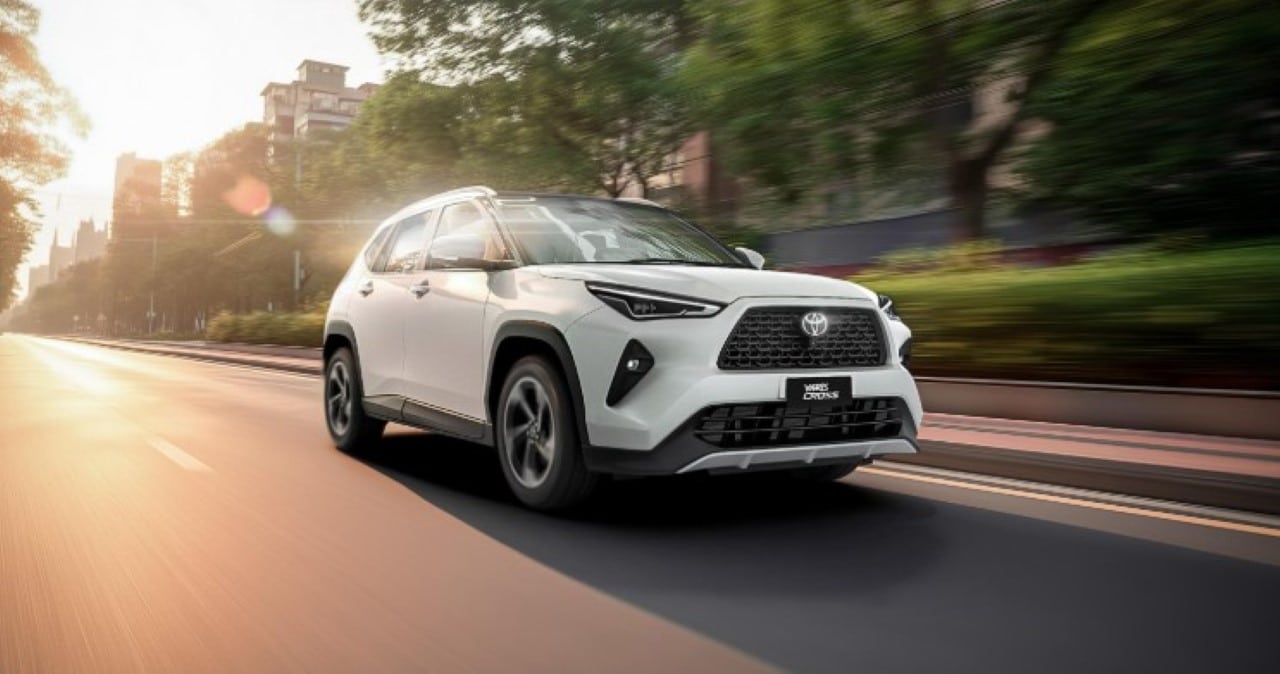
The big advantage of the Toyota Yaris Cross lies in its efficient flex hybrid engine, whose consumption data released by the Inmetro is impressive. In the urban cycle, the hybrid model presents fuel savings that can reach 30% with gasoline and a notable 33% with ethanol, a significant difference compared to its direct competitors. On the road, gains are 6.5% with gasoline and 4.7% with ethanol, reinforcing the efficiency proposal.
While the conventionally aspirated flex version delivers 110 hp and 14.3 kgf·m with gasoline, and 122 hp and 15.3 kgf·m with ethanol, the full hybrid configuration combines a thermal engine of 91 hp and 12.3 kgf·m with an electric engine of 80 hp and 14.4 kgf·m, totaling a combined power of 111 hp. Embora acceleration performance is slightly lower, the difference of just one second from 0 to 100 km/h is practically imperceptible in daily driving, prioritizing economy.
Compact structure with expanded space
Despite being a compact SUV, the Yaris Cross surprises with its generous dimensions, which bring it very close to the larger model Corolla Cross. Measuring 4,310 mm in length, 2,620 mm in wheelbase, 1,770 mm in width and 1,665 mm in height, it offers a robust and imposing stance. The trunk, with 400 liters (or 391 liters in the hybrid version), guarantees good luggage capacity, meeting the needs of families and trips.
The difference of just 20 mm in the wheelbase in relation to the higher category SUV and the 55 mm more width are details that, in practice, are noticed mainly when carrying three passengers in the rear seat, ensuring a good level of comfort. The optimization of internal space, combined with a modern design, contributes to the driving experience and comfort of the occupants, a crucial point for market acceptance.
Strategic positioning and pricing in the market
The Toyota Yaris Cross hits the market with a competitive price range, ranging from R$149,990 for models intended for taxis and Pessoas with Deficiência (PCD) up to R$189,990 for the top versions. Essa pricing strategy aims to democratize access to flex hybrid technology in a segment with high sales volume, making the vehicle attractive to different consumer profiles. The positioning seeks to balance cost-benefit, performance and sustainability, aligning with current trends in the Brazilian automotive sector.
National automotive market scenario
The beginning of the year in the national automotive market demonstrated an accommodation in sales, according to Anfavea’s balance sheet. In January, 170.5 thousand light and heavy vehicles were sold, registering a slight drop of 0.4% compared to the same period of the previous year. Esse result, although modest, is considered small, even with one less working day in the month of January.
Cars grew by 1.4%, while light commercial vehicles increased by 3%. However, the entity has already signaled that the forecast for the remainder of the year is uncertain, especially in a period of national elections, which can historically influence consumer and market behavior.
Average daily sales reached 8,100 units, an increase of almost 4% compared to January of the previous year, exceeding the initial projections of Anfavea (2.6%) and Fenabrave (3%) for the year. Essa initial performance suggests that there may be some accommodation in the following months, after a warmer start than expected.
This beginning of the year scenario, with slight growth in some segments and forecast challenges, shows a market in transition. The arrival of new models, such as the Yaris Cross, plays an important role in boosting sales and introducing new technologies to consumers.
Challenges and balance of imports
Vehicle inventories in the domestic market registered a considerable increase, going from 37 days in December to 57 days in January. Essa distorção é mais acentuada nos veículos importados, que atingiram 172 dias de estoque, em contraste com os 29 dias dos veículos nacionais. BYD, for example, was one of the companies that imported a large volume of electric cars last year, taking advantage of the period of reduced import tax, a benefit that is not maintained in the current year, but still has an impact on stocks.
Historically, Argentina has been the main external supplier of vehicles for Brasil, benefiting from the Mercosul agreements. Contudo, for the first time in January, China surpassed Argentina, with 16,400 units imported against 13,400, showing a change in commercial relations and the origin of vehicles arriving in the country. Este data reflects the growing influence of Asian automakers in the Brazilian market and the diversification of supply chains.
The dynamics of stocks and imports indicate a complex market, influenced by fiscal policies and trade agreements. The ability of automakers to manage these factors will be crucial to maintain competitiveness and the supply of vehicles aligned with the demand of Brazilian consumers.
Technology and consumer trends
Analysis of the breakdown of vehicle sales in January 2026 offers a clear overview of consumer trends and technologies gaining ground in the market. Flex-fuel vehicles continue to dominate, representing 67.7% of sales, reflecting the preference for this technology and the country’s existing fuel infrastructure. Next, diesel models account for 11.7% of the total, maintaining their relevance mainly in segments such as pickup trucks and larger SUVs.
Hybrid (6.7%), electric (5.1%) and plug-in hybrid (5.1%) vehicles account for a significant share, indicating constant growth in the acceptance of cleaner and more efficient technologies. The share of gasoline vehicles was 3.8%. Esse scenario shows a gradual consumer transition to options that offer lower consumption and environmental impact, a movement that Toyota Yaris Cross with its hybrid flex technology seeks to strategically capitalize on.
Overcoming obstacles and optimism for the future
Toyota, despite having faced a natural disaster that impacted its engine factory in Porto Feliz, in the state of São Paulo, demonstrates resilience and focus on the future with the launch of Yaris Cross. The event, which affected the brand’s market position, was overcome through investments and restructuring. With the new SUV, the company seeks to recover ground and strengthen its presence in the compact vehicle segment, where there is great potential for growth and demand for innovations. The investment in hybrid flex technology is a clear sign of Toyota’s vision to offer solutions that meet the current and future needs of consumers, with renewed optimism for the market.



