
Drivers will be able to see videos on the car dashboard with Apple’s new feature restricted to stationary vehicles


The latest update to the Apple ecosystem introduced a feature that promises to change the dynamics of entertainment inside cars, allowing videos to be played directly on the dashboard screen. The novelty arrives accompanied by strict guidelines that condition the operation of the resource to the total immobility of the vehicle, ensuring that the innovation does not compromise the driver’s attention. Essa mudança atende a uma demanda crescente por consumo de mídia em telas maiores dentro do habitáculo, transformando a central multimídia em um display de alta definição para momentos de espera, sem violar as normas internacionais de trânsito.
Security protocols and automatic blocking
The system operates through deep integration between the smartphone and the car’s hardware, using sensors to check the vehicle’s status in real time before releasing the image. Diferente of common mirrorings, the new software architecture requires electronic confirmation that the gearshift is in the park position or that the electronic parking brake is activated. Essa digital barrier was designed to be infallible, always prioritizing the car’s telematics data over the user’s media requests.
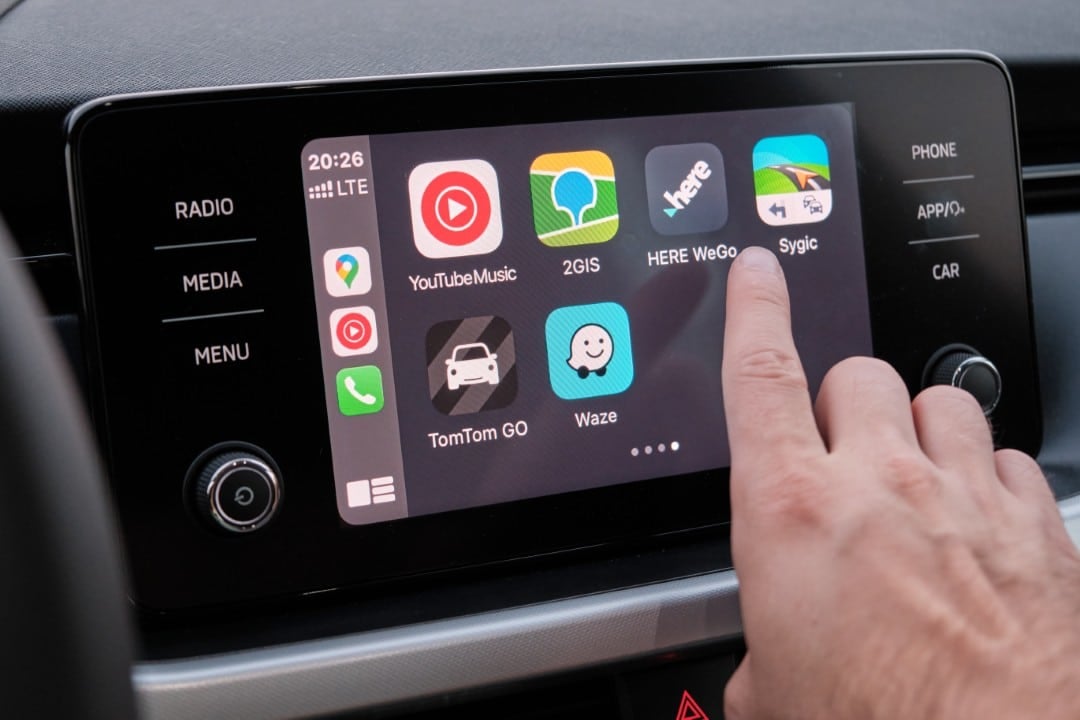
Road safety remains the central pillar of this implementation, with logic locks constantly monitoring speed sensors and transmission. The moment the system detects any movement of the wheels or movement of the gear lever to forward or reverse positions, video playback stops immediately. The screen automatically returns to the navigation or audio interface, eliminating visual stimuli that could distract the driver and increase the risk of collisions due to inattention.
Technical synchronization and the role of automakers
To enable this experience, the technology is based on the improvement of the AirPlay protocol, now optimized specifically for vehicular environments. The system establishes a high-speed data path that separates the video stream from the audio stream, ensuring perfect synchronization with the car’s sound system and eliminating the latency typical of older Bluetooth connections. Heavy graphics processing is intelligently distributed between the cell phone’s processor and the multimedia center chip, which helps prevent devices from overheating and preserves the battery during prolonged use.
Effective activation of the feature depends directly on the collaboration of car manufacturers, who need to update their systems’ firmware to support the new validation protocols. Automakers face the challenge of ensuring that their internal systems communicate vehicle status accurately and without delay to the Apple device. Therefore, the availability of the function is not automatic for all compatible cars, requiring specific certifications and exhaustive tests by brands before release to the end consumer via software updates.
The current scenario reflects a transformation in the use of time inside the vehicle, driven especially by the growth of the electric car fleet and the need for charging stops. The ability to watch cinema-quality films and series while waiting at airports, schools or charging stations re-contextualizes the car as a digital leisure and coexistence space. The technology therefore acts as a bridge between domestic convenience and urban mobility, maintaining safety as a non-negotiable requirement for operation.



