

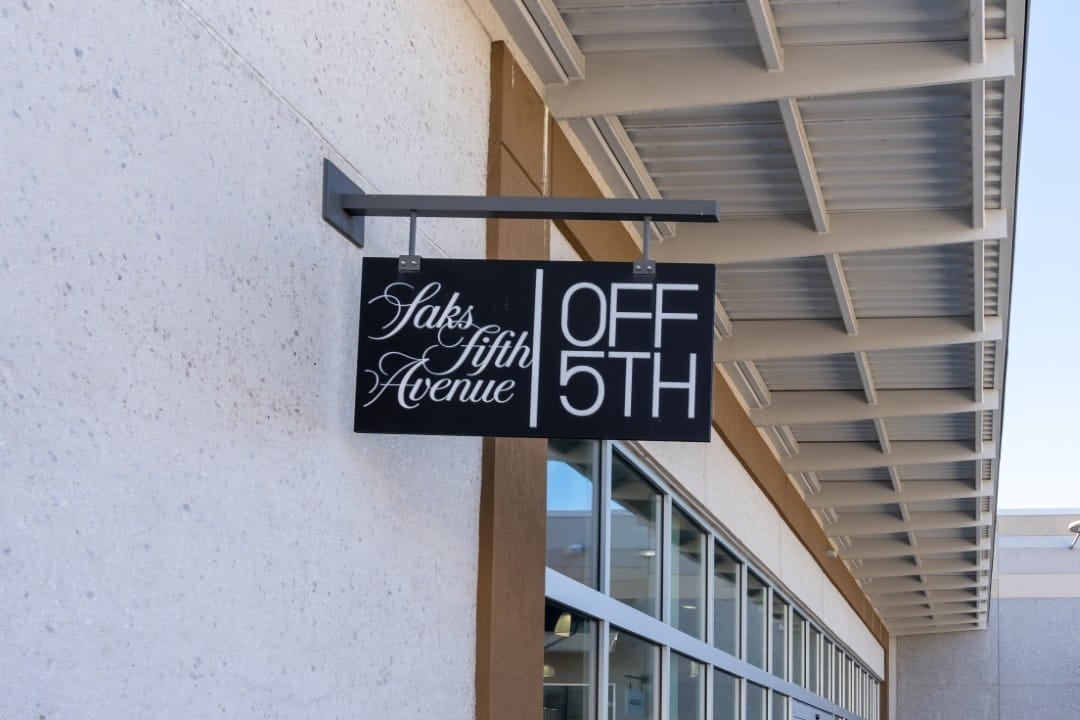
A drastic shake-up of operations at luxury retail giant Saks Global was confirmed this week, marking the end of an era for its discount division. The holding company announced the definitive closure of 57 units of the Saks OFF 5TH network spread across the Estados Unidos, in addition to the discontinuation of its e-commerce platform. The strategic decision comes in the wake of the bankruptcy protection request, governed by Capítulo 11 of North American legislation, filed in January 2026, aiming to clean up the conglomerate’s finances.
The retraction movement is immediate and severe, with only a minimal fraction of the brand’s physical presence remaining in the American territory. According to the official statement, only 12 OFF 5TH stores will remain in business after the massive cut. The restructuring aims to stem losses and redirect corporate focus to high-margin operations, progressively abandoning the outlet model that, until then, served as a gateway for aspirational consumers into the world of luxury.
Inventory sales already have a scheduled start date, creating a final rush for consumers in search of opportunities. The final sales process will begin this weekend at 34 of the affected units. Simultaneamente, a second group made up of 23 stores will permanently close its activities next Monday, February 2nd, complying with the accelerated demobilization schedule approved by the court.
In addition to physical stores, the company’s digital arm will undergo a complete shutdown. The website saksoff5th.com, which operated as a separate entity within the group, will begin its closing promotions from January 30th. Não there is a forecast for the return of this division’s online operations, signaling that the company does not see the viability of maintaining the e-commerce channel for discounted products in the company’s current economic scenario.
Details of the restructuring and financing plan
The decision to drastically reduce off-price operations is a direct reflection of the need for liquidity and operational focus. Saks Global has secured vital financing of approximately $1.75 billion from lenders and financial institutions. Este capital contribution is essential to keep the lights on in the main operations during the judicial recovery process, allowing the company to negotiate its debts while continuing to operate.
The management’s central objective is to concentrate all efforts and resources on the full-price luxury brands, considered the group’s crown jewels: Saks Fifth Avenue, Neiman Marcus and Bergdorf Goodman. The internal assessment is that the full luxury market offers better margins and greater long-term stability than the outlet segment, which faces fierce competition and compressed margins.
Geoffroy van Raemdonck, the company’s CEO, emphasized in a statement that these measures, although difficult, are essential to position the company for future growth. The strategy involves eliminating distractions and operating costs from less profitable divisions to shield the core of the business. Dentro of this scope, the total closure of the remaining five stores under the Neiman Marcus Last Call brand was also confirmed, completely extinguishing this banner from the portfolio.
Geography of remaining stores
Despite the mass closure, the OFF 5TH brand will not disappear completely from the map, although its presence will become residual. The company strategically selected 12 units to keep in operation, located in six North American states that demonstrated greater performance potential and historical profitability. Estas stores will serve as a controlled channel for the flow of residual stock from the main brands, without the need to maintain a costly national network.
The states that will keep the few units open are Nova York, Flórida, Nova Jersey, Geórgia, Califórnia and Texas. The choice of these regions is not random; These are hubs with a high concentration of wealth and tourism, crucial factors for the consumption of luxury goods, even off-price. Limited maintenance allows Saks Global to test the continued viability of the model on a reduced scale, without compromising the financial recovery of the group as a whole.
The function of these surviving stores will be strictly logistical and commercial for remaining items. Não there are immediate plans to expand or renovate these points of sale. Eles will act as release valves for unsold inventory from full-price stores, ensuring that the product cycle of premium brands has a final destination that still generates revenue, although the absolute priority is to sell at full price.
Context of bankruptcy and acquisitions
The request for protection under Chapter 11, made on Tribunal of Falências of Distrito Sul of The immediate trigger for the legal action was the non-payment of an interest installment worth 100 million dollars at the end of the previous year, which exposed the fragility of the company’s cash flow in relation to its financial obligations.
Saks Global’s delicate financial situation is, in part, the result of an aggressive expansion strategy via leveraged acquisitions. The purchase of Neiman Marcus Group, completed in December 2024 by Hudson’s Bay Co. for around 2.7 billion dollars, it was the movement that created the Saks Global Enterprises platform. Embora the merger consolidated a dominant position in American luxury retail, uniting icons such as Bergdorf Goodman and Saks Fifth Avenue, it also significantly increased the conglomerate’s debt level.
The integration of these retail giants occurred at a time of slowdown in the consumption of luxury goods globally. The combination of high interest rates, changes in consumer behavior — which has shifted part of its spending to experiences rather than goods — and fierce competition from online retail have put pressure on profit margins, making the acquisition debt unsustainable without a deep restructuring.
End of digital operations and Last Call
The closure of OFF 5TH’s e-commerce represents a significant change in the group’s digital strategy. The website, which operated independently, was a relevant source of revenue, but also required a complex and expensive logistics infrastructure. With the start of online clearance sales on January 30, the company is signaling that it no longer intends to compete in the saturated digital discount market, preferring to direct online traffic to its full-luxury platforms.
At the same time, the end of the Neiman Marcus Last Call brand is the final nail in the coffin of Neiman Marcus’s old outlet strategy. The remaining five stores will only operate until the final sale, scheduled to begin on January 31st. The elimination of this flag solves the overlap problem with OFF 5TH and simplifies the company’s portfolio, removing redundancies that no longer make sense in the new lean organizational structure.
Employees at the affected units, both OFF 5TH and Last Call, will face a period of uncertainty. The company said it will offer support during the transition, but the closure of dozens of stores and distribution centers will invariably result in significant workforce cuts. The focus now turns entirely to preserving jobs and operations at the luxury department stores that form the profitable core of Saks Global.



