
Telescope in the Canaries reveals band of ionized iron crossing the center of the Ring Nebula

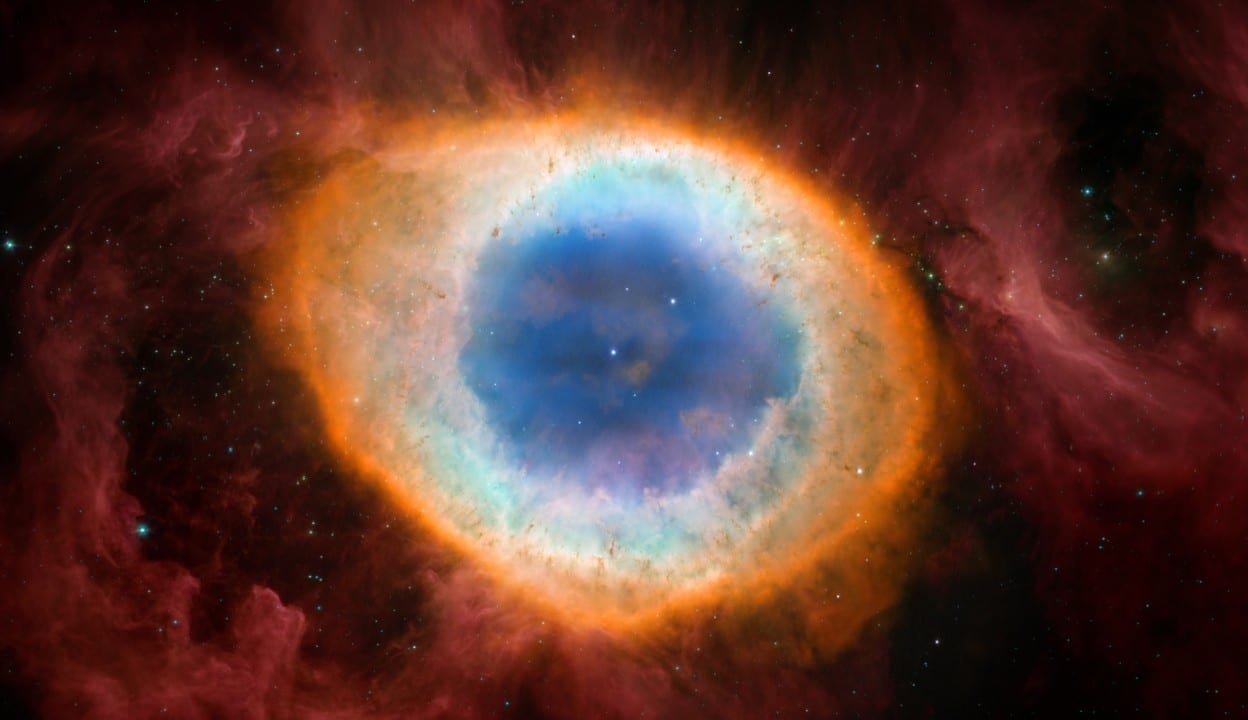
A detailed observation carried out with the William Herschel telescope, located in Ilhas Canárias, identified a unique formation in the constellation of Lira. Dados collected by the WEAVE instrument revealed a linear structure composed of highly ionized iron running through the central region of Nebulosa of Anel, also cataloged as M57. The celestial object is located approximately 2,300 light-years from Terra and is one of the most studied targets in modern astronomy due to its proximity and characteristic brightness.
The discovery surprised the scientific community, as the iron found in planetary nebulae usually remains trapped in cold dust grains, making its spectroscopic detection in gaseous form difficult. However, the new analysis demonstrated that, in this specific region, the element appears as a hot and excited gas, forming a narrow band that crosses the internal cavity of the system. Essa configuration differs radically from the diffuse distribution observed in other chemical elements, such as helium and hydrogen, which make up the majority of the gas cloud.
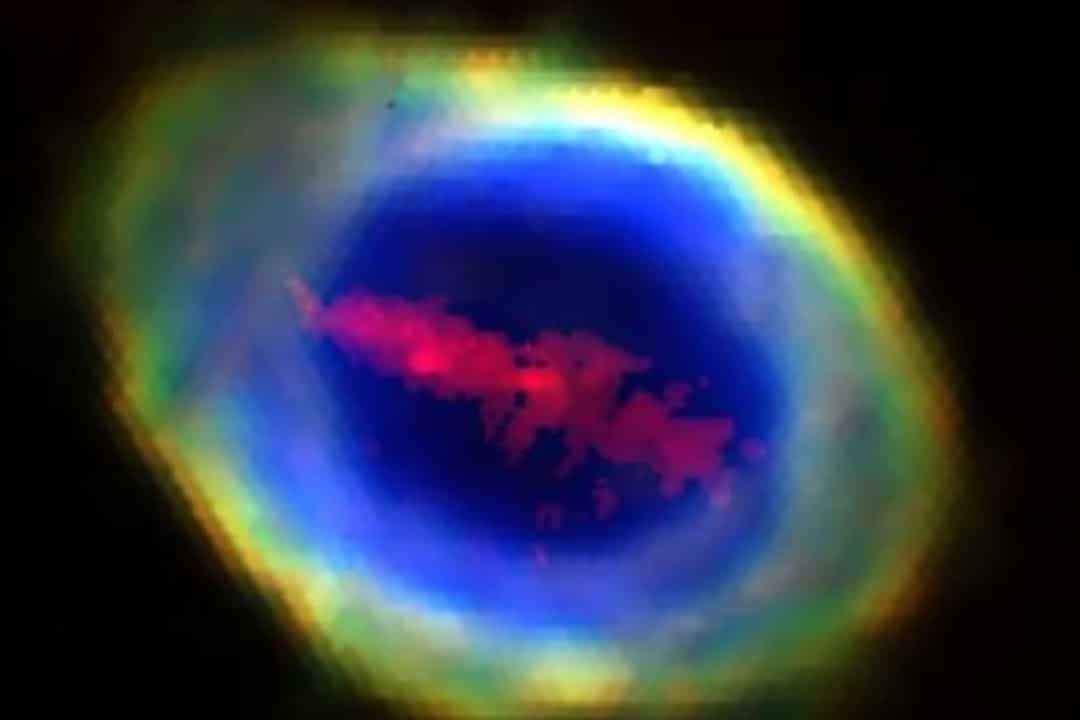
The researchers highlight fundamental characteristics that make this finding unique in the study of stellar evolution:
– The structure has a defined linear shape, extending hundreds of astronomical units within the nebula.
– The gas presents ionization levels double or triple the standard, indicating exposure to intense energy sources.
– The location of the iron band is centralized, contrasting with the outer rings of colder material.
– Não there are previous records of similar patterns in observations made by other optical equipment.
Technical capacity of the WEAVE instrument
The identification of this structure was only possible thanks to the full-field spectroscopy technology used by the WEAVE instrument. Diferente Compared to conventional methods that only analyze limited ranges or isolated points, this equipment allows the simultaneous mapping of thousands of points in a single observation. Essa scope provides a complete view of the chemical composition and dynamics of gases in extensive objects such as planetary nebulae.
During the testing and commissioning phase of the equipment at Ilhas Canárias, astronomers were able to isolate the specific spectral lines emitted by iron. The high resolution of the data made it possible to separate the emission of this element from the background glow of the nebula, revealing the crossbar that had gone unnoticed in decades of monitoring by ground-based and space telescopes.
Anomalies in chemical composition
The presence of iron in a gaseous and highly ionized state suggests extreme physical conditions in the core of M57. Normalmente, the temperatures in the regions where iron is detected are not sufficient to release the element from cosmic dust and ionize it to such an extent. The phenomenon indicates that heating mechanisms or intense ultraviolet radiation, coming from the central white dwarf, are acting selectively in this specific band.
The distribution of other chemical elements reinforces the uniqueness of the discovery. Enquanto nitrogen and oxygen spread in a volumetric and predictable manner, iron follows a confined path. Isso raises questions about the processes of mixing and ejection of materials during the final stages of the life of the star that gave rise to the nebula.
Current theoretical models of planetary nebulae will have to be revised to accommodate this new variable. The existence of such a distinct structure rich in heavy metals challenges the understanding of how these elements are recycled in the interstellar medium after the death of intermediate-mass stars.
Hypotheses about the origin of the structure
One of the main theories discussed by scientists to explain the origin of this iron bar involves the fate of planetary systems. Existe the possibility that the observed material is the remnants of rocky planets or smaller bodies that were destroyed and vaporized during the expansion of the parent star. The mass of iron calculated in the structure is compatible with the amount found in the cores of terrestrial planets.
Another line of investigation suggests that the phenomenon may be the result of internal processes within the star itself before its white dwarf phase. Mecanismos convection or magnetic fields could have concentrated heavy elements in specific regions, which were subsequently ejected in a collimated or linear jet rather than a symmetrical spherical explosion.
The absence of clear evidence for a binary companion star or recent violent shocks makes the explanation even more complex. The linearity of the structure requires a physical agent that has confined the gas, preventing its natural dispersion in the vacuum around the central star.
The data indicate that mass ejection in stars similar to Sol may be much more chaotic and structured than previously assumed. Nebulosa from Anel, formed nearly 4,000 years ago, continues to reveal layers of complexity that help predict the future of Sistema Solar itself.
Evolutionary and stellar context
Planetary nebulae represent the final stage in the life of stars that have low or intermediate mass, a category in which Sol falls. When the star exhausts its nuclear fuel, it expels its outer layers, creating a cloud of gas and dust that is illuminated by the remaining core, now transformed into an extremely hot white dwarf. The study of these formations is crucial to understanding how the universe is chemically enriched, since these objects return to space elements such as carbon, nitrogen and, as now observed, iron, which will be fundamental for the formation of new stars and planets. The Nebulosa of the Anel serves as an ideal natural laboratory due to its orientation towards the Terra, allowing visualization of its internal structures in great detail.
Comparison with space observations
Recent images captured by the James Webb space telescope showed impressive details of M57 in the infrared spectrum, highlighting molecular rings and hydrocarbon filaments at the outer edges. However, Webb focuses primarily on cooler, more molecular materials, while the WEAVE instrument complements this view by analyzing the optical spectrum and high-energy ionization at the center.
Historical observations made by Hubble had already identified gas knots and asymmetries on the periphery of the nebula, but not the central iron bar. Combining data from these different observatories now allows the construction of a much more accurate three-dimensional model, where each instrument reveals a different layer of the complex architecture of the nebula.
Future research perspectives
The next steps in the investigation involve using telescopes with even higher resolution to determine the exact three-dimensional position of the bar in relation to the central star. Entender the speed at which this iron gas moves can confirm whether it is being ejected or whether it is in a stable orbit.
Furthermore, astronomers intend to expand the search for similar signatures in other planetary nebulae. If ionized iron structures are common, it will change statistics about the chemical composition of the local interstellar medium and the frequency of planetary destruction in dying star systems.
Impact on astronomical knowledge
The detection of this structure reinforces the importance of revisiting classic celestial objects with new instrumentation. Mesmo nebulae observed centuries ago still hold secrets that only become visible with the advancement of spectroscopy and data analysis technologies, expanding our understanding of the dynamics of the cosmos.



