

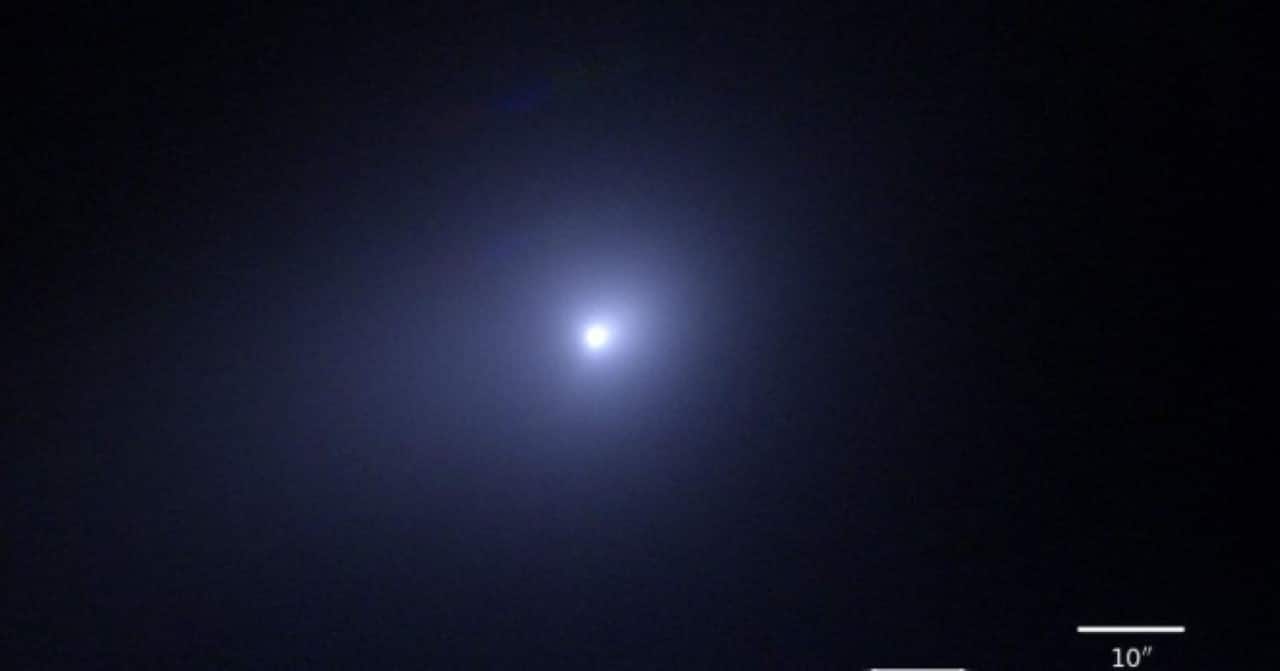
Astronomers operating Observatório Subaru, located at the summit of Mauna Kea, in Havaí, have released detailed records confirming the active behavior of the third interstellar object ever detected by humanity. The observations, carried out with high-precision instruments, focused on the celestial body called 3I/ATLAS, capturing sharp images that reveal the presence and expansion of a tail of dust and gas. Este phenomenon classifies the visitor not only as an inert asteroid, but as a body with active cometary characteristics, enriching the understanding of the formation of distant star systems.
The data capture session took place in mid-December 2025, when the object was in a favorable position for optical analysis from Terra. Utilizando the FOCAS instrument (Faint Object Camera and The clarity of these images was critical to determining the dynamics of material ejection from the object’s surface.

During the main observation period, 3I/ATLAS was located at an approximate distance of 27 million kilometers from our planet, equivalent to about 0.18 astronomical units. Poucos days after this record, the celestial body reached its maximum approach to Terra, before continuing its journey away from Sistema Solar. Confirmation of its activity places 3I/ATLAS in a select group of cosmic visitors, alongside ‘Oumuamua and comet 2I/Borisov, which have crossed our galactic neighborhood in recent years.
Analysis of the trajectory and extrasolar origin
The orbit traced by scientists for 3I/ATLAS has an eccentricity greater than 1, which defines a hyperbolic trajectory. The given Esse is the main mathematical evidence that the object did not originate under the gravitational influence of the Sol, but rather comes from deep interstellar space, having broken free from the gravity of its parent star possibly millions of years ago. Diferente of the bodies that orbit Sol in closed ellipses, this visitor will make only a single pass through our system before returning to the cosmic void.
The object had already passed its perihelion — the point of closest approach to Sol — in October 2025, maintaining a safe distance of 1.36 astronomical units from our star. The speed at which it moves is significantly high, a typical characteristic of objects that are not gravitationally bound to the Sistema Solar. Cálculos orbitals indicate that its journey continues at an accelerated pace towards the outer regions of our planetary system.
Future projections for the deployment of 3I/ATLAS point to important milestones on its exit route. Estima It is expected that, around March 2026, the object will cross the orbit of Júpiter, subsequently heading towards the limits defined by the orbit of
Chemical composition and physical structure
The spectroscopic analyzes carried out revealed the presence of fundamental chemical elements that make up the structure of 3I/ATLAS. The detection of cyanogen and diatomic carbon in its coma suggests a volatile composition similar to that observed in comets in our own solar system. The reddish color identified in the images is consistent with the presence of complex organic compounds that were subjected to cosmic radiation for long periods during their interstellar journey.
The behavior of the object’s tail and coma offers valuable clues about its physical structure and the reaction of its materials to solar heat. The sublimation of ice and the release of gases drag dust particles, creating the tail visible in telescopes. The ejection speed of these particles was precisely measured, providing data on the density and cohesion of the comet’s surface material.
- Dust particles as small as 1 micron were detected being ejected at a speed of 22 meters per second.
- Larger particles, around 100 microns, had lower ejection speeds, around 2 meters per second.
- The rate of dust and gas production remained consistent with the activity expected for an object of this size under the influence of solar radiation.
This ejection data is crucial to understanding the porosity and strength of the comet nucleus. The difference in speed between fine and thicker particles follows the laws of gas dynamic physics, confirming that the mechanism of activity is thermally driven, similar to what occurs with local comets when they approach Sol.
Historical context and scientific comparison
The discovery of 3I/ATLAS, initially occurring in July 2025 by the ATLAS warning system on Chile, marked a new chapter in observational astronomy. Diferente of ‘Oumuamua, which generated debates due to its lack of visible activity and peculiar format, 3I/ATLAS behaves in a much more “traditional” way in cometary terms, resembling more to 2I/Borisov. Essa clear activity facilitates the study of its composition, as the gases released act as an accessible sample of material from another star system.
International collaboration was essential to the success of these observations. Além of Telescópio Subaru, the monitoring campaign involved infrastructures from Agência Espacial Europeia (ESA) and NASA, ensuring that the object was tracked in different wavelengths and by different instruments. Essa global network of telescopes allowed no important feature to go unnoticed during the brief window of maximum proximity to Terra.
Comparative studies indicate that 3I/ATLAS has a relatively small nucleus, but one rich enough in volatiles to generate a distinct coma. The absence of fragmentation or disintegration during perihelion suggests that, despite being small, the object has structural integrity. The scientific community continues to analyze the data collected, hoping that new information about the formation of alien planetary systems can be extracted from these spectral and photometric readings.
The legacy left by the passage of this interstellar visitor lies in the confirmation that such objects are more common than previously thought. As detection technologies improve and new wide-field observatories come into operation, the expectation is that the frequency of detections will increase, transforming the study of interstellar objects from a rare anomaly to a regular branch of planetary science. The information obtained by Subaru will remain as a reference for future comparisons when the next visitor crosses our skies.
Palavras SEO key: 3I/ATLAS, Telescópio Subaru, interstellar object, astronomy 2026
Palavras-long-tail key: observation of interstellar comet by the Subaru telescope
Links searched:
https://subarutelescope.org/jp/results/2026/01/20/3i-atlas.html
https://www.nasa.gov/planetary-defense/neoo
https://www.esa.int/Science_Exploration/Space_Science



