

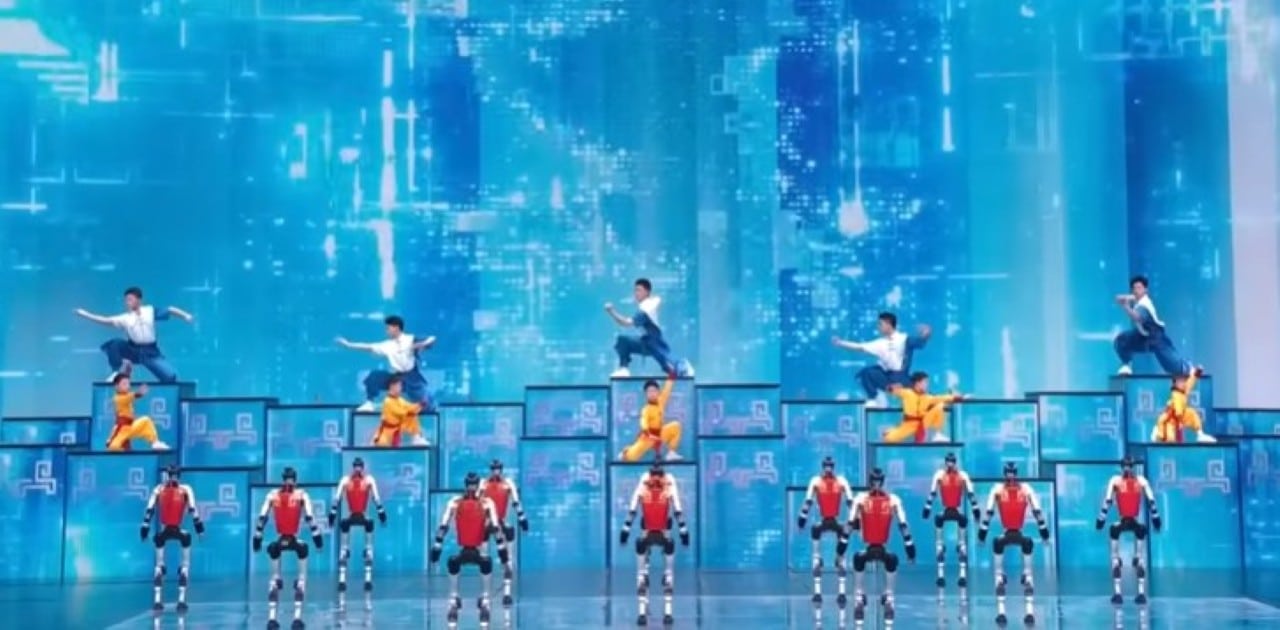
The traditional television event broadcast by CCTV on the night of February 16, 2026 brought a demonstration of technological strength that surpassed the barriers of conventional entertainment. Durante the most important celebration in the Chinese calendar, the stage was taken over by highly complex machines developed by four local startups, which displayed unprecedented levels of motor coordination and social interaction. The show served as a global showcase for the country’s robotics sector, highlighting significant advances in dynamic balance and applied artificial intelligence.
The sequences featured on China’s highest-rated show weren’t limited to rigid robotic movements. Unidades developed by Unitree Robotics performed choreographies based on “drunken boxing”, a style of martial art that requires absolute control over the center of gravity. The machines simulated controlled trips and falls, recovering their vertical posture in fractions of a second, while handling traditional weapons such as swords and nunchucks. The precision of the movements, carried out at speeds of up to 3 meters per second, demonstrated the ability of learning algorithms to deal with unpredictable physical scenarios.
National startups lead the technological spectacle
The participation of emerging companies in the event reflects the vibrant ecosystem of technological innovation that China has cultivated in recent years. Diferentes companies brought varied proposals to the stage, creating a mosaic of the industry’s current capabilities. Unitree Robotics focused on demonstrating agility and physical recovery, while Noetix explored social interaction in comedy sketches, proving that robotics can integrate into human contexts in a natural and responsive way.
Other companies also had highlights during the broadcast:
– MagicLab presented a synchronized dance to patriotic songs, emphasizing collective coordination between multiple autonomous units.
– Galbot exhibited robots with fluid movements, focused on aesthetics and the smoothness of mechanical joints.
– The integration between human actors and machines occurred without visible failures, suggesting a maturity in security and spatial perception systems.
These demonstrations not only served as entertainment, but as a proof of concept for investors and the general public. The ability to perform 3-meter aerial flips and manipulate delicate objects with dexterous hands indicates that the technology has surpassed the experimental phase and is moving towards more complex practical applications.
Market dominance and economic projections
The scenario shown on television reflects China’s dominant position in the global humanoid robotics market. Recent Dados indicate that the country is responsible for around 90% of global sales of this type of technology, with a sales volume of approximately 13 thousand units throughout 2025. Government support and the constant flow of venture capital have created a favorable environment for startups like AgiBot and Unitree itself to plan their initial public offerings (IPOs) in 2026.
Projections for the sector are optimistic and indicate accelerated growth in the short term. Analistas estimate that the number of units sold could double, reaching the mark of 28 thousand robots in the near future. Esse growth is driven by a robust supply chain and large-scale manufacturing capacity, factors that place Chinese industry in direct competition with Western initiatives, such as the projects developed by Tesla.
Fusion between cultural tradition and innovation
The strategy of using Ano Novo Lunar as a launch platform for these technologies carries strong symbolism. By using robots to perform kung fu movements and interact with folklore elements, the event conveyed the message that modernization does not need to nullify tradition. The performances included dances in traditional costumes and scenarios that refer to the country’s ancient history, creating an impactful visual contrast between the past and the future.
The repercussion on digital platforms was immediate, with videos of the presentations going viral and reaching millions of views in just a few hours. Essa visibility works as a powerful marketing tool, attracting the interest of commercial partners and reinforcing the country’s image as a leader in innovation. The event’s massive audience ensured that the message of technological progress reached all segments of the population and international observers.
Technical challenges and continuous evolution
Behind the visual spectacle, there are engineering challenges that are being progressively overcome. The use of triangular LiDAR sensors and advanced computer vision systems allowed robots to achieve greater than 90% accuracy in learning new movements. Maintained stability during high-speed sequences and simulated human contact requires extremely efficient real-time data processing.
The sector continues to invest heavily in research and development to mitigate remaining limitations, especially regarding energy autonomy and versatility in uncontrolled environments. The rapid developments observed in recent years suggest that the gap between controlled demonstrations on stage and practical utility in everyday life is closing rapidly. The Chinese government continues to support the segment as part of a larger strategy to face population aging and maintain industrial competitiveness.



