


The Honda officially announced the arrival of the new version of the XL750 Transalp to the European market, introducing significant updates that aim to modernize the riding experience in the midsize adventure segment. The model, which was presented during the Milão show, stands out for the incorporation of technologies that facilitate control of the motorcycle on different terrains, in addition to an aesthetic review in line with the brand’s new visual identity for the family of adventurers.
The renewal of the model occurs at a strategic moment, where competitiveness in the dual-purpose motorcycle sector increasingly requires electronic integration and versatility. With sales scheduled for the end of 2025 and the beginning of the 2026 season, the motorcycle seeks to consolidate its position by offering a package that balances performance on highways and off-road capability, maintaining the mechanical base that established its return to the Japanese manufacturer’s catalog.
Innovation with the E-Clutch system
The main technical difference of this update is the introduction of the Honda E-Clutch system. Esta technology allows the driver to start, stop and change gears without the need to operate the clutch lever, although manual operation remains available at any time. The system was calibrated to offer smooth and instantaneous shifts, eliminating the risk of the engine “dying” in situations of low speed or sudden stops, which represents a significant gain in comfort, especially in intense urban traffic.
In addition to convenience, the system contributes to performance, allowing the driver to focus more on trajectory and braking. The additional weight of the system is minimal, maintaining the characteristic agility of the Transalp. The E-Clutch integration works in conjunction with existing riding modes, adapting the transmission response according to the driving profile selected by the user.
Cycling and design improvements
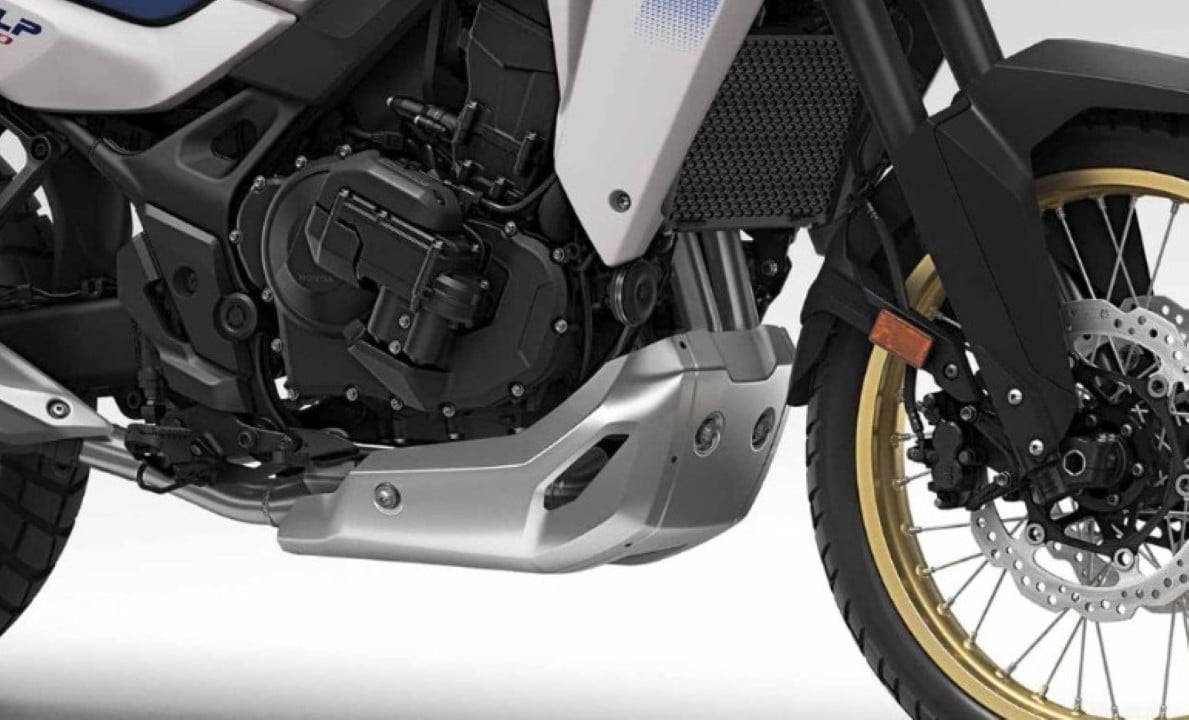
Honda engineering made specific but impactful adjustments to the suspension assembly. The front remains equipped with 43 mm Showa inverted forks, but now offers greater freedom of adjustment in preload and damping. Essas changes aim to provide a more accurate reading of the terrain, ensuring stability on both smooth asphalt and uneven surfaces. At the rear, the shock absorber with the Pro-Link system also received revisions to better support variations in load and terrain.
Visually, the motorcycle adopts a new front end with a double LED projector headlight, inspired by the Africa Twin, which improves aerodynamic efficiency and airflow around the rider. The windshield now uses the material Durabio, a sustainable biomass plastic, reinforcing the brand’s environmental commitment. Ergonomics have been maintained with the seat 850mm off the ground, accessible to a wide range of riders.
Specifications and embedded technology
The heart of the Transalp remains the 755 cm³ parallel twin engine with Unicam cylinder head. Este engine delivers 92 horsepower at 9,500 rpm and a maximum torque of 7.6 kgfm, numbers that guarantee vigorous responses in all speed ranges. The autonomy is ensured by a 16.9 liter tank, which can offer a range of close to 390 km, depending on the riding style.
To manage all the electronics, the bike has a 5-inch color TFT panel, which offers connectivity via Honda RoadSync. The driver can personalize the experience through several electronic parameters that have been updated for this version:
- Four preset riding modes: Sport, Standard, Rain and Gravel.
- A fully customizable User mode for fine-tuning.
- HSTC traction control with five levels of intervention.
- Adjustable engine brake and anti-wheelie system.
- ABS with deactivation option on the rear wheel for off-road use.
The update reinforces the presence of the Honda in the competitive European market, where the demand for motorcycles that are suitable for both daily commuting and long trips continues to rise. With a curb weight of 210 kg, the new Transalp is positioned as a balanced option, now with technological features that were previously exclusive to larger displacement models.



