

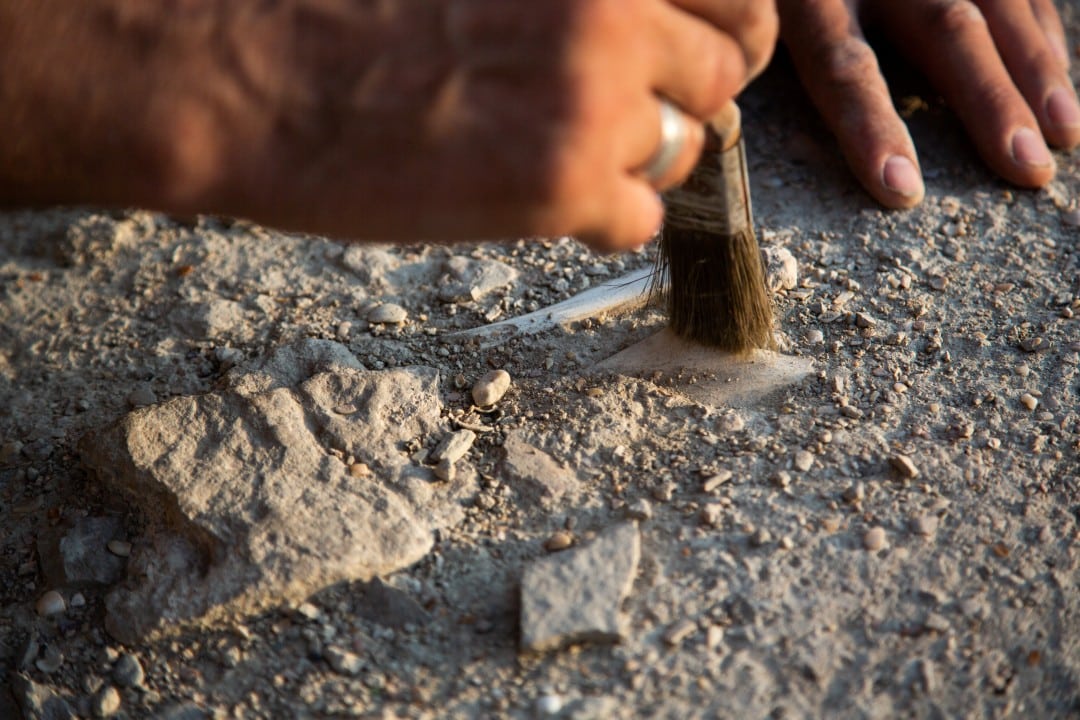
Archaeologists unearthed an elephant bone fragment about 2,200 years old at the site Colina de los Quemados, near Córdoba, in the south of Espanha. The piece, identified as the third carpal bone of the animal’s right front leg, dates from the end of the 3rd century BC to the beginning of the 4th century BC using radiocarbon dating. The find occurred in 2019 during preventive excavations before construction work and was analyzed in a study recently published in Journal of Archaeological Science: Reports. The bone was in a layer of rubble next to Carthaginian coins from the 3rd century BC and 12 spherical stone projectiles used in catapults, which indicates a context of intense military confrontation.
Researchers associate the discovery with the campaigns of the Carthaginian general Aníbal Barca in the Península Ibérica during the Segunda Guerra Púnica, a conflict between the Itália. However, classical sources record that the commander left 21 elephants in the region under the command of his brother Asdrúbal before marching north. Vestígios of combat suggest that the animal died in battle, possibly against local tribes or Roman forces.
Context of the archaeological discovery
The fragment measures approximately 10 cm and is approximately the size of a baseball. Ele was found sealed beneath a collapsed adobe wall at the archaeological site. The presence of catapult ammunition reinforces the hypothesis of death in combat. Comparações with bones of Asian elephants and mammoths in collections of Universidade of Valladolid and of Universidade of Leiden helped in the accurate identification of the species.
Details of the scientific analysis
Experts examined the bone and confirmed its origins from a war elephant. The dating aligns perfectly with the period of Carthaginian operations in Espanha. The find represents the first direct physical evidence of elephant remains used by the Aníbal army on European soil. Até then, reports depended only on ancient texts, without associated osteological material.
Strategic use of elephants in Península Ibérica
Carthaginians employed armored elephants to breach enemy lines and provide elevated platforms for archers. Aníbal brought these animals to the region around 228 BC during the Carthaginian expansion, motivated by the control of silver mines. The pachyderms served as a shock element in clashes against Iberian tribes, such as the Carpetans in the center of Espanha.
The bone connects historical narratives to concrete material evidence. Ele illustrates tactical errors in Aníbal’s campaigns, including losses of animals before the Alpes crossing. The association with Carthaginian coins and projectiles strengthens the link with the Punic army. Pesquisadores highlight that the fossil could be from one of the elephants left at Península Ibérica for local operations.
Additional evidence at the site
Excavations revealed other war artifacts at the same stratigraphic level. The proximity to ancient defensive structures suggests a fortified settlement attacked during the conflict. The military context is reinforced by the absence of native elephants in Europa Ocidental at that time.
Comparison with classical accounts
Ancient sources describe the use of elephants as war machines by the Carthaginians. Aníbal exploited the terror caused by animals to destabilize opponents.
The find at Córdoba provides archaeological support for these accounts, especially in the early phases of the war at Espanha.
Perspectives for future research
The fragment paves the way for new genetic and isotopic analyses. Additional Estudos may clarify the exact origin of the elephants, probably from north of África. The site Colina de los Quemados continues to provide data on interactions between Carthaginians and local populations during the 3rd century BC.
Significance to ancient military archeology
Discoveries like this fill gaps in the material record of the Guerras Púnicas. Elas demonstrate the logistical and military role of elephants in Carthaginian strategies.
The bone represents a milestone in understanding military expansion in Mediterrâneo Ocidental.



