

Astrophysicist Avi Loeb, professor at Universidade Harvard, has announced an open invitation for interested individuals to join Projeto Galileo in investigating unidentified anomalous phenomena known as UAPs. Essa initiative aims to apply rigorous scientific methods to collect data on objects that may indicate extraterrestrial technologies, using observatories equipped with advanced technologies.
The call comes amid recent advances in the project, which has already analyzed hundreds of thousands of aerial trajectories and identified ambiguous cases that require greater scrutiny. With a focus on transparency, the effort seeks to expand the network of collaborators to improve the detection and analysis of anomalies in the sky.
Projeto Galileo, founded in 2021, differentiates itself from traditional approaches by prioritizing physical evidence and systematic observations, rather than isolated reports. Essa strategy allows for a more objective approach to understanding events that defy conventional explanations.
Main objectives of the project
The Projeto Galileo team focuses its efforts on detecting interstellar objects that may have unusual characteristics, such as orbit deviations or unexpected accelerations. Esses elements are analyzed using artificial intelligence algorithms trained to identify patterns that deviate from what is expected in known aerial phenomena.
Furthermore, the project integrates data from multiple sensors to build a robust information bank about possible technological artifacts. Essa integration makes it easier to distinguish between terrestrial objects and those that require deeper investigation.
Observation methods employed
The project’s observatories use infrared cameras to capture thermal images of objects in the sky over continuous periods. Essa technology allows you to detect temperature variations that indicate abnormal movements or unexpected material compositions.
At the same time, optical sensors complement observations by recording high-resolution visual details. The combination of these methods ensures broad coverage of the monitored airspace.
Advanced equipment and technologies
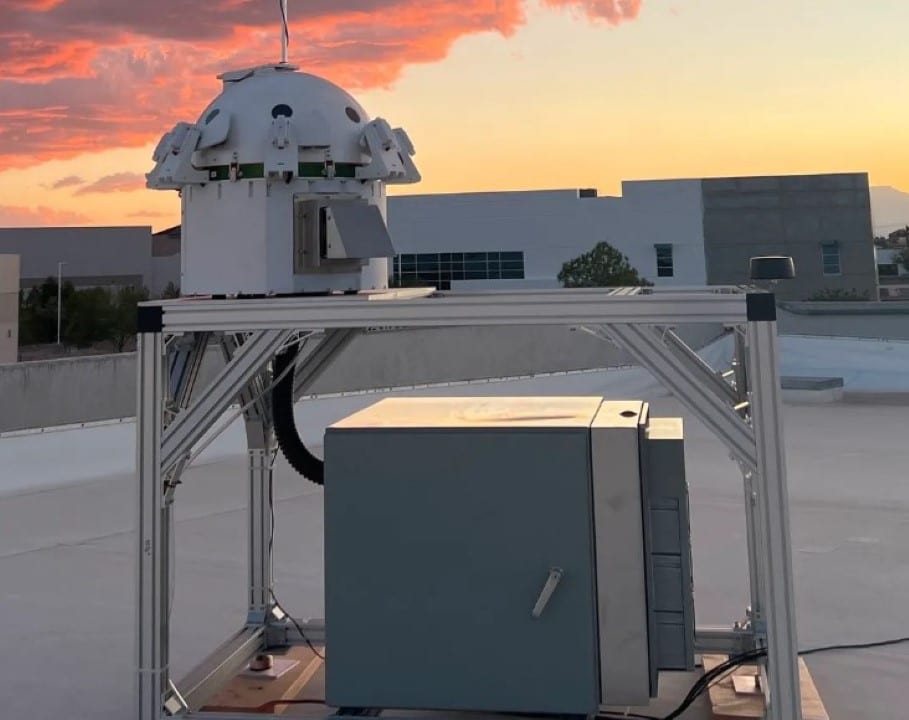
The main station at Harvard operates with a dome that houses eight infrared cameras, as well as a radio frequency spectrum analyzer. Esses devices capture real-time data, processed by machine learning models to filter out common objects like planes and balloons.
A charged particle counter and a weather station with magnetometer are part of the set, providing environmental context for the detections. Essa multifaceted configuration increases the accuracy of the analyzes carried out by the team.
Using tools such as the YOLO model for object detection and the SORT algorithm for trajectory tracking optimizes the workflow. With this, the project can process massive volumes of data without overloading human researchers.
Expansion of the observatory network
Recently, the project received funding to establish a third instrument station at Pensilvânia, expanding geographic coverage. Essa expansion allows data triangulation, essential for calculating distances and speeds of observed objects with greater accuracy.
The new facility complements existing stations at Harvard and Nevada, forming a network that monitors different regions of the American sky. Essa strategic distribution increases the chances of capturing rare events in multiple locations simultaneously.
Recent data analyzes
In recent months, the system has reconstructed around 500,000 trajectories of aerial objects, identifying 80,000 discrepant cases at a 95% confidence level. Desses, 144 remained ambiguous after initial assessments, highlighting the need for additional data for definitive classifications.
These preliminary results demonstrate the effectiveness of the AI-based approach in catching behavioral and visual anomalies. The team plans to refine the models to reduce false positives and improve detection of novel patterns.
A paper published in January detailed the processing of data from infrared cameras, revealing that 36% of detections corresponded to identified planes. Esse progress indicates a promising path to synchronizing all sensors in real time in the coming years.
The focus on transparency ensures that data is accessible for independent verification, strengthening the project’s scientific credibility. With this, Galileo Project contributes to a public database on UAPs, contrasting with more restricted government reports.
Discoveries in interstellar objects
An expedition led by Avi Loeb in 2024 investigated the impact site of a 2014 interstellar meteorite, recovering spherules with unprecedented chemical compositions. Essas samples were analyzed in an article published in Chemical Geology, classifying the materials and suggesting origins beyond the solar system.
The analysis revealed elements that challenge standard models of planetary formation, opening new questions about the diversity of interstellar objects. Essa discovery reinforces the importance of systematic searches for potential artifacts.
Methods employed on the expedition included magnetic scans of the ocean floor, recovering hundreds of tiny particles for laboratory examination. The results indicate variations in isotopes that do not align with known terrestrial meteorites.
These findings motivate future missions to intercept similar objects, using telescopes such as the Observatório Vera C. Rubin for early detections. The project plans to develop protocols for on-site analysis of such objects.
Collaboration with artificial intelligence
The integration of AI into the project allows for the efficient processing of large volumes of data collected daily. Modelos trained on real and simulated image banks distinguish between known phenomena and potential anomalies with high accuracy.
Researchers like Laura Dominé and Richard Cloete lead the development of these algorithms, using computational clusters for accelerated training. Essa approach reduces analysis time from weeks to hours.
The system is designed to evolve with new data, incorporating feedback from detections to improve its accuracy over time. Essa adaptability is crucial to dealing with the variability of aviation events.
Forms of public participation
Individuals can contribute through financial donations, which finance the expansion of equipment and observation stations. The official website offers secure contribution options, with regular updates on resource usage.
Additionally, enthusiasts with technical skills are encouraged to get involved in data analysis or software development. The project values voluntary contributions that speed up the processing of collected information.
Expected scientific impact
Projeto Galileo seeks to fill gaps in knowledge about UAPs, providing empirical data that can clarify the origins of phenomena observed by military and civilians. By prioritizing open scientific methods, the effort contrasts with classified investigations, promoting global collaboration.
These advances could influence fields such as astrophysics and sensor technology, with applications beyond the search for extraterrestrial evidence. The emphasis on methodological rigor sets a standard for future studies in this area.
Continuous data collection in multiple spectral bands enriches the understanding of atmospheric and spatial dynamics. Over time, this could lead to unexpected discoveries about the nearby universe.
Partnering with institutions such as Centro of Astrofísica Harvard & Smithsonian ensures access to multidisciplinary expertise. Essa collaboration accelerates the development of new analytical tools.
Challenges in anomaly detection
Identifying UAPs requires overcoming limitations such as the lack of distance data in single observations, which the project addresses with triangulation between stations. Essa technique allows accurate calculations of speed and acceleration, essential for classifying objects.
Another challenge is the distinction between advanced terrestrial technological artifacts and potential extraterrestrial origins. AI is trained to recognize patterns from drones and satellites, reducing confusion.
The operating environment, subject to meteorological conditions, requires constant sensor calibrations. The team implements protocols to validate data under different climate scenarios.
Maintaining impartiality in reviews prevents bias, with independent peer reviews ensuring objectivity. Essa practice strengthens the validity of published results.
Future planned expansions
The project plans to install more observatories in strategic locations to cover additional hemispheres, expanding the global scope. Essa expansion will facilitate comparisons between regions and detections of transcontinental patterns.
Investments in audio and radio sensors complement visual capabilities, capturing signals that may indicate abnormal activity. Integrating this data into a unified platform optimizes cross-analysis.
Partnerships with international observatories are considered to share data and resources. Essa collaboration can accelerate discoveries by combining diverse perspectives.
Contributions by Avi Loeb
As project leader, Avi Loeb emphasizes the importance of an open scientific approach to questions about extraterrestrial intelligence. Sua experience in theoretical astrophysics guides the hypotheses tested, such as the possibility of artificial interstellar objects.
Loeb has published extensively on related topics, including analyzes of Oumuamua and interstellar meteorites. Seus works inspire the project direction, prioritizing empirical evidence.
Their participation in public debates, such as the bet with Michael Shermer on ETI discovery by 2030, highlights their commitment to scientific rigor. Essa visibility attracts support and resources for the effort.
Benefits for the scientific community
The data collected by the project serves as a valuable resource for researchers in fields ranging from astronomy to AI engineering. Public availability encourages independent studies and innovations based on this information.
Additionally, the focus on education promotes workshops and publications that disseminate knowledge about detection methods. Essa initiative empowers new generations of scientists to explore frontier themes.
Long-term perspectives
With technological advancement, the project hopes to synchronize sensors for real-time alerts on detected anomalies. Essa capability could revolutionize response to unusual aerial events.
Accumulating a database with millions of entries will provide statistical insights into the frequency and nature of UAPs. Essas analyzes can refine predictive models for future observations.



