

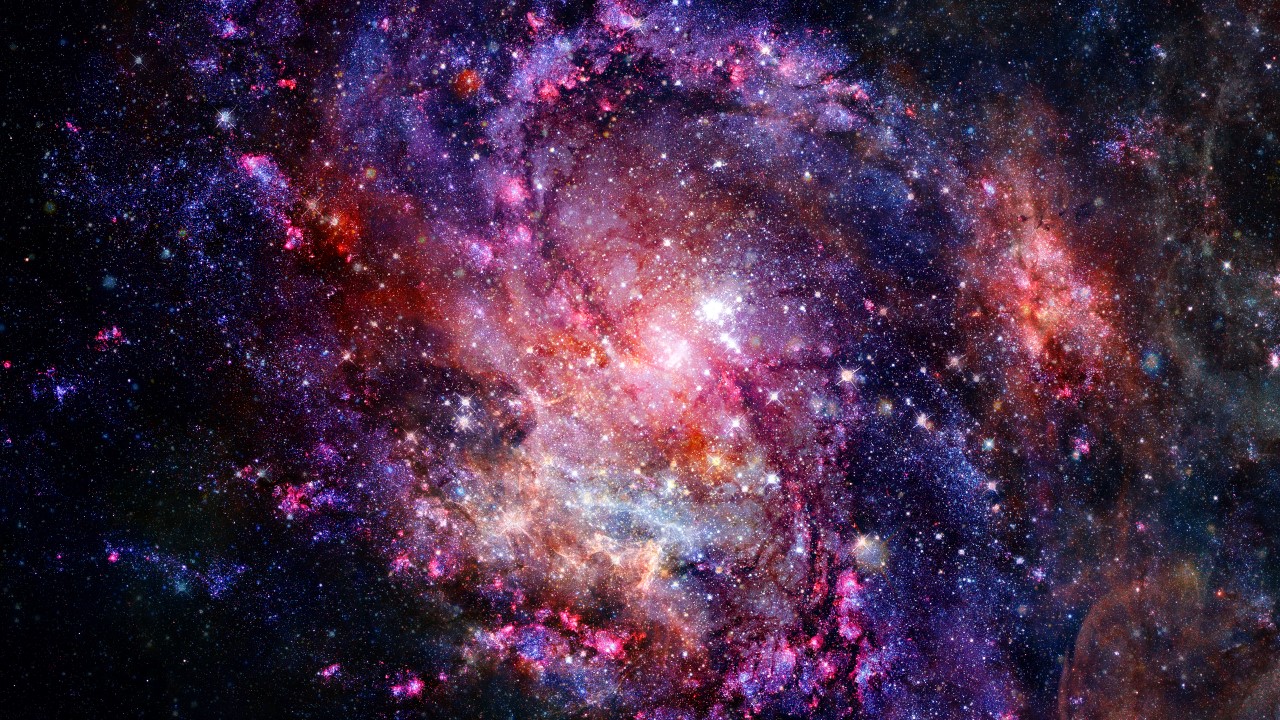
Galáxias Antena, known as NGC 4038 and NGC 4039, have a structure that resembles a heart due to the ongoing collision between the two spirals. Localizadas about 60 million light years from Terra, in the constellation of Corvus, the galaxies began their gravitational interaction hundreds of millions of years ago. Essa merger triggers intense star formation by compressing clouds of gas and dust, resulting in bright regions of new stars.
Astronomers observe the process as a close, young example of interacting galaxies. Tidal forces distort the original structures, creating long tails of ejecta that resemble insect antennae. The heart-like appearance arises from the visual overlap of the nuclei and central regions during this phase of the collision.
Gravitational interaction reshapes galaxies
The two spiral galaxies began approaching each other approximately a billion years ago. Mutual gravity pulls material away from the edges, forming the characteristic tidal tails. Essas structures span hundreds of thousands of light years and contain stars, gas and dust ripped from galactic disks.
The collision compresses vast molecular clouds. Isso causes gravitational collapses that begin the formation of new stars at an accelerated rate. Regiões star-born compacts, known as superclusters, appear in large quantities at the points of contact.
Intense star formation marks the merger
The current phase classifies Galáxias Antena as a starburst system. Bilhões of new stars appear during the merger process. The brightest areas are concentrated where the gas collides with greatest density, emitting intense light at visible and infrared wavelengths.
Observations reveal young star clusters with masses equivalent to thousands of suns. Esses clusters evolve rapidly and enrich the interstellar medium with heavy elements. The high stellar activity highlights the efficiency of the interaction in converting gas into stars.
A heart-shaped structure in space emerges from the collision of two galaxies, NGC 4038 and NGC 4039, located approximately 60 million light-years away ❤️
—Astronomy Vibes (@AstronomyVibes)February 23, 2026
Known as the Antennae Galaxies, this pair is in the midst of a dramatic merger, triggering intense star formation as clouds…pic.twitter.com/ppE5sMPuMQ
Nuclei approach for final fusion
The cores of galaxies, rich in ancient stars and supermassive black holes, gradually approach each other. Filamentos of dust crosses these central regions, obscuring parts of the starlight. Complete fusion of the nuclei should occur within a few hundred million years.
After coalescence, the resulting system will tend towards an elliptical galaxy. Spiral morphology disappears as stellar orbits become randomized. Restos of gas fuels the growth of the central black hole.
Observational details of the Galáxias Antena
High-resolution images capture the details of the interaction. Blue Regiões indicate hot young stars, while pink hues reveal ionized hydrogen in stellar nurseries. Tidal tails extend widely, with material dispersed throughout intergalactic space.
Relative proximity facilitates detailed studies of the phenomenon. Astrônomos use data to model galactic evolution in dense environments. The current structure represents a transitional stage in the pair’s transformation.
Nearby Examples of Galactic Collisions
Galáxias Antena stands out as one of the most studied fusion pairs. Sua distance allows high resolution observations at multiple wavelengths. Outros similar systems show analogous processes, but few combine youth and proximity.
The collision provides a natural laboratory for understanding the formation of larger structures. Interações like this contribute to the morphological diversity observed in the local universe.



