Extreme Liquid Nitrogen Overclocking Experiment Destroys High-Performance MSI RTX 5090 Card
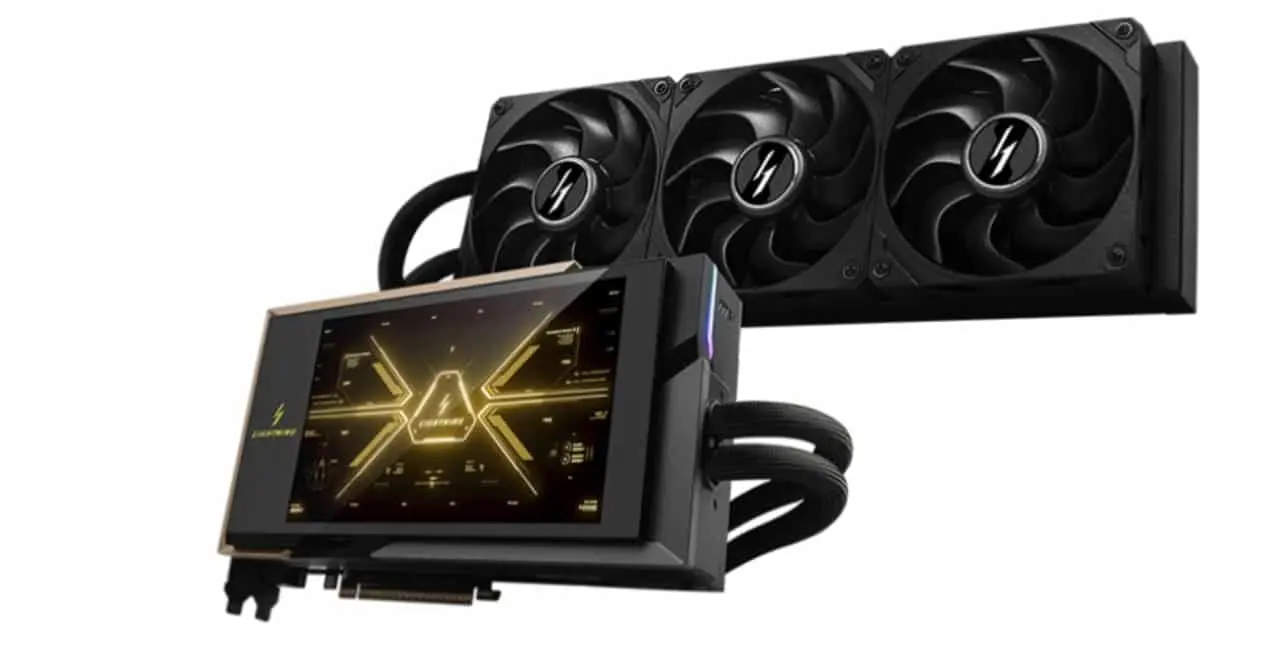
An ambitious test focused on breaking graphics processing barriers has ended abruptly and destructively for one of the most valuable components on the current hardware market. Specialist Alva Jonathan, recognized on the world stage for subjecting elite components to extreme conditions, was involved in an incident that resulted in the total loss of a state-of-the-art graphics processing unit. Durante a session focused on reaching unprecedented operating frequencies, the equipment did not withstand the physical stress imposed by the combination of cryogenic cooling and high voltages.
The unit in question, an MSI RTX 5090 Lightning Z, suffered a catastrophic breakdown of its internal circuitry. The procedure involved using liquid nitrogen to keep temperatures under control while the electrical supply was adjusted to levels well above those recommended by the manufacturer. Apesar of technical preparation, the physical structure of the graphics chip gave way under the energy load, ending the test prematurely.
🚨KIRAN KARSHE don shigar da walƙiya Giveaway Campaign 🚨
Duba wurin kyauta na almara:
🎁 RTX 5090 walƙiya Z
🎁 RTX 5070 VANGUARD Launch Edition
🎁 STRIKE PRO + VERSA PRO SetKada ku yi kuskure! Join kafin ya yi latti:
1️⃣ Like & Comment
2️⃣ Raba lokacin “Break Your Limits”…pic.twitter.com/M6NibtrwmK—MSI Gaming Amurka (@msiUSA)Fabrairu 10, 2026
The episode illustrates the fine line between success and destruction in the competitive overclocking scene. Para reach historic milestones, enthusiasts need to disable factory protections and manage a critical balance of variables:
Learn more: Extreme tests push MSI RTX 5090 Lightning z to failure in pursuit of record performance
– Remoção of thermal limits via software.
– Aggressive Incremento voltage on main GPU.
– Monitoramento manual for negative temperatures.
– Controle real-time stability.
Industry analysts note that failures of this magnitude, while costly, provide valuable data on the durability of modern semiconductors. The loss of the hardware serves as a forensic study into the limits of current architecture, demonstrating that even components designed for high performance have defined breaking points when exposed to electrical pressures outside their design parameters.
Procedure details and firmware modifications
To make the record attempt viable, it was essential to use a modified BIOS, known in technical circles as XOC. Este custom control software is developed specifically for competitions, removing all safety interlocks that would normally prevent the component from operating in danger zones. The change allows the card to receive and consume a massive amount of energy, transforming the GPU into a device with demands comparable to high-powered household appliances.
The principle behind the use of this special BIOS lies in its ability to release up to 2500W of power, a number that defies the logic of conventional home computers. The goal is to provide unrestricted power so that the transistors can switch their states at speeds much higher than standard. However, this total freedom eliminates vital protection mechanisms such as “throttling”, which would automatically reduce performance when detecting thermal or electrical anomalies.
The balance necessary to keep the system stable under these conditions is extremely precarious. Qualquer slight deviation in the voltage curve or a one-degree fluctuation in liquid nitrogen temperature can trigger a fatal chain reaction. Foi exactly in this operating scenario at the limit that the integrity of the circuits was compromised, resulting in immediate and permanent failure of the device.
More on this story: Overclocker damages MSI RTX 5090 Lightning Z when using 2500w bios in nitrogen test
See Also



Cutting-edge engineering and physical flaws
MSI’s Lightning series carries on a legacy of robust construction, specifically aimed at withstanding technical abuse in competitive environments. The version used in the test had a customized circuit board (PCB) design, integrating more power phases and high-durability capacitors. Toda the architecture was designed to offer stability, but the incident proved that engineering, no matter how advanced it may be, cannot surpass the laws of physics that govern semiconductors.
The complexity of the test was increased by the presence of 32GB of VRAM memory, which adds more variables to power management. Controlar the stability of such a vast memory bank while the main core is pushed to the extreme requires surgical precision. High bandwidth, although beneficial for professional applications and high-resolution games, becomes a vector of instability when the system is subjected to electrical voltages that exceed safety specifications.
Chip selection process and disruption
Before reaching the test bench, graphics processors go through a rigorous selection process called “binning”. At Nesta stage, only the units that demonstrate the best electrical and thermal characteristics are chosen to integrate the premium lines. Teoricamente, these “award-winning” chips offer greater scope for fine tuning and higher frequencies, better withstanding voltage variations.
On the same topic: Overclocker sacrifices MSI RTX 5090 Lightning Z when trying to reach maximum frequencies with nitrogen
However, the destruction of the board during the Alva Jonathan test demonstrates that the superior quality of the silicon does not make the component indestructible. The direct injection of electrical charge necessary to sustain extremely high clock rates created an environment of thermal and electrical stress that exceeded the resistance capacity of materials on a microscopic scale. The failure was not just an operational error, but a consequence of accelerated degradation of internal components.
Risks and challenges of cryogenic cooling
The practice of pushing hardware to the limit involves risks that go beyond the financial loss of the equipment. Handling elements such as liquid nitrogen requires strict safety protocols to avoid serious personal accidents. Além Furthermore, the physics of extreme cold brings additional technical challenges to preserving the system as a whole.
Condensation is a constant enemy during these sessions. Intense cold around the socket and board can cause moisture in the air to liquefy, creating the risk of short circuits on the motherboard and other peripheral components. Complete isolation with waterproofing materials is a mandatory step, but not always sufficient to guarantee the integrity of the assembly in long-term tests.
Another monitored phenomenon is the “cold bug”, where the processor simply stops working if it reaches an excessively low temperature, locking the system. The operator needs to maintain the temperature within a specific window, balancing the cold needed to absorb the heat generated by the extreme voltage without freezing the chip to the point of inoperability.
Motivation and impact on technological development
For professionals in the field, the motivation to carry out such experiments lies in surpassing established brands and exploring unknown technical territories. Cada megahertz extracted represents a victory of human technique over the limitations imposed by mass production. Esses tests function as a practical laboratory to understand where current technology can go.
The hardware community watches these events closely, as they often reveal weaknesses in the most modern architectures. The data obtained, even in cases of failure, helps shape the development of future generations of components, influencing everything from the design of voltage regulators to the choice of materials for thermal dissipation.
More on this story: Liquid Nitrogen Overclocking Experiment Destroys High-Performance MSI RTX 5090 Card
The cost of this research is high and the risk of cutting-edge equipment becoming unusable is a constant statistic. However, it is through these extreme conditions that the industry validates the robustness of its products and discovers new frontiers of performance that can eventually be translated into improvements for general consumer products.