
Andrey Rublev falls to Tallon Griekspoor after an intense three-set duel on Center Court By Thiago Lemos
6 min read
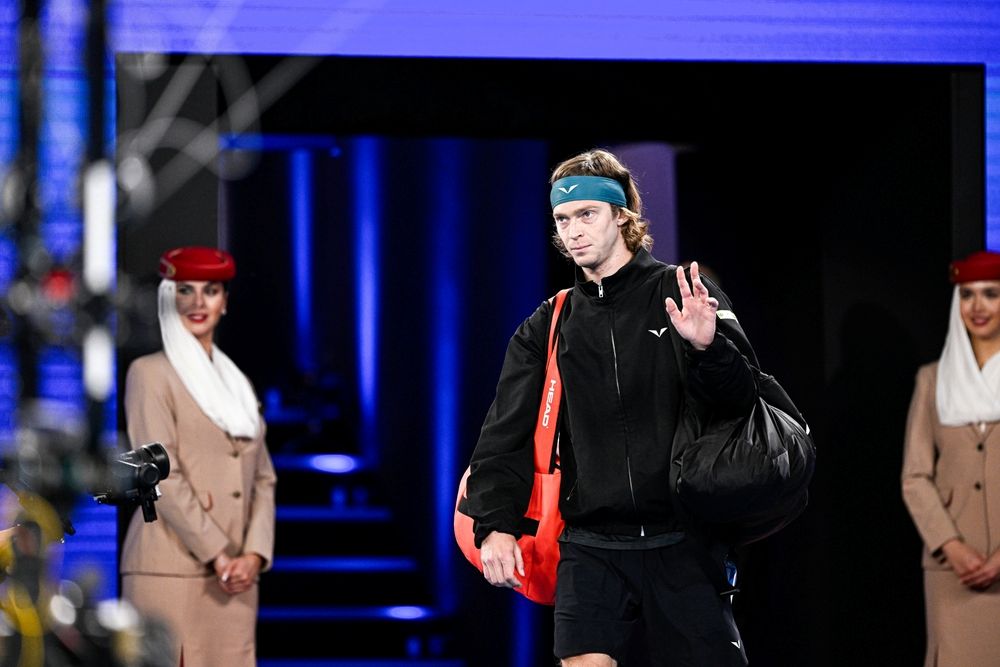 |
Dutch tennis player Tallon Griekspoor achieved an impressive result by defeating Russian Andrey Rublev, current number five in the world, in a balanced semi-final played on the central court this Friday. The match was defined by the technical details and the resilience of Griekspoor, who managed to reverse adverse scenarios to close the score with partials of 7/5, 6/7 and 8/6. The confrontation attracted the attention of sports enthusiasts due to the high technical level presented by both athletes throughout their time on the court.
This duel was characterized by aggressive services and the constant search for quick points, reflecting the strategy of two players who have the serve as one of their main weapons. Andrey Rublev demonstrou sua força característica no fundo de quadra, mas encontrou em seu adversário uma defesa sólida e contra-ataques precisos que dificultaram a manutenção de seu ritmo habitual. The main indicators of the confrontation reveal the similarity of performance between the semifinalists:
- Total converted actions: 39 (20 for Rublev and 19 for Griekspoor);
- Double faults committed: 2 for the Russian and 2 for the Dutch;
- Use of points earned in the first service: 85% for Rublev and 74% for Griekspoor;
- Total points scored in the match: 76 for each side of the match.
That forehand FLEW 😳
— ATP Tour (@atptour)February 27, 2026
Physically struggling but Griekspoor claims the opener 7-5 vs Rublev@DDFTennis | #DDFTennis pic.twitter.com/3GkMsMW7Q9
Technical performance and efficiency in decisive moments
The match began with both players confirming their service games with relative ease, using the power of the first serve to avoid prolonged exchanges. Tallon Griekspoor proved to be slightly more efficient in returning serve during the first set, managing to break Rublev’s serve at the crucial moment to close the partial at 7/5. Essa initial advantage gave the Dutchman the confidence necessary to face the pressure imposed by the Russian, who is known for his physical and mental intensity in high-level tournaments.
In the second set, Rublev raised his level of play and started to take more risks on the lines, seeking to shorten the points and destabilize Griekspoor’s movement. The balance was so great that the partial had to be decided in an exciting tiebreak, where the Russian showed coolness to tie the game and take the decision to the final set. Rublev’s ability to bounce back after losing the first set reinforced his position as one of the most resilient competitors on the current professional circuit.
Serving statistics and use of break points
The dominance of the servers was the keynote of the confrontation, with few break opportunities appearing for both sides during the three sets played. Rublev finished the game with a 70% first serve rate, while Griekspoor maintained an average of 67%, numbers considered high for a match with such high pressure. Efficiency on the second serve was also a differentiator, with the Dutchman winning 74% of these points, compared to 62% for the Russian tennis player, which helped to avoid unnecessary pressure in his service games.
- Andrey Rublev had 6 break opportunities and did not convert any of them;
- Tallon Griekspoor took advantage of the only break point chance he had in the entire game;
- The Dutchman won the only tiebreak played in the match;
- The maximum sequence of games won was 7 for Griekspoor against 3 for Rublev.
Mental strength and consistency on center court
Tallon Griekspoor’s victory is directly due to his unshakable mental stance, especially in the moments when Rublev seemed to regain control of the game. Mesmo Faced with 20 aces fired by the Russian, the Dutchman did not let himself get discouraged and maintained his strategy of varying the game whenever possible to take his opponent out of his comfort zone. Essa consistency allowed him to withstand Rublev’s attacks and wait for the exact moment to deliver his defining blows.
Andrey Rublev, despite the defeat, presented numbers that in many situations would be enough to guarantee a victory, such as the 59 points scored in his own service games. Entretanto, the inability to convert the break points that arose throughout the match ended up weighing against the Russian in the final result. High-performance sport punishes small mistakes in execution, and Griekspoor knew how to capitalize on the rare gaps left by the top 5 in the world rankings.
Game pace and volume of points receiving serve
The dynamics of points receiving the serve showed a slightly more aggressive Griekspoor in ball trajectory readings of Rublev. Ele managed to score 17 points in these conditions, while the Russian added 12, highlighting a greater difficulty in reading the Dutchman’s service on this specific date. Essa small margin of difference was essential for the game to remain even until the last moments, preventing any of the athletes from taking a definitive lead on the scoreboard.
Another relevant factor was the count of consecutive points scored, where both tennis players reached the mark of five points in a row at different moments of the match. Esse data reinforces the alternation of favorable moments for each side, transforming the semifinal into a true physical chess game. Griekspoor’s physical preparation also stood out, as he maintained the intensity of his lateral movements even after more than two hours of intense confrontation under the sun on the central court.
Preparation for the title fight in the grand final
With the triumph over one of the tournament’s top seeds, Tallon Griekspoor enters the final with high morale and the status of a player capable of taking down giants. Sua trajectory in the competition has been marked by constant technical evolution and rapid adaptation to court conditions. The focus now turns to physical recovery, aiming for the decision to take place at the local time of the event headquarters, respecting the interval necessary for the athlete to perform to their full potential.
The impact of this defeat to Andrey Rublev will be analyzed by its technical team, focusing mainly on the low conversion of service break opportunities. The Russian remains one of the most consistent names on the circuit, but this setback serves as a warning about the need for adjustments in games decided by a few points. Griekspoor, in turn, celebrates one of the brightest moments of his recent career, consolidating himself as a dangerous opponent for any player on the professional tennis circuit.
Statistical summary of the semifinal clash
A detailed analysis of the final numbers shows that efficiency was the watchword for the Dutch tennis player’s classification. Ter won 14 games against 11 by Rublev shows that, in moments of definition, precision was alongside Griekspoor. The control of unforced errors and the low incidence of double faults ensured that the show was decided by technical merit and not by gratuitous mistakes, raising the level of the semi-final.
Tallon Griekspoor now awaits the definition of his next opponent, maintaining the training regime and tactical adjustments necessary to seek the trophy. The victory over Rublev is already considered one of the great stories of this edition of the tournament, reinforcing the unpredictability and charm of elite competitions in world tennis. The public present on the central court gave both athletes a standing ovation, recognizing the effort and quality of the game presented on this sporting day.











