

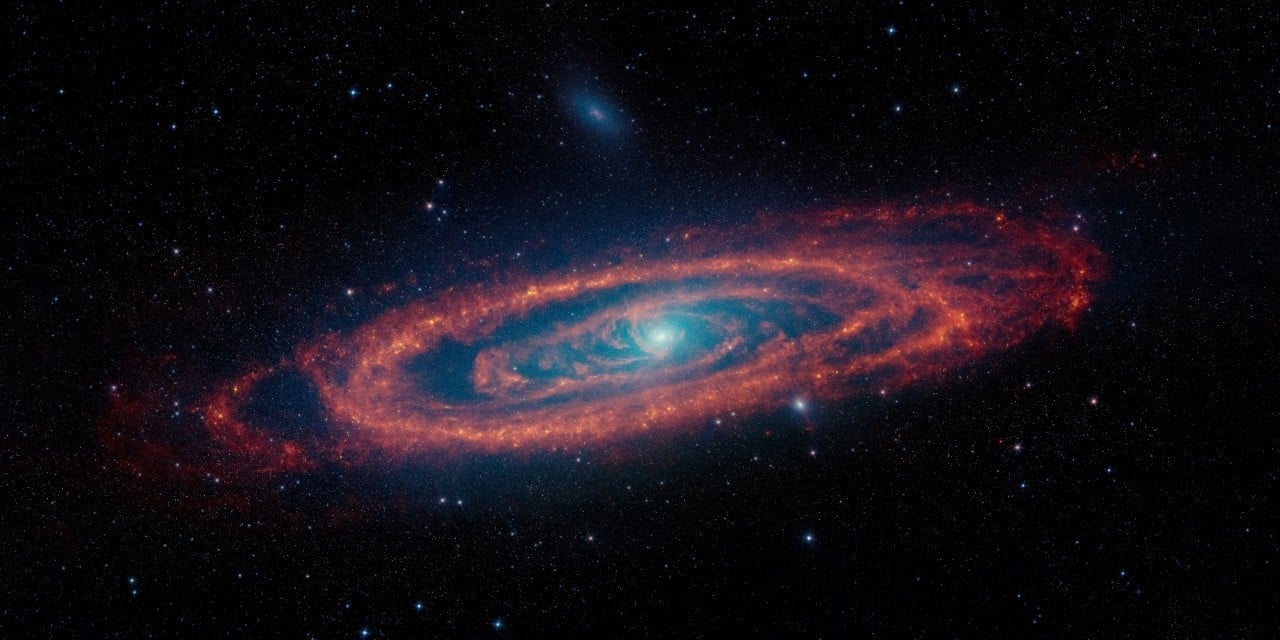
The James Webb space telescope captured images of massive elliptical galaxies that appear advanced in maturity within the first 500 million years after Big Bang. Essas structures, full of heavy elements, emerged at a time when the cosmos was still considered young and chaotic. The initial discovery sparked debate about possible errors in estimating the age of the universe, calculated at around 13.8 billion years.
Researchers analyzed additional data from the Alma observatory and computer simulations to understand the phenomenon. The observations indicate that these galaxies do not imply a revision of cosmic chronology, but they reveal more efficient formation mechanisms than previously thought. In regions of high matter density, the evolutionary process occurs at an accelerated rate, allowing the creation of elliptical giants in short time frames.
The explanation lies in protoclusters, extreme environments where multiple young galaxies collide and merge quickly. Esse cascade of interactions transforms incipient systems into organized and stable structures. The findings reinforce the understanding of how the universe built its first cosmic megacities without changing the fundamental date of Big Bang.
Protoclusters as cosmic accelerators
Protoclusters represent dense concentrations of matter that facilitate galactic mergers at high speeds. In Nesses environments, gravity acts intensely, bringing together gas and dust to form stars at rates tens of times higher than normal. Simulations show that such regions arise naturally in early fluctuations of dark matter.
These structures not only accelerate growth, but also enrich galaxies with heavy metals produced in early supernovae. Observações recent studies confirm that protoclusters like SPT2349-56 exhibit record star formation rates in the early universe. Isso explains why elliptical galaxies appear “adults” so early in cosmic history.
Revised hierarchical evolution
Traditional models described galaxy formation as a gradual process, starting with small gaseous clumps that evolve into spirals and ultimately ellipticals through slow mergers. However, data from James Webb indicate that in protoclusters, this path is drastically shortened. Multiple Fusões occur simultaneously, creating giants in hundreds of millions of years.
The presence of stellar bars in galaxies like COSMOS-74706, observed 11.5 billion years ago, suggests that complex internal structures form earlier than predicted. Essas bars funnel gas to galactic centers, powering supermassive black holes and regulating stellar growth. The discovery implies adjustments to cosmological simulation models to incorporate these high-density scenarios.
This review does not invalidate the hierarchical theory, but refines it by including environmental variations. Regiões dense spaces accelerate steps that in isolated areas require billions of years. Assim, the universe exhibits diversity in its evolution, with protoclusters acting as catalysts for early maturity.
Impact on telescopic observations
The James Webb telescope continues to provide high-resolution images that reveal previously unseen details about the early universe. Suas Infrared observations penetrate dust clouds, exposing distant galaxies that appeared invisible in previous telescopes. Combinado with the Alma, which detects radio emissions, the dataset allows us to accurately reconstruct stellar histories.
Recent studies have identified clusters like A2744z7p9OD, forming 12.8 billion years ago with masses trillions of times that of Sol. Essas detections highlight the ability of current instruments to map the early cosmos. Pesquisadores plan additional campaigns to catalog more protoclusters and test hypotheses about evolutionary acceleration.
The integration of data from multiple telescopes enriches the analysis, confirming that elliptical galaxies do not defy the age of the universe, but illustrate its efficiency under certain conditions. Futuras missions can explore variations at different redshifts to validate these mechanisms.
Role of dark matter in accelerated formation
Dark matter forms halos that attract baryonic gas, creating deep gravity wells in protoclusters. Fluxos cold matter directly feeds galactic centers, promoting bursts of star formation. Simulações indicate that at high densities, collisions dissipate kinetic energy quickly, leading to cohesive mergers.
These processes result in quiescent galaxies, with little recent star formation, similar to modern ellipticals. Observações of James Webb show that such objects accumulate masses comparable to Via Láctea in short time frames. The presence of heavy elements suggests rapid supernova cycles and chemical enrichment.
Details of the observed galaxies
Galaxies like the “Monster Vermelho” captured by James Webb exhibit excessive brightness for their time, with ages estimated at 12.8 billion years. Essas structures, the size of Via Láctea, defy expectations by presenting mature compositions. Análises spectroscopic measurements confirm its distance and composition without relying on gravitational lensing.
Other detections include ancient barred spirals, such as Alaknanda, 30,000 light-years across and billions of stars. Essas galaxies indicate that stellar bars emerge early in dense environments. The data suggest that protoclusters have fostered morphological diversity since cosmic beginnings.
Researchers observe that these galaxies go through phases of quiescence after initial bursts, stabilizing their structures. Comparações with modern clusters reveal evolutionary parallels, reinforcing the idea of environmental acceleration.
Integrating multi-frequency observations makes it possible to map the distribution of gas and stars in these galaxies. Resultados point to fusion rates ten times higher in protoclusters than in isolated fields.
High-density fusion mechanisms
In protoclusters, young galaxies often collide due to their proximity and low relative speeds. Cada fusion releases energy that heats the gas, but at extreme densities, cooling occurs quickly, allowing new cycles of star formation. Modelos computational models reproduce these scenarios, showing how multiple interactions create massive ellipticals.
The dynamics involve gravitational torque that aligns spins and orbits, facilitating efficient coalescences. Observações of Alma detect carbon monoxide emissions, indicating abundant gas reserves. Essas reserves fuel the accelerated growth, explaining the observed chemical maturity.
Hydrodynamic simulations incorporate feedback from black holes, which regulate the process by ejecting excessive gas. Assim, the balance between accretion and ejection maintains the stability of the resulting galaxies. Estudos comparisons with clusters at lower redshifts validate this evolutionary progression.
These mechanisms do not require revision of the Hubble constant or the matter density, preserving the standard cosmological model. Instead, they highlight early heterogeneities that shape the large-scale structure of the universe.

Contributions from complementary telescopes
The Alma observatory complements the James Webb by mapping molecular gas distributions in distant galaxies. Suas observations reveal high concentrations in protoclusters, supporting acceleration hypotheses. Juntos, the instruments provide a complete picture of chemical and morphological evolution.
Other telescopes, such as Chandra, detect X-ray emissions from active black holes in these ancient structures. Esses signals indicate intense activity at galactic centers, consistent with frequent mergers. Collaboration between space and ground missions enriches the available data set.
Future research aims at high-resolution spectroscopy to measure precise velocities and compositions. Esses efforts will help quantify fusion and enrichment rates in different cosmic environments.
Implications for modern cosmology
The findings reinforce that the universe operates with varying efficiency depending on local density. Protoaglomerados act as natural laboratories to study physics in extreme conditions. Updated Modelos incorporate these insights, improving predictions about the distribution of galaxies in the observable cosmos.
Improved understanding aids the search for even older galaxies, potentially close to redshift 20. Future Instrumentos, such as Extremely Large Telescope, will extend these observations. Continued progress refines our vision of Big Bang and the subsequent era.
- High density of matter accelerates galactic mergers.
- Chemical enrichment occurs via early supernovae.
- Stellar bars form on short timeframes.
- Black hole feedback regulates growth.
These elements highlight the complexity of early cosmic evolution.
Advances in computer simulations
Cosmological simulations have evolved to include resolutions that capture dynamics at protocluster scales. Programas like IllustrisTNG reproduce scenarios where elliptical galaxies emerge quickly. Esses models validate observations of James Webb by predicting mature galaxy populations at high redshifts.
Adjustments to the dark matter and dark energy parameters refine the predictions, bringing them in line with real data. Pesquisadores use supercomputers to test environmental variations and their impacts on galactic morphology.



