


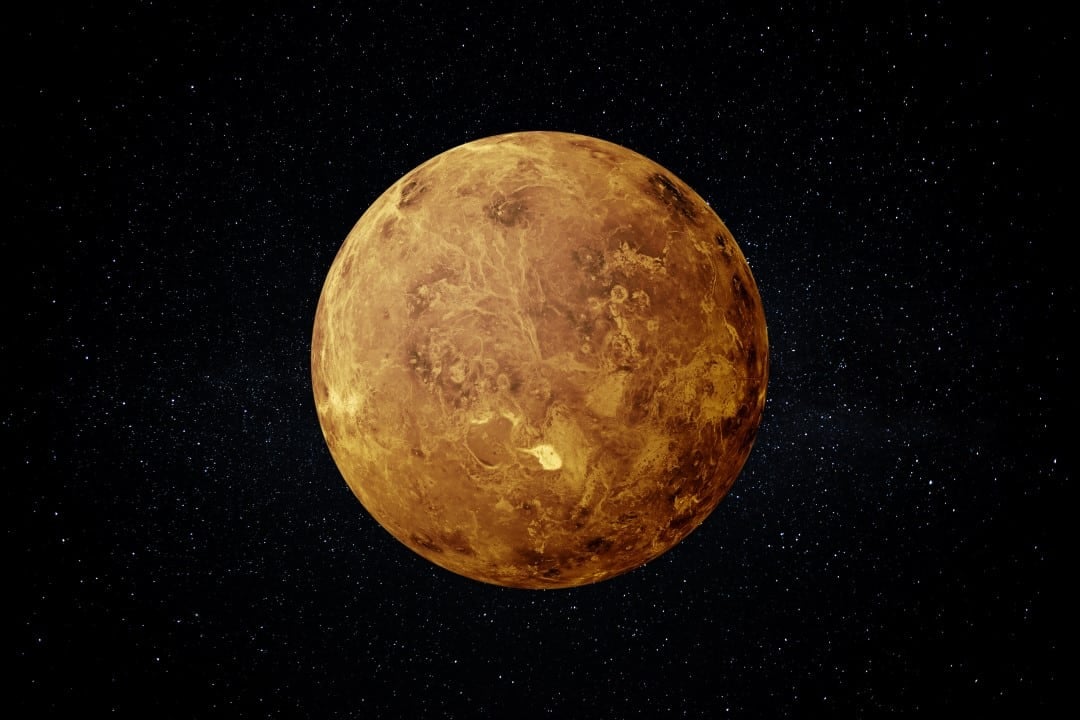
The Parker Solar Probe probe, Nasa, captured images of the surface of Vênus in visible light during approaches to the planet, revealing details of the topography beneath the dense clouds of sulfuric acid. The discovery occurred incidentally in gravitational assistance flights carried out in July 2020 and February 2021. The WISPR instrument, designed to observe the solar corona, recorded the night side of the planet and identified features such as the Aphrodite Terra mountainous region.
The images emerged when the probe passed about 12,380 km from the Venusian surface. WISPR’s ability to detect visible and near-infrared wavelengths allowed it to capture thermal radiation emitted by extremely hot soil. Essa observation represents the first time that the surface of Vênus has been imaged in visible light from space.
Main features identified in the images
- Aphrodite Terra appears as a large dark area due to lower thermal emission in the elevated regions.
- Tellus Regio and plains like Aino Planitia show subtle temperature variations.
- The planet’s edges exhibit an intense glow caused by atmospheric luminescence on the night side.
- Thin traces in the photos correspond to cosmic ray particles hitting the sensor.
WISPR instrument detects unexpected thermal radiation
WISPR was activated during the third pass by Vênus, on July 11, 2020. Cientistas expected to see only the upper clouds, but the camera penetrated the dense atmosphere and captured thermal contrasts at the surface. The planet’s average temperature reaches around 460 degrees Celsius, with differences of up to 30 degrees Celsius between plateaus and plains.
These thermal variations explain the dark and light patterns in the images. Higher Regiões, like Aphrodite Terra, emit less thermal radiation because of their altitude, creating visible silhouettes even through permanent sulfuric acid clouds.
Comparison with data from other missions
The images from Parker Solar Probe show similarities to those captured by JAXA’s Akatsuki probe, at wavelengths close to infrared. Essa correspondence confirmed that WISPR recorded thermal emissions from the surface. The data complements radar maps from the Magellan mission, which revealed the Venusian relief decades earlier.
Atmospheric phenomena highlighted at the edges
The edge of the planetary disk appears with pronounced brightness in all captures. Esse halo results from atmospheric luminescence, produced by the recombination of oxygen atoms in the upper atmosphere excited by solar ultraviolet radiation. The phenomenon occurs exclusively on the night side and reinforces the complexity of the Venusian atmosphere.
Applications for future space exploration
WISPR’s extra sensitivity extends its use beyond solar observation. The instrument can detect cosmic dust in the vicinity of Sol in greater detail. Além Furthermore, the findings in Vênus indicate potential for analyzes of other rocky planets in future missions.
Parker Solar Probe continues to adjust its orbit with assistance flights at Vênus. The trajectory brings it increasingly closer to Sol, with proximity records predicted for the coming years. The multifunctional success of the equipment demonstrates how specialized technologies can generate unexpected advances in different areas.
Contribution to the study of Venusian geology
These observations provide a new perspective on the planet’s evolution. Apesar from the proximity to Terra, Vênus presents a surface dominated by volcanism and distinct tectonics. Visible light imagery helps connect thermal data with existing topographic maps.
The mission team continues to refine operations to take advantage of WISPR in future passes. The feat reinforces the value of versatile instruments in long-term space exploration.



