


The night sky presents one of the most anticipated spectacles by the scientific community and astronomy enthusiasts around the world. The rare coincidence between a total lunar eclipse, which gives the satellite a reddish hue known as a blood moon, and the supermoon phenomenon, occurs simultaneously. Este specific alignment requires that Lua be in its full phase and at the closest point in Earth’s orbit, perigee, at the same time that it crosses the shadow cast by planet Terra.
Experts explain that the characteristic color of the blood moon is the result of the refraction of sunlight by the Earth’s atmosphere, which filters blue colors and allows only red tones to reach the lunar surface. Durante the height of the eclipse, the satellite does not disappear completely, but takes on a copper or reddish glow that varies depending on weather conditions and the amount of dust in the atmosphere. The last time these two events occurred with such temporal precision allowed detailed records of orbital dynamics.
The observation of this phenomenon directly depends on the geographic location and local meteorological conditions, with the local time of each region defining the beginning of the totality phase. In areas with clear skies and low light pollution, the supermoon appears significantly larger and brighter than usual before entering the umbra zone. Abaixo, we list the main components that make this astronomical night a highly relevant event:
- Lunar perigee: moment when Lua reaches the minimum distance of around 363,300 kilometers from Terra.
- Total eclipse: perfect alignment between the Sol, the Terra and the Lua, blocking direct sunlight.
- Atmospheric refraction: physical process that diverts red light towards the Terra shadow cone.
- Visual magnitude: apparent increase of up to 14% in size and 30% in brightness of the lunar disk.
Particularities of the red glow on the lunar surface
The Earth’s atmosphere plays the role of a giant lens that redirects sunlight into the shadow of Terra, hitting Lua with warm tones. Este physical effect is similar to what occurs during sunset, where light travels through a thicker layer of the atmosphere and loses its shorter wave frequencies. Quando the eclipse reaches its maximum phase, the Lua becomes an indicator of the planet’s atmospheric health, reflecting the purity or saturation of aerosols in the air.
Scientists use these moments to measure the composition of the Earth’s atmosphere from the reflection observed in the lunar disk during totality. The darker and redder the Quanto appears, the greater the presence of particles such as volcanic ash or urban pollution in the stratosphere. Studying this data helps understand climate cycles and particle dispersion on a global scale without the need to launch new space probes.
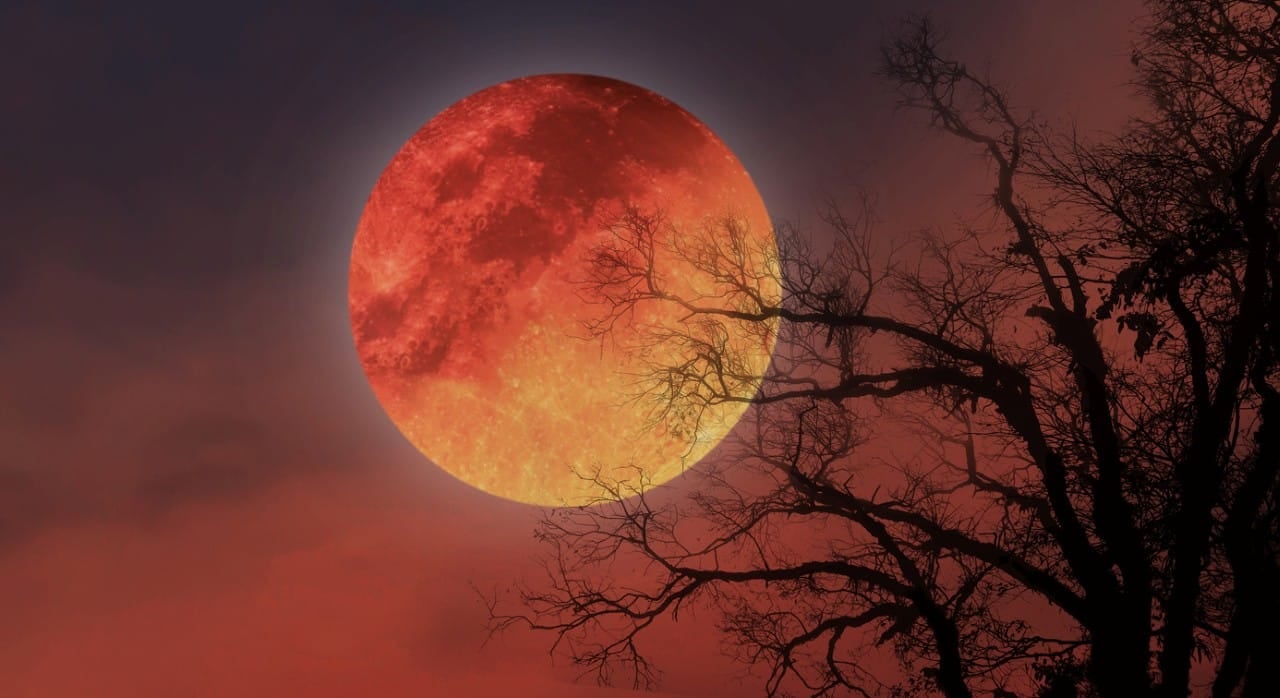
Influence of perigee on the visual size of the supermoon
The term supermoon refers to the full Lua that occurs near perigee, the point at which the satellite is closest to Terra in its elliptical orbit. Devido at this proximity, the angular diameter of Lua increases significantly for the terrestrial observer, creating the illusion that it is “touching” the horizon or urban structures. Este increase in size is a geometric characteristic that, added to the intense brightness, makes it easier to see lunar craters and seas even with the naked eye.
The combination with the total eclipse makes the event even rarer, as the interval between supermoons and total eclipses does not always coincide in the civil calendar. Milhares of photographers and researchers position themselves in observatories to capture the transition from intense silver to deep red in a matter of minutes. Essa rapid change in luminosity requires calibrated equipment to record the sudden drop in magnitude during the dimming process.
Unlike solar eclipses, observing the blood moon and supermoon is completely safe and does not require eye protection filters. Binóculos and amateur telescopes are excellent tools for distinguishing color variations at the edges of the lunar disk during entry into twilight. The show lasts several hours, allowing the public to follow all the phases, from the first contact with the shadow until the complete exit of the Lua from the occultation region.
Importance of records for modern astronomy
Data collected during this double event provides crucial information about celestial mechanics and the accuracy of long-term orbital predictions. Institutos astrophysicists compare current measurements with historical records to refine the mathematical models that govern the Terra-Moon system. High-resolution photographic documentation also helps in scientific dissemination, bringing the lay public closer to complex physics and optics concepts.
In addition to its scientific value, the event has a significant cultural impact, mobilizing communities in several countries for public observation sessions coordinated by astronomy clubs. The interest generated by these natural phenomena tends to boost investments in scientific education and renew the fascination with space exploration. Manter a detailed archive of these events allows future generations to understand the evolution of Earth observation techniques.
Orbital dynamics and the periodicity of lunar phenomena
The simultaneous occurrence of a supermoon and a total eclipse does not follow a fixed annual pattern, which increases the exclusivity status of each recorded event. The Saros cycle, which predicts the periodicity of eclipses, does not always align the full Lua phase with the exact perigee required for supermoon classification. For this reason, when calculations indicate the overlap of these variables, the scientific world prepares months in advance to guarantee full coverage.
Variations in the lunar orbit are influenced by the gravity of Sol and other planets, which makes each supermoon slightly different from the last in terms of distance and brightness. Monitorar these subtleties are vital for satellite navigation and for understanding Earth’s tides, which suffer greater gravitational influence during perigee. Modern science depends on these open-air natural laboratories to validate theories that underpin global positioning technology.
Historical frequency of double events in the sky
Historical records indicate that intervals of decades can separate a blood moon that occurs exactly at the time of a supermoon visible in all hemispheres. The last major sequence of total lunar eclipses, known as a tetrad, brought intense discussions about the frequency of these alignments. Cada new occurrence is treated as a unique opportunity to check whether atmospheric refraction patterns have changed significantly compared to previous centuries.
Comparative analysis between different eclipses helps document phenomena such as global warming or large volcanic eruptions, which alter the transparency of the atmosphere. If Lua is shades of gray or dark brown instead of red, this indicates a dense, debris-laden atmosphere. Assim, the natural satellite acts as a mirror that reflects the environmental conditions of Terra itself to attentive observers.
Ideal conditions for viewing the astronomical phenomenon
To ensure the best observation experience, it is recommended that those interested seek locations away from the lights of large cities, where the contrast of the sky is greater. The use of astronomy applications can help identify the exact moment when Lua will enter the totality phase according to the local time zone. It is important to consider that visibility may be affected by low clouds or fog, common at certain times of the year in coastal or mountainous regions.
Even in urban environments, the magnitude of the supermoon allows for satisfactory observation, especially when the star is close to the horizon, where the visual magnification effect is clearer. Prédios heights or mountains can serve as reference points for creative photos that show the imposing size of Lua in relation to the landscape. Patience is essential, as the complete eclipse process takes hours to develop, from the penumbral phase to the definitive exit from the Earth’s shadow.
Lua continues to be the closest and most accessible object of study, serving as a gateway for those who want to understand the universe in a practical and direct way.



